
February 25, 2011
The situation in the Mideast is disturbing and many economists fear that rising oil prices could derail an economy that is just now beginning to gather momentum. However, for that to happen, the situation in the Mideast must deteriorate significantly.
Without a doubt crude oil prices have risen, which has pushed gasoline prices higher. At the end of September gasoline was $2.67 per gallon. Today it is $3.14. That represents a 17% increase.
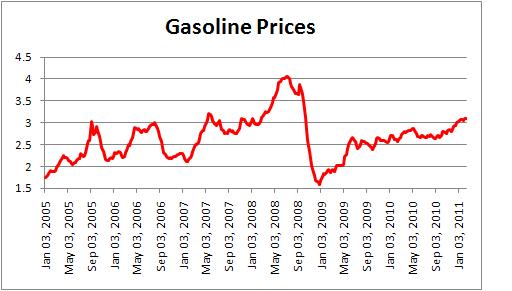
As it stands currently the countries whose leadership has been or may be overthrown are Tunisia, Egypt, and now (perhaps) Libya. But those three countries represent just 3.0% of world oil production (2.1% for Libya, 0.8% from Egypt, and 0.1% from Tunisia). It makes no sense that countries that produce just 3.0% of world oil production should trigger a 17% increase in gasoline prices.
For the market’s fears to be realized Saudi Arabia (which produces 11.2% of global oil output), Iran (4.8%), and the United Arab Emirates (3.2%) must not only become embroiled in conflict, but also suffer a significant decline in their oil output. Anything is possible, but it appears to us that there is already a considerable “fear premium” built into gasoline prices and a further sharp increase from today’s price of $3.14 per gallon would require a significant widening of the conflict. If that does not happen gasoline prices could easily reverse direction.
But suppose gasoline prices remain at $3.14 per barrel. What does that do to inflation and GDP growth here in the United States? Will that push us back into recession?
First, with respect to inflation, oil prices represent 5.4% of the CPI. That would include gasoline, and heating oil. The 17% increase in oil prices we have experienced thus far would thus boost the CPI by 0.9%. But that is just the direct effect. Oil is a direct input to the production of some items, like plastics. Shipping costs will lift the prices of other goods. The combined effect of all this might boost the CPI by a total of 1.5%. But in 2010 the CPI rose 1.5%. So if gasoline prices remain where they are today for the rest of the year, the CPI might climb by 3.0%. That is clearly worse than the 1.7% increase we are currently predicting, but keep in mind that in 2008 just prior to the recession gasoline prices spiked to $4.00 per gallon and the CPI climbed by 5.0%. Thus, a 3.0% inflation increase this year is certainly unwelcome, but it was only a couple of years ago that a 3.0% inflation rate would have been viewed positively.
Second, turning to its impact on the economy, a 17% increase in oil prices is not nearly as debilitating as it might have been in the mid-1970’s. This is because the economy has shifted from being manufacturing based in that earlier time period, to one that is currently oriented towards services and technology. Oil prices are irrelevant for the service sector. Similarly oil prices do not matter much to Microsoft, Intel, and IBM. Indeed, in our economy today spending on gasoline and other energy goods is only about 2.5% of GDP. So if we hypothesize that the recent 17% run up in gasoline prices translates into less money spent elsewhere in the economy, then GDP growth should be retarded by about 0.4%. Given that our current forecast is for GDP growth in 2011 of 4.3%, what has happened thus far to energy prices is hardly going to tip the economy back into recession.
Having said all of this, higher energy prices do matter. Those on the lower end of the income scale are forced to make tough choices between paying the rent, buying the food, or filling the car with gas in order to get to work. Thus, the impact is not evenly distributed amongst our citizens. Some are hit harder than others. While one can talk endlessly about energy conservation and reduced reliance on oil, the fact of the matter is that in the short-term there is little that can be done to mitigate the impact of higher gasoline prices. One would hope that our policy makers get the message and begin to find ways to develop alternative energy sources, but don’t hold your breath
Stephen Slifer
NumberNomics
Charleston, SC
Follow Me