
December 12, 2014
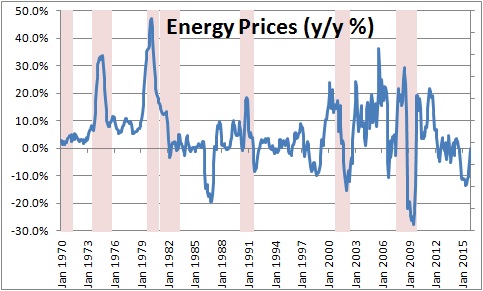
Rising oil prices have been a contributing factor to every major recession in the West since the mid-1970’s. It is never the only factor causing these economic downturns, but it is invariably a contributing factor. Similarly, our most impressive periods of sustained growth in the 1980’s and 1990’s were lubricated by falling oil prices. Thus, it is logical to expect that the 43% drop in the price of crude oil since June will lead to a significant pickup in the pace of economic activity next year not just in the U.S. but around the globe.
Crude oil prices have fallen 43% from $105 in July to $60. The EIA expects prices to average $63 per barrel in 2015. So not only have prices collapsed, they are expected to remain close to their current level for the foreseeable future.
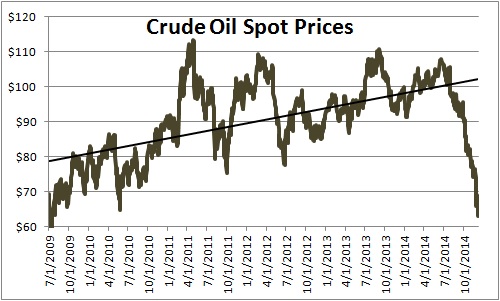
The catalyst for this dramatic price drop has been technological advancement in the U.S. oil industry in the form of hydraulic fracturing and horizontal drilling which have unlocked supplies of oil in previously inaccessible areas. During the past five years oil production in the United States has risen 85% from 5.0 million barrels per day to 9.2 million. Prices did not fall initially because in those earlier years the global economy was emerging from recession and economic activity and oil demand rose in tandem. But now as economy activity in Europe and Asia has softened the supply of oil far exceeds demand and prices have collapsed.

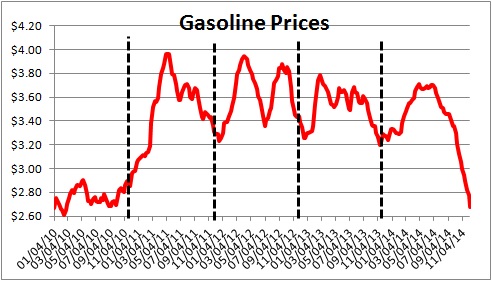
Gasoline prices have followed a similar pattern. They have fallen from $3.70 a gallon back in July to $2.63 currently. The energy department expects gasoline prices to average $2.60 per gallon next year. Like crude, gas prices have fallen sharply and are expected to remain close to their current level throughout 2015. In the U.S. a rough rule of thumb is that every $.01 drop in gasoline prices will boost consumer spending by $1 billion. Thus, a $1.07 drop should boost consumer spending by $107 billion or 0.9%. But the catch here is that gasoline prices have to stay at these lower levels. If the EIA is right and low prices are relatively steady, the positive impact on consumer spending in 2015 will be pronounced. However, as shown below, gasoline prices typically have a pronounced seasonal increase between December and June, so what EIA is anticipating is totally different from the norm. Given the sea change that is underway in the oil market the EIA could be right. However, we are not yet convinced and anticipate a rebound in gas prices in the first half of next year to perhaps $3.30 per gallon which would reduce the positive impact on consumer spending to some extent.
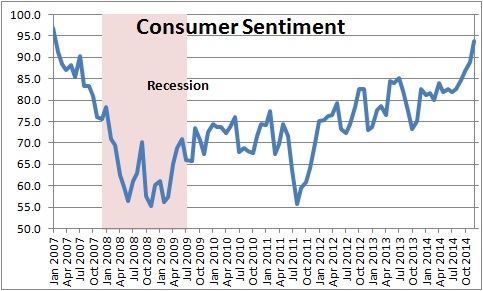
Either way consumers will be able to spend money saved at the pump on other items. At the same time consumer confidence has climbed which will stimulate consumer spending. An obvious beneficiary will be the auto industry as a surge in jobs and more income from falling gas prices will encourage consumers to buy a new car. The agricultural sector which is very energy intensive will get a lift. That translates into lower food prices. Airlines will experience a significant drop in the cost of jet fuel which eventually will filter through into lower ticket prices. Portions of the manufacturing sector that are heavy users of petroleum based products – think plastic and chemicals — will also get a boost.
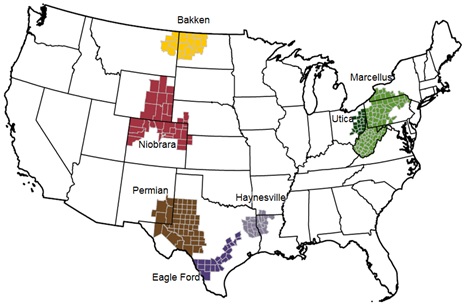
Not every sector of the economy will benefit from falling oil prices, however. In the manufacturing sector, for example, industries like steel and cement that supply the oil industry will get hit. There will also be some GDP offset from reduced drilling activity. However, the EIA believes that oil prices will remain high enough in 2015 to support new drilling in the major shale areas in North Dakota and Texas, so this offset should be relatively minor.
We currently expect GDP growth in the U.S. to pick up from 2.6% this year to 3.3% in 2015. But if the EIA is right and oil prices remain close to their current level, the risk is that growth could be even more robust.
Keep in mind that the benefits of lower oil prices are not confined just to the U.S. The world’s largest economies will all benefit. At the moment the IMF expects GDP growth in China, the world’s second largest economy to slip from 7.4% this year to 7.1% in 2015. But given the steady drop in oil prices expected growth in China next year will probably be revised upwards. The same kind of upward revisions should be expected for Japan, Germany, France, the U.K., Italy, and Canada.
The positive impact on global GDP growth is likely to be far more substantial than is currently anticipated.
Stephen Slifer
NumberNomics
Charleston, SC
Follow Me