
July 1, 2011
Economic statistics for June to be released during July will remain gloomy, but better news is on the way. The economic weakness that began in April is soon to end. Most economists have attributed this spring slowdown largely to a combination of steadily rising food and gasoline prices, and production difficulties caused by an inability by manufacturers to get necessary parts following the earthquake and tsunami in Japan. But recent data suggest that these difficulties are soon to end. Consider the following.
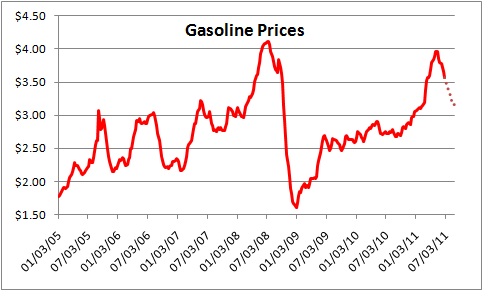
Gasoline prices have fallen steadily since reaching a peak of $3.97 per gallon in early May. While currently at $3.57 it is clear they are headed lower. On June 23 the U.S. announced that it will release 30 million barrels of oil from the Strategic Petroleum Reserve. Other International Energy Agency countries will release another 30 million barrels. Crude oil price futures fell 5% by the end of the day bringing the cumulative decline to about 20%. As a result, it now seems likely that by the end of July gasoline prices will drop to about a $3.15 per gallon. As shown in the accompanying chart, gasoline prices were $2.75 in late September before their most recent surge. While gasoline prices may not revert to late September levels, they will certainly get close.
In addition to rapidly falling gasoline prices, other commodity prices appear to be in full retreat. For example, the U.S. Department of Agriculture recently reported that corn planting in June was far larger than expected. Indeed, it was the second biggest planting since World War II. In response to that surprise announcement corn futures fell 15% over the course of two days. Because corn is widely used by farmers to fatten cattle, pigs, and chickens, changes in corn prices can impact a wide variety of other agricultural products. A lot can happen during the course of the summer to alter this happy outcome, but for now it appears that the surge in commodity prices earlier this year is in the process of being reversed.
As food and prices rose U.S. consumers were forced to pay higher prices, but that meant they had to trim expenditures on other goods and services. For example, suppose your income was $100 initially and you buy 10 items at $1.00 apiece. If the price of those items rises to $1.25 you can now only afford to buy eight of them. So what happened? In this example, the 25% increase in prices (from $1 to $1.25) caused economic activity to fall by 20% (from 10 to 8). Inflation was higher, economic output (GDP growth) was lower. The recent drop in prices should reverse that process and result in a considerably faster pace of economic activity in the third and fourth quarters.
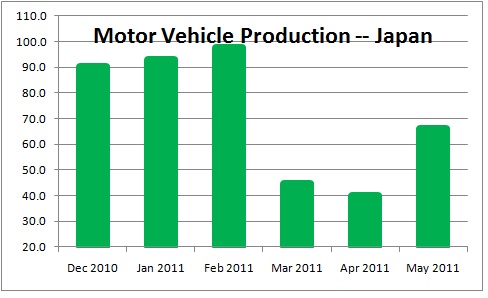
Following the tsunami in Japan output of motor vehicles fell more than 50% in March and another 10% in April. But recently released data indicates that automobile production in Japan rebounded 65% in May and has now recovered more than half of its earlier losses. Indeed, Toyota expects to be back to full production by August and, given the May pickup, that seems achievable. What this means is that factory output in the U.S. should also snap back by the end of the summer. You will recall that the drop in industrial production in the U.S. during April and May was entirely attributable to a slowdown in the production of motor vehicles and parts. During April and May auto production fell 7.8% because of an inability to get parts from Japan; factory production excluding motor vehicles and parts rose 0.4% during those two months. Given the rebound in auto production in Japan, there can be little doubt that industrial production in the U.S. will bounce back in July and August.
Having said all of this, it will take a while for these changes to be reflected in the various economic indicators. The odds are that June data will continue to be on the soft side, so the first clear sign of a pickup will not be evident until we get July data during August. So be patient, but the spring slowdown in the economy is soon to be history.
Stephen Slifer
NumberNomics
Follow Me