
October 30, 2015
Given the softness in the third quarter GDP data and the continuation of virtually nonexistent inflation, the Fed could have opted for a statement following the recent FOMC meeting that justified a further delay of the long-awaited first increase in the funds rate. But it did not. The Fed virtually told us that the rate hike will happen in December.
Following every FOMC meeting it issues a statement that tells us what policy changes were made and provides a brief discussion of why it chose that particular action. At the meeting on September 17 the Fed had a sentence which read, “Recent global economic and financial developments may restrain economic activity somewhat and are likely to put further downward pressure on inflation in the near term.” In effect, the stock market turmoil that began in China and spread around the globe made Fed officials nervous, and they wanted to get a better handle on the extent of the fallout before choosing to raise rates.
At the meeting on October 28 they eliminated that sentence altogether. In effect, Fed officials were now comfortable that any impact on the economy and/or inflation from the recent stock market correction would prove to be temporary. Why the sudden change of heart? There are probably a variety of reasons.
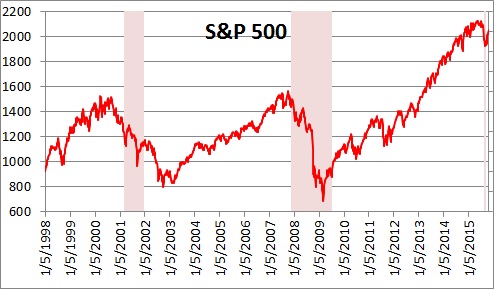
First, the stock market has largely reversed its September decline. The stock market fell 10% between mid-July and the end of August. But it has since rebounded and now stands at 2,079 which is only 47 points or 2.2% below its previous high. Any fear that the earlier drop could have turned into a rout has essentially been eliminated.
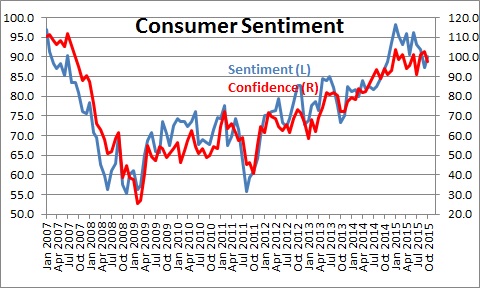
Second, in the wake of the stock market drop consumers could have gotten nervous but that too did not happen. Both the University of Michigan and Conference Board measures of sentiment continue to track at a very high level. The sentiment data do not hint at a slower pace of consumer spending.
Third, initial unemployment claims, a measure of layoffs, have continued to track at the lowest level since 1973. Thus, the labor market has not softened in any way in response to the stock market selloff.
While the Fed no longer seems as concerned about “global economic and financial developments”, something could come along to change their mind before the December meeting. But in the absence of some catastrophic event, the Fed has essentially stated its intention to raise rates at that time. In the FOMC statement on October 28 it contained the following sentence: “In determining whether it will be appropriate to raise the target range at its next meeting, the Committee will assess progress–both realized and expected–toward its objectives of maximum employment and 2 percent inflation.” In the past 40 years the Fed has never been so specific about the timing of a particular policy action. The Fed agonizes over the change of a single word from the previous statement. If it is different, there is a reason. In this case they are telling us — in as specific language as they can — that December is the date for the inevitable first rate hike.
Why so much attention to that first move? Because it has been nine years since the Fed last raised interest rates. Some market participants have never seen anything other than 0% short-term interest rates. Many have never lived through a rising rate environment. Firms not only have to figure out how higher rates might impact their own firm, they need to worry about how it may affect their clients.
And why does the Fed need to do it? Two reasons. First, the Fed has provided the banking system with $2.5 trillion of surplus reserves via its bond buying program. Those funds are available to the banking system to lend. If consumers and businesses become willing to borrow and banks become willing lenders there are enough surplus funds available to ignite a vigorous — and highly inflationary — spending spree. The Fed does not want that to happen. It has to get those reserves out of the system before that happens.

Second, there is currently little slack remaining in the economy. The unemployment rate which was once 10% is now at 5.1%. Even with slow grow in the manufacturing sector the utilization rate which was once 64% is now 76% and close to its long term average. If the economy continues to expand at its current pace inflation is sure to climb once oil prices level off.
It is time for the Fed to get started.
Stephen Slifer
NumberNomics
Charleston, S.C.


Hi Steve,
As you mention in your text above, it seemed to me a near certainty that the Fed would raise rates in December. I was reading the notes from the Oct meeting and noticed the text below. I’m curious how this affects your view of the Fed’s stance, if at all.
Always appreciate reading your stuff.
Thanks
-Pat
Members saw the updated language as leaving policy options open for the next meeting. However, a couple of members expressed concern that this wording change could be misinterpreted as signaling too strongly the expectation that the target range for the federal funds rate would be increased at the Committee’s next meeting. While members differed in their assessment of the likelihood that incoming information will warrant an increase in the target range for the federal funds rate when the Committee meets in December, they agreed that, in making the decision, the Committee will evaluate progress toward its objectives, taking into account a wide range of information, including measures of labor market conditions, indicators of inflation pressures and inflation expectations, and readings on financial and international developments. It was noted that the expected path of the federal funds rate, rather than the exact timing of the initial increase, was most important in influencing financial conditions and thus in affecting the outlook for the economy and inflation.
Hi Pat,
Missed your comment until this A.M.
Your question is a legitimate one. The Fed always want to leave itself some wiggle room. Neither they nor any of us can be certain exactly what tomorrow may bring.
However, their language talking about the fact that a rate hike would be considered at the next meeting is as strong language as I have ever heard them use in these directives. They have never been quite so specific. I guess we will see in just a couple of weeks.
Steve
Hi Steve,
Thanks for the response. I only recently starting reading the Fed minutes and am trying to get a handle on the tenor and tone of what we’re supposed to take away from them.
Appreciate your insight.
-Pat