
October 29, 2010
The economy is considerably stronger than it appears and seems poised to accelerate in the months and quarters ahead. As these comments are being written it is not clear that the Fed is going to provide additional stimulus, but the odds are heavily skewed in that direction. Does the economy need additional help? It seems to be healing quite nicely on its own, and a quick fix may ultimately do more harm than good. Why can’t policy makers be more patient?
We learned this morning that third quarter GDP growth was 2.0%. Admittedly, that is not a very robust pace. But GDP measures spending on domestically-produced goods. Our spending on goods and services regardless of where they were produced (i.e., U.S. made products and imports) climbed at a steamy 3.9% rate in the third quarter after having surged 5.1% in the second quarter. Thus, consumers and businesses are spending at a healthy pace, but what they are purchasing to a large extent are goods that were produced by our trading partners. Monetary policy is designed to regulate the overall pace of spending. Fed policy over the past year has been wildly successful in enticing consumers and businesses to spend, but it cannot determine where they choose to do their spending.
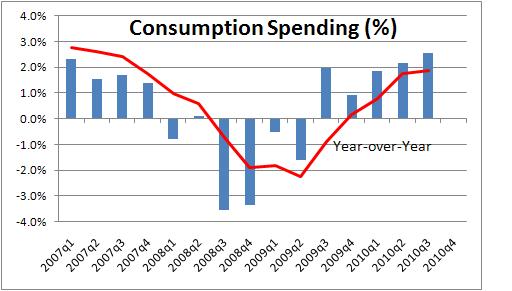
Consumer spending is the biggest sector of our economy and accounts for about 70 per cent of GDP. In the third quarter such spending climbed 2.5%. That is the fastest pace thus far in the recovery, and it has been steadily gathering momentum. It is hard to imagine that the consumer needs assistance.
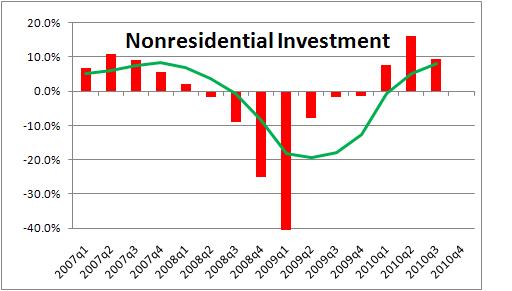
Similarly, investment has been and continues to be robust. Plants and equipment spending, led by purchases of computer equipment and software, climbed at a 9.7% rate in the third quarter, which follows a second quarter gain of 17.2%. Such spending seems destined to continue at a robust pace for some time to come for a variety of reasons. First, computer equipment has a relatively short shelf life and needs to be replaced every three years. Second, firms have learned that they can enhance profitability by replacing people with computers. Finally, corporate profits have allowed businesses to accumulate an unprecedented amount of cash; it will not sit idle for long.
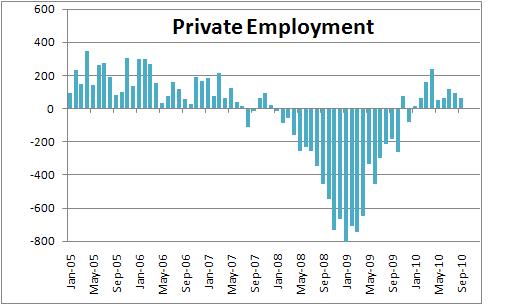
It is true that the economy has not produced an adequate number of jobs. But private sector employment has been rising by nearly 100 thousand jobs per month since the beginning of the year, and the number of jobs will rise more quickly as the economy gradually gathers momentum during 2011. Nothing the Fed can do at this point is going to translate into significantly faster jobs growth.
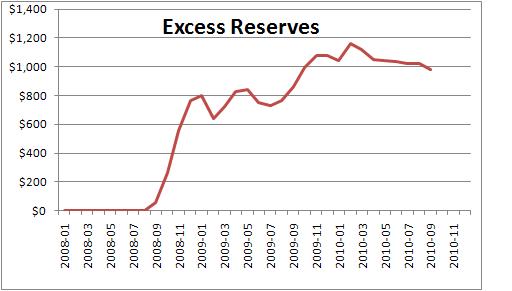
The problem in the economy today is not liquidity. There are already $1 trillion of surplus reserves slopping around in the banking system. Those are funds that are available for lending. The problem is that consumers are currently more interested in paying down debt than they are in making new loans to finance a faster pace of spending. And firms, particularly small businesses, are hesitant to spend more rapidly because of uncertainty about the future cost of health care, tax levels, and the regulatory environment. Hopefully, in the wake of the recent election some of this uncertainty will be eliminated.
Keep in mind, too, that monetary policy works with a lag. If the Fed eases today, it will not boost the economy until the middle of next year. But almost every economist expects faster growth by the middle of 2011. It is possible that additional Fed easing will kick in at exactly the wrong time and actually force the Fed to begin raising rates in the second half of next year.
Thus, additional Fed easing seems ill-advised for a number of reasons:
- The economy does not seem to need additional stimulus.
- Providing additional reserves will do little to create more jobs or remove political uncertainly.
- By the time the stimulus arrives, it may no longer be needed.
- The Fed may have difficulty draining reserves at an appropriate pace once the economy truly does begin to accelerate. Too fast and the economy slips back into recession. Too slow and inflation will re-emerge.
Stephen Slifer
NumberNomics
Charleston, SC
Follow Me