
May 16, 2013
Why everybody is so pessimistic? Every few days the stock market sets another record high level. The economy is chugging along at a moderate pace. The economy is producing 200 thousand jobs per month. The official unemployment rate has fallen faster than anybody expected. The Fed has pledged to remain on the sidelines for at least another year. Against this background the next recession is years away. The time has come to lose the negative spin and accept the fact that the economy is doing well now and is likely to do well for the foreseeable future. Enjoy the ride.
The National Federation of Independent Business (NFIB) recently released its April index of small business optimism. The index rose 1.8 points to 95.2 which is the highest level thus far in the expansion. That should be a relatively happy event.
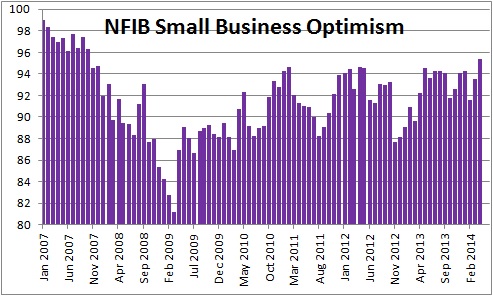
But here are some comments in the NFIB’s press release:
“This reading can only be characterized as a high end recession reading.”
“It’s tough to get excited by meager growth in an otherwise tepid economy.”
“Washington remains in a state of policy paralysis.”
“From a small business perspective there continues to be no progress on their top problems: cost of health insurance, uncertainly about economic conditions, energy costs, uncertainty about government actions, unreasonable regulation and red tape, and the tax code.”
In our opinion the NFIB is not doing its small business members any favor by adopting such a negative viewpoint. It should be focusing, instead, on how small businesses can take advantage of the unique opportunity presented by the combination of moderate GDP growth, low inflation, and extremely low interest rates.
GDP grew at a 2.6% pace last year and is expected to expand at a 3.0% clip in 2014. Economists generally regard the economic speed limit as about 2.5%. Faster growth will eventually force the Fed to raise the funds rate in an attempt to head off a pickup in inflation. Faster growth is not always a good thing. Be careful what you wish for.
The stock market reflects expected future earnings. Every few days it sets a new record high level. Corporate profits have never been higher and are climbing at a 9.5% pace. Investors seem to think that the combination of moderate growth, low inflation, and low interest rates is a dynamite combination.
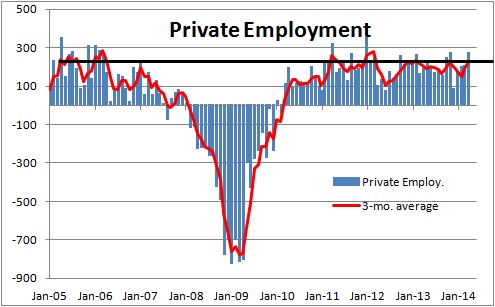
The economy is cranking out 225 thousand jobs a month. It rarely gets much better than that. It is true that some of these jobs are temporary or part time positions, and often are in low paying industries like retail or the food and beverage industry. But with the unemployment rate nationally at 6.3% and falling quickly (5.3% in South Carolina), employers are soon going to have to look a bit harder to find the workers they need. That means that employment opportunities for our youth will become more readily available. Many of those temporary or part time jobs may be converted into full time positions. And firms will soon have to offer higher wages and/or benefits to attract qualified workers.
The Federal Reserve has done everything in its power to tell us that they plan to maintain a low rate environment for the foreseeable future. They will not begin to raise the funds rate until the middle of next year and thereafter will allow it to rise only slowly. That basically ensures the viability of the expansion for another four years.
Against this background it is hard to understand the current degree of pessimism. Having said that, it is apparently in no one’s interest to admit that the economy is doing OK. The press focuses on the negative aspect of any report presumably in an effort to attract more readers or viewers. Republicans cannot admit the economy is performing in an acceptable manner given that an election is just six months away. Democrats characterize the labor market as terrible because they want to increase the minimum wage and extend unemployment benefits.
Perhaps the good news is that chronic pessimism is preventing the economy from expanding too quickly. The faster it grows, the sooner the Fed will be forced into the game by raising interest rates. So while this pessimism appears unwarranted, it may not be such a bad thing after all.
Stephen Slifer
NumberNomics
Charleston, SC


Stephen, your interpretation of the state of the economic continues to be on track and really makes me feel good. Thank you for seeing through all the negative stuff that the naysayers seem to think make sense.
…Darrel
Thanks, Darrel. I found myself getting all worked up when I would read some particularly negative piece on the economy, so I thought maybe it was time to write about it. Things are not perfect, but they never are. I guess whenever we get to the next recession the boo-birds will say, “See, I told you so”. Happens every time. Thanks for sending your note!
Steve