
November 26, 2020
No, not the animal kind. The European version.
Back in May, Greece was the first European Union country to accept a combined EU/IMF assistance package. Ireland is now the second. Portugal has admitted that it, too, is likely to need a bailout before long. The fourth European country with debt problems is Spain. The Portugal-Ireland-Greece-Spain combo has became known as PIGS. It would be a serious mistake for the United States to view the debt issues in Europe as simply a “European problem”. The clock is ticking for the U.S. and it needs to get its own fiscal house in order.
During the spring of 2010 Greece faced imminent default and on May 2 accepted a 110 billion Euros assistance package from the European Union and the IMF.
Economists frequently look at a country’s debt outstanding relative to GDP, which measures the extent to which that country will be able to repay its debt. Using IMF data for 2011, that ratio for Greece currently stands at 117% which, as shown below, is huge.
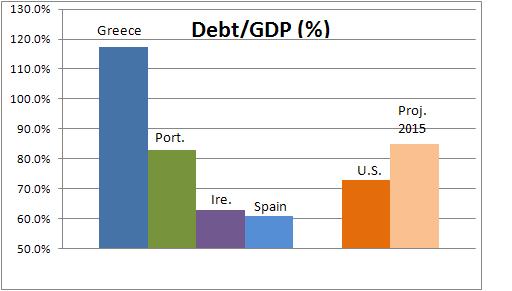
To put that number in context, for the G-7 countries as a whole prior to the onset of recession, that ratio was about 50% which was generally accepted as a “comfortable” debt burden for a country. During the recession, as economies shrank and budget deficits skyrocketed, those ratios mushroomed and that ratio now stands at 80%.
For the U.S., its current debt/GDP ratio is about 72% which is manageable. But the problem going forward is that its budget deficits are not expected to shrink quickly. As a result, debt will grow faster than GDP for the foreseeable future. By 2015 the IMF estimates that this ratio will have jumped to 85% which puts it clearly in the danger zone.
Why did Ireland suddenly become a target? Here the problem seems to be the budget deficit as a percent of GDP. When the European Union was formed, it was written that the budget deficit for any member country should not exceed 3% of GDP. For the European Union as a whole this was not a problem until the recession hit. In 2007, for example, the EU ratio was comfortable at 0.8%. In the wake of the recession that ratio has climbed to 5.5%.
For Ireland, the recession popped the housing bubble. As a result, the Irish deficit currently stands at 11.2% of GDP and it is expected to remain elevated at 5.2% in 2015.
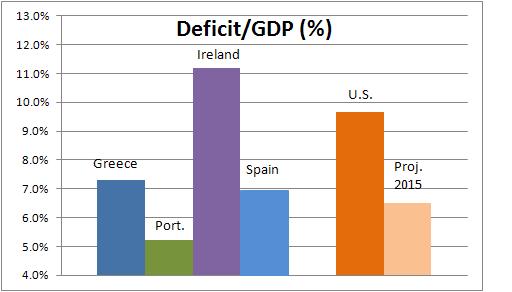
How does the U.S. compare? Like Europe, its budget deficit was not a problem until the recession. After having surged during the recession, the IMF expects that deficit/GDP ratio to be 9.7% in 2011 and it is not likely to fall quickly. By 2015 the IMF projects it still to be 6.5%. Remember, that ratio is occurring during the good times when the economy is growing. Economics suggests that it is OK to run a budget deficit and incur debt during a recession in order to stimulate the economy. But then a country should run a surplus and pay back that debt during the growth periods. The U.S. is doing the former, but not doing the latter. As a result, cumulative debt is going to be an issue at same point unless the U.S. soon takes action to shrink its projected budget deficits.
Next on the radar for speculators is Portugal. But Portugal is a relatively small country and its debt/deficit issues should not present any significant problem for politicians. But Spain’s economy at $1.1 trillion is five times larger than Greece, Ireland, or Portugal. Hence, it is a bigger potential problem. But as shown above, its outstanding debt relative to the size of its economy is not nearly as large as it was for the others. Hence, there is a chance that Spain can deal with its debt problems internally without EU or IMF assistance. But if Spain does have a problem the 750 billion rescue package cobbled together by the European Union and the IMF should be big enough. If Greece, Ireland, and Portugal use about 300 billion Euros or 40% of the package, the remaining 450 billion Euros should be adequate to bail out Spain.
Stephen Slifer
NumberNomics
Charleston, S.C.
Follow Me