
September 30, 2011
Third quarter GDP growth still seems likely to be about 2.3%, which is far better than the 0.4% and 1.3% growth rates recorded in the first two quarters of the year. Thus far consumers are still spending at a moderate pace. Businesses are creating a few new jobs and are willing to invest to bolster profits. As a result, the economy is expanding, but at a relatively subdued pace. However, there is a lingering fear that the difficulties in Europe are going to spill over into the U.S and push the economy back into recession. That concern will not be easily eliminated.
Early in the year the combination of rising oil prices followed by supply shortages in the U.S. caused by the tsunami in Japan sharply reduced first half GDP growth. The supply shortages have now been eliminated, and oil prices have reversed a significant portion of their earlier run-up. While the economy weakened, investors shrugged off many of these worries and the S&P remained near its cyclical high through mid-July.
But then renewed concerns about Greece’s ability to service its debt made investors nervous. The debt worries eventually spread to Italy which is the fourth largest European economy. Far more disturbing was the acrimonious debate in the U.S. about increasing the debt ceiling, a seeming inability of policy makers to deal with the problem, a near default by the U.S. Treasury in early August, and the downgrade of U.S. debt by Standard & Poor’s. Suddenly it became apparent to investors that the U.S. had looming debt problems not unlike the ones that exist in several European countries. In the eleven trading sessions between July 25 and August 9, the S&P fell 17% from 1344 to 1120. While today’s level of 1150 is not very different from the low point in early August, the volatility between then and now has been particularly disturbing with daily changes of 2-5 percentage points becoming a common occurrence.
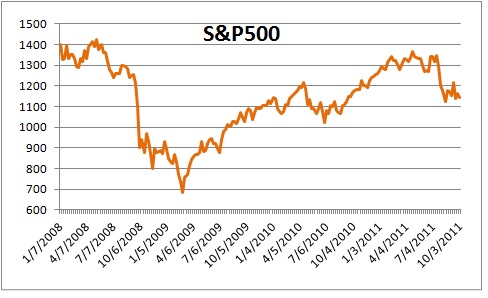
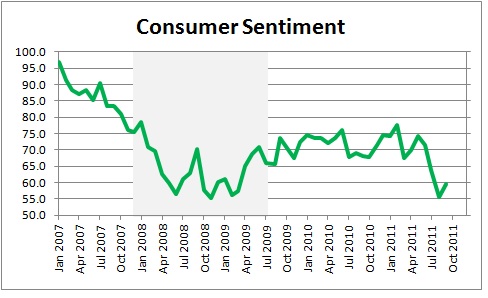
This late July/early August selloff in the stock market and its subsequent volatility has made consumers as nervous as they were following the collapse of Lehman Brothers in September 2008. However, consumers have paid down enormous amounts of debt in the past three years and have a debt burden that is roughly in line with where it has been for the past 30 years. Corporate profits and cash levels are at record high levels. Firms are hiring. Thus, it is difficult to see any significant weakening in the pace of economic activity, and virtually no chance of a double dip recession.
Having said all of that it is equally difficult to envision a return to the 3.5% growth rate we had anticipated for 2011. While the U.S. government has had a looming debt problem for years, the issue became far more acute following passage of the $787 billion bailout package in March 2009. For two and one-half years the markets ignored the problem, but suddenly debt has become the hottest factor driving global equity markets today.
The problem is there is no end in sight. Will Greece default? If so, when? As each deadline passes without a problem, the markets will rise. When the next deadline looms, they will once again become nervous. Will the European bailout fund be large enough to contain the problem? What is U.S. bank exposure to Greece? Closer to home, will Congress be willing to approve more money for FEMA? Will it be offset elsewhere in the budget?
It is easy to envision a scenario in which debt issues dominate the headlines for months to come. As a result, the markets will remain extremely volatile with each additional news item. Those market swings will make consumers nervous. They will also make firms wary of hiring many additional workers. That, in turn, will curtail consumers’ ability to spend. If GDP continues to expand at the roughly 2.5% pace we envision, there will be continuing pressure on policy makers – the Federal Reserve, Congress, and the president to do something. Unfortunately, there is little they can do to help. Plodding along is probably the best we can do for the foreseeable future.
Stephen Slifer
NumberNomics
Charleston, SC
Follow Me