
October 21, 2016
With the election less than three weeks away it is increasingly likely that Secretary Clinton will be our next president. The composition of the Congress remains in doubt. But no matter what happens on November 8 the truly poisonous political climate is likely to continue for the foreseeable future. As a result, it is hard to see how the business community will generate any degree of confidence. That means that investment spending will barely rise in 2017 and productivity growth will remain anemic. Against that background GDP growth seems likely to limp along at about 2.0% which is disappointing. We could do so much better if the political environment in Washington would change. Our leaders in that city appear to have forgotten the word “compromise”.
We much prefer to talk about economic indicators rather than politics. We know something about the former but little about the latter. However, politics is having a significant impact on the economic environment today, particularly on corporate investment, and cannot be ignored.
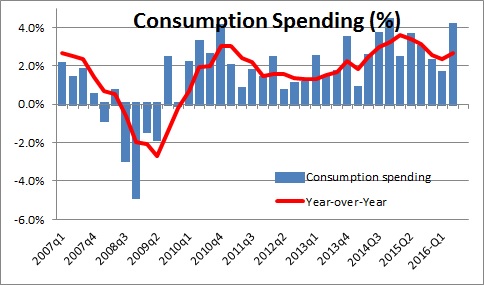
We are struck by the difference in confidence between consumers and business people. Consumers feel good and are willing to spend freely.
Business people, however, have absolutely zero confidence. Their investment budgets are frozen and they lack any willingness to invest.
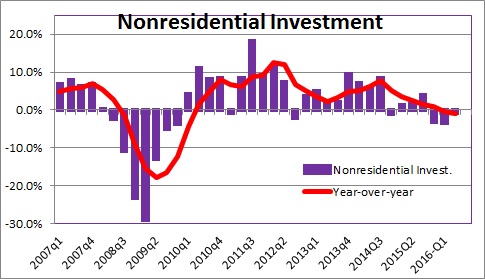
How can it be that one group can feel relatively encouraged, while the other – which includes many of the same people as in the first group – is completely lacking in confidence?
Business leaders are unnerved by a long laundry list of perceived problems. The corporate tax rate in the U.S. is 39% versus 23% elsewhere in the world. That encourages corporate leaders to shift their headquarters overseas. Earnings from overseas operations are frozen in those countries because of the stiff tax penalty that would be incurred if those earnings were repatriated to the U.S. The regulatory environment can only be described as stifling – especially for small businesses which lack the resources to pour through 80,000 plus pages of federal regulations. Obamacare is in shambles as insurers rapidly retreat from the individual ACA health care markets and far fewer than expected younger, relatively healthy adults are signing up. Clinton is opposed to the Transpacific Partnership. Brexit has further muddied the waters. The U.S. appears to be backtracking from the long-established notion that trade agreements boost economic activity.
No wonder businesses are reluctant to invest.
We have noted on numerous occasions that solutions to the problems described above can only come from Washington. The economy is paying a price for political gridlock in the form of little investment, marginal growth in productivity, and anemic GDP growth. Political advantage seems more important than doing what is necessary to support the business community and brighten our economic future.
We have been in the economic forecasting business for almost 50 years and have never felt so compelled to discuss politics and its potential impact on the economy. The two candidates offer widely divergent paths for our economic future. Whatever you do, do your homework, decide which candidate best represents your views, and vote. Your future – and your kid’s future – depend on it.
Let us close with two positive factors. First, GDP growth should be about 2.0% next year regardless of who wins the election. There is no recession in the immediate future.
Second, recall that in 2010 a bipartisan commission of nine Republicans and nine Democrats – the Simpson Bowles Commission — somehow defied the odds and managed to carve out an agreement that would have solved many of the problems described above. They recommended the following:
- Simplify the individual tax code by adopting three tax brackets, lower individual tax rates with the top bracket dropping to 23%, and eliminate most tax deductions.
- Cut the corporate tax rate to 23% and eliminate most corporate tax deductions.
- Cut defense and non-defense spending equally and eliminate all congressional earmarks.
- Reduce Social Security benefits, particularly for high income individuals, gradually increase the retirement age to 68 years, and increase the payroll tax maximum to $196,000.
- Raise the age for receiving Medicare benefits to 68 and make us pay more for our health insurance by paying only 50% of health care expenditures between $500 and $5,000.
Unfortunately, President Obama rejected the proposal because it cut too deeply into entitlement spending. Republicans complained that it raised taxes too much. In the end, the commission’s recommendations were not adopted. The point is that six years ago some of our congressional leaders defied the odds and devised a bipartisan agreement that would put the economy’s tax policies, government spending, Social Security and Medicare on a sustainable path.
Politicians have the ability to resolve our current economic woes. They did it once. They can do it again. Like Hurricane Matthew we should probably prepare for the worst and hope for the best.
Stephen Slifer
NumberNomics
Charleston, SC
Follow Me