
March 11, 2016
A hot topic in the economics world these days is the lack productivity growth. It has been slogging along at a 0.5% pace for the past five years. Between 1995 and 2010 productivity growth was steamy at about 2.5%.
Productivity growth is a big deal. It helps to determine how quickly the economy can grow. Back in the 1990’s our economic speed limit was believed to be about 3.5%. Today, partly as a result of slower growth in productivity, that speed limit has slowed to 2.0%. It is a factor in determining how rapidly the stock market is going to rise. Stock prices grow roughly in line with nominal GDP growth. If nominal GDP growth is 6.0%, corporate earnings and the stock market should grow at about that same pace. If nominal GDP slips to 4.0% the stock market will not grow as rapidly. It plays a big role in determining how large our future budget deficits are going to be. The faster the economy grows the more tax receipts flow into the government and the smaller the budget deficit. Slower growth makes the deficit bigger. Productivity growth is the primary determinant of growth in our standard of living which is generally regarded as the growth rate in per capita income. With 1% growth in productivity per capita income will double in 70 years; with 2% growth it doubles in 35 years. Thus, the recent slowdown in productivity is troublesome. Why has it slowed so sharply? How long will it last?
During the past 70 years productivity growth in the U.S. has averaged 2.2% but its growth rate is erratic. In the 25-years following the end of World War II productivity growth averaged 2.8% annually. That is the fastest growth rate we have experienced for any protracted period of time. Many economists characterize this as the “golden age” for productivity.
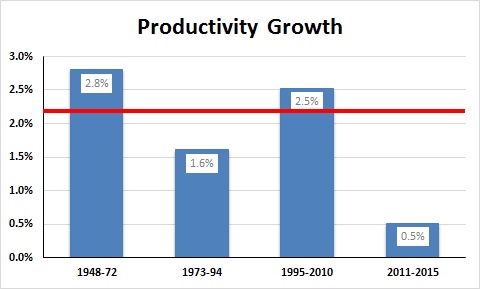
In the subsequent 20 years productivity growth slumped to 1.6% which at the time was the slowest growth period we had ever encountered. Nobody is quite sure why.
Productivity re-accelerated from the mid-1990’s to the end of 2010. This growth spurt was almost certainly attributable to the widespread adoption of computers, communications equipment, software, and the Internet. During that time growth quickened to 2.5%.
But from the end of 2010 through the end of last year growth plunged to 0.5%. It grew at about one-third the pace of the previous slow growth period. Why?
Some economists suggest that no major innovations occurred in that period of time. Facebook and Twitter provide entertainment value, but they do not increase the efficiency of the American worker. Other economists believe we are underestimating growth in the service sector where output gains are more difficult to measure but, thus far, there is little evidence that data difficulties account for much of the slowdown. Still others believe that the 1995 to 2010 period was an anomaly given the technological innovations introduced during that period of time, and that productivity growth has reverted to the 1.5% average recorded earlier. The lack of productivity growth remains a mystery.
We are believers in the continuing rapid advances in technology such as the cloud, aps, biotechnology, nanotechnology, robotics, 3-D printing, self-driving vehicles, and powerful machine intelligence. Hence, we are convinced that the productivity slump will not continue for long. There may be a long lag between investments in information and communication technologies and actual improvements in productivity as firms fumble around trying to figure out what this stuff allows them to do. Having said that, for now we are talking about productivity quickening from 0.5% growth today to 1.5%. We are not talking about a return to the 2.5% average of the 1990’s and early 2000’s. To get there we need some help from Washington.
Firms today are reluctant to invest largely because of uncertainty. Uncertainty about the corporate tax rate. Will it be lower once a new Administration takes charge next year? What deductions will be disallowed? To what extent will firms be allowed to repatriate offshore earnings? How much will health care benefits cost the firm? Will Obamacare be repealed? How might the new Administration alter existing trade agreements? The regulatory environment is stifling. While large firms can devote significant legal and financial resources to figure out how to cope, small firms are at a disadvantage. Will there be wholesale changes in the regulatory environment? For now firms seem more intent on using retained earnings to buy back outstanding stock to boost stock prices and increase dividends to reward investors. Resolution of some of these issues should stimulate investment and, ultimately, boost productivity growth.
While we remain optimistic for now we are largely banking on faith.
Stephen Slifer
NumberNomics
Charleston, SC
Follow Me