October 30, 2026
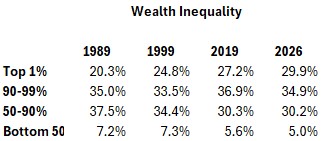
Consumer confidence is near a record low level. While there are a variety of causes one that is near the top of the list is the growing inequality of income and wealth. The wealth of the top 10% of households is growing rapidly while those in the bottom 50% are struggling. This has created a sense of despair amongst those in the bottom 50% who seem to believe that they can never get ahead no matter what they do while the rich keep getting richer. Billionaires and large, rapidly growing companies are hated because of their success. As a result, a variety of government led programs have been discussed to fix the problem. Wealth taxes are on the ballot in a number of states. Progressives are lobbying for much higher income tax rates for high-income households and corporations. Some want to close capital gains loopholes presumably to increase capital gains tax revenues. Others want to increase the power of unions who will presumably lobby hard to secure outsized wage gains for union workers. But these solutions are backward. They are trying to punish the wealth creators and increase the role of government to solve the problem. Keep in mind that governments don’t create wealth, they spend it. We should be doing things that encourage investment, entrepreneurship, and education in the trades. Boost productivity. Broaden apprenticeship programs. Eliminate the vast array of unnecessary and wasteful government regulation at all levels. The biggest cause of wealth inequality today is not billionaires, but rather bad government policies.
There is inequality of income and wealth in any economy. It is not just the United States. The problem is that the concentration of wealth at the top has grown at a turbocharged rate in the seven years following the 2020 recession as gains from the stock market and home prices have significantly boosted the wealth of middle and upper income consumers while those at the bottom who have neither a stock portfolio nor own a home have risen far more slowly. To be more specific the wealth of the top 1% has grown about 12% annually in the past seven years. The wealth of the bottom 50% has grown at 7% per year. With inflation averaging 4.5% per year in that seven year period both groups are outpacing the increase in prices, but the ones at the top are obviously doing far better than the ones at the bottom. While the inequality of wealth has increased, that does not mean that the wealth of the bottom 50% of households has declined. It has not. It has simply risen more slowly than that of the wealthier households.
As wealth has risen there are more and more billionaires today which attract a lot of attention. There is a general perception that they must have gotten so rich by using unethical business practices. In today’s world that makes all billionaires targets for social media. They are seen to be evil.
But here is another reality. They are creating wealth and hiring workers. We should be celebrating their success and entrepreneurship, not condemning it. If we want to reduce income inequality let’s find ways to make workers into business owners.
Encourage stock ownership plans so that the workers can share in the profits that they helped produce.
Encourage more business leaders to offer 401k programs to their employees which will help them save more for their future.
Let’s think differently about education. The traditional 4-year college degree has always been regarded as the key to financial success for high school graduates. We are not disparaging a college degree. It is great for many students. But not all. Many young people have no idea what they really want to do for the rest of their life. Some are not mature enough at age 18 to be successful if they enter college right after high school. The other reality is that many recent college grads are having difficulty getting that first job. AI has replaced many entry level positions. Furthermore, some of these college grads have degrees in programs that are so specific that they do not appeal to the vast majority of employers or offer the skills that those firms require. Let’s encourage our younger people to think seriously about a trade school. These schools offer a surprising number of programs many of which are at the cutting edge of today’s technology. While going to a technical college the student will most likely have an apprenticeship which will give them valuable work experience while simultaneously learning a trade. They will also almost certainly have a job waiting for them at the end. For those that are so inclined upon graduation they can transfer to a 4-year college, get the same degree as those students who have attended for all four years, and saved tens of thousands of dollars in tuition fees in the process. The opportunity is there for these younger people to embark on a successful career if only they, their parents, and their high school guidance counselors, will open their minds to something other than the traditional 4-year college degree.
Let’s get government out of the way and allow the capital that is being used to finance enormous budget deficits to find its way into the private sector to encourage investment and boost productivity. That will allow our standard of living to grow more quickly. The federal budget deficit for the most recent fiscal year was $2.0 trillion with projected deficits that size or even bigger for the next decade. That means that each year the government must issue $2.0 trillion of debt to pay its bills. The debt to GDP ratio is currently 100% but is expected to climb to 120% in the next ten years – unless there is a recession between now and then which would make it even higher. We might want to ask the French what excessive government borrowing has done to cripple their economy. The jig is up in France. Is the U.S. headed in the same direction? It appears so.
Many states are thinking seriously about some form of a wealth tax like Prop 40 in California. That is misguided. New taxes are rarely one time events. They become embedded. And the tax rate never goes down; it only goes up. Keep in mind that these wealthy individuals can move to other states where they are welcome rather than despised. They can also move to other countries and the U .S. will lose their entrepreneurship, their capital, and their wealth generating companies.
Others suggest trying to beef up the power of unions. That is another misguided idea. Union membership has been declining for the past 50 years. Why? Because unions charge dues and many workers feel they are not getting their money’s worth from union membership. Their leaders become wealthy. They do not.
Still others talk about increasing the minimum wage. But a company that employs a lot of unskilled, low income workers may choose to hire fewer workers and make their existing employees work harder to make up the difference. A higher minimum wage can benefit some workers, but in the end there will be fewer workers at that firm and in the industry as a whole. It is a solution that seems to penalize owners rather than build up the skills of the workers they employ. That is not an attractive solution.
Excessive regulation is dampening entrepreneurship. The recently released GDP report showed 3.4% GDP growth in the third quarter. It was led by investment spending as the AI buildup continues at a breathtaking pace and by consumers’ willingness to spend. The notable laggard amongst the major GDP categories was housing. Certainly higher mortgage rates are a primary culprit. But so, too, is the inability of builders to get enough workers to boost the pace of production. They have jobs to offer. They simply cannot fill them. Deportation has eliminated a significant number of foreign workers in the housing industry. And in many cases it has made legal, law-abiding foreign workers afraid to come to work for fear that ICE will show up at their work site. Let’s devise an immigration policy where foreign workers are once again welcome in this country. We need them. And let’s eliminate some of those unnecessary, overlapping, and ill-advised regulations, particularly at the local level, that are boosting builder costs and raising the price of every new home they build. If we are serious about creating more affordable housing and reducing inequality let’s allow builders to actually build more houses and apartment units.
The bottom line is that if we want to reduce income and wealth inequality let’s encourage entrepreneurship, productivity, employee ownership, savings, and education. Let’s not further expand the size of the government sector in an effort to solve the inequity problem. The private sector builds wealth. The government sector spends it.
Stephen Slifer
NumberNomics
Charleston, S.C.


Hallelujah! Wish you were running for office – or already in charge of things in D.C>
This analysis wisely address the data, the problem, and the better place to look for solutions. A public service.
It just seems to me that almost everybody I talk to is concerned about the income and wealth inequality, but they are advocating the absolutely wrong solutions.
Thanks Andy. I appreciate the kudos.