
November 20, 2015
The global economy is experiencing two simultaneous seismic shifts that have fundamentally altered the economic landscape – Oil and China. In general these events will stimulate growth in developed countries, but sharply curtail growth in emerging economies around the globe. Consider the following:
Oil. The drop in oil prices has clearly affected countries around the globe. Oil-importing countries benefit as consumers pay less to fill the car’s tank with gas which leaves money left over to spend on other goods and services. Firms that use oil as a source of energy also benefit. Countries that are the so-called “winners” from the drop in oil prices are oil-importing economies like the United States, Europe, and Japan which are all large, developed economies.
The negative impact is felt by oil exporting countries which is a much longer list – Saudi Arabia, Russia, Iran, Iraq, Nigeria, United Arab Emirates, and Venezuela. These countries are all amongst the so-called emerging economies of the world. The drop in oil prices hits these countries particularly hard because they tend to use oil revenue to finance government spending. When oil revenue gets cut in half, government spending shrinks. which reduces the pace of economic activity.
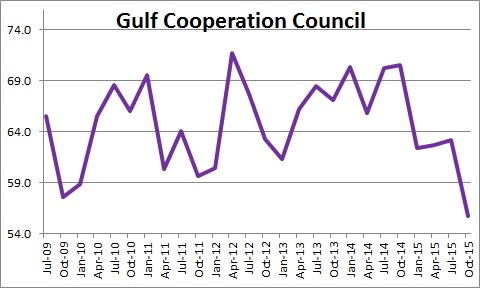
The Young President’s Organization produces a measure of global confidence which can be broken down into a number of different regions. To highlight the negative impact of falling oil prices consider the series on confidence amongst countries that are members of the Gulf Cooperation Council which is an economic union of all Arab States in the Persian Gulf except for Iraq. Hence, their fate is closely tied to the price of oil. In the past year confidence has fallen almost 15 points from 70.5 to 55.7 which is in sharp contrast to the 65-70 point range that existed previously. Having said that, at 55.7 the level of the index is consistent with moderate – but no longer stellar – economic growth amongst GCC countries.
Given that oil inventories today are at a record high level, oil is no longer going to trade between $80-110 per barrel. Instead, it is likely to trade permanently in a range from perhaps $30-60 per barrel
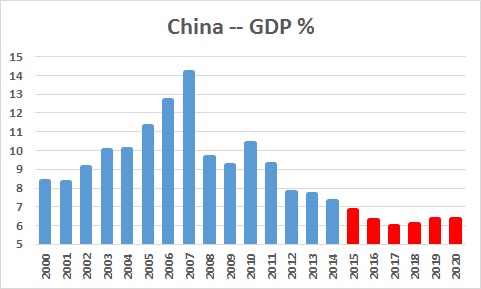
China. Growth in China has slowed from a double-digit pace a few years ago to 7.5% last year, to 6.8% this year, and to an expected 6.0-6.3% pace in the years ahead. Given a growth slowdown in the world’s second largest economy of that magnitude, there will clearly be negative effects amongst countries that sell a significant amount of goods to China.
Developed countries like the United States, Europe, and Japan are major exporters of goods to China. But in each case trade with China is a relatively small portion of their economy. The growth slowdown in these countries caused by China is nothing more than a ripple effect.
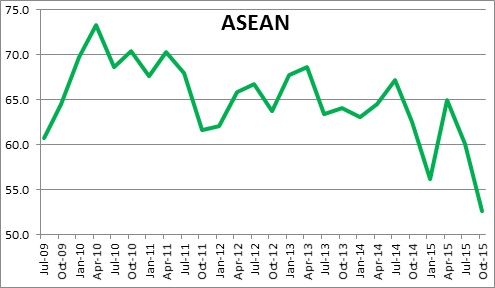
However, there is a long list of countries where trade with China plays a very important role in their economy. The so-called ASEAN countries – which include Indonesia, Malaysia, the Philippines, Singapore, Thailand, Vietnam, and Myanmar – have been hit hard by the Chinese growth slowdown. In this case confidence in the past couple of years has slipped from 70 to 52.6. Their economies will continue to expand, but the pace of expansion for the next couple of years will be sub par compared to their previous performance.
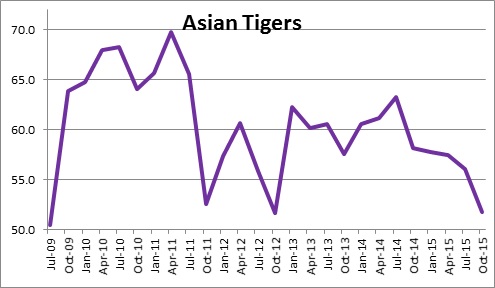
More countries hit hard by China’s economic malaise are Hong Kong, South Korea and Taiwan which (including Singapore) are collectively known as the Asian Tigers. The chart appears quite similar. Their economies have also taken a big hit from China.
The drop in oil prices and slower growth in China have transformed the economic landscape. Oil prices have been cut in half and are not going back up any time soon. Growth in China has been cut largely in half and will remain slow. In general the beneficiaries of these two global events are the developed economies of the world, with the negative impact being felt most acutely by emerging economies around the globe. But if oil prices stabilize at about $45 per barrel, and the bulk of the growth slowdown in China has already occurred, we would argue that most of the impact around the globe – both positive and negative — is behind us.
Stephen Slifer
NumberNomics
Charleston, SC
Follow Me