
July 8, 2015
The naysayers always find something to worry about. But then that particular concern seems to disappear. That seems to be happening currently. We believe that GDP will rebound from 1.1% in the first quarter to 2.6% in the second, and remain at roughly that same pace through the end of the year. That is not to say the economy is booming. Instead, it just continues to chug along at a moderate pace – and that is a good thing.
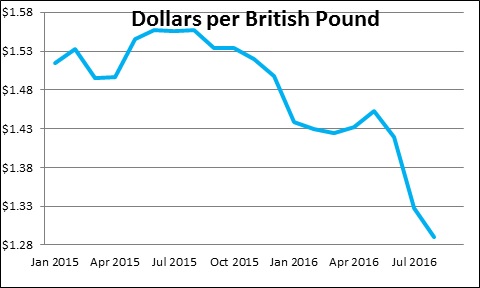
The latest concern was that the British vote to leave the European Union would strengthen the dollar and weaken growth in U.S. exports. The dollar has strengthened against the British pound. Prior to the vote one U.K. pound cost $1.44. Today it costs $1.29. That is a 10% appreciation of the dollar relative to the pound.
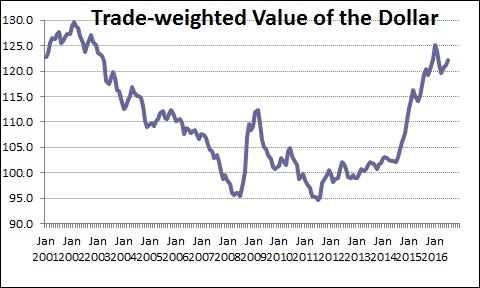
But our principal trading partners are our neighbors to the North and South – Canada and Mexico – and those two currencies have been stable in the wake of the Brexit vote. In fact, the trade-weighted value of the dollar was essentially unchanged in June after having declined about 4% earlier this year. That stands in sharp contrast to the protracted run-up that occurred between October 2014 and the end of last year which did cause exports to decline in 2015. However, weakness in exports will not be an impediment to GDP growth in 2016.
Keep in mind, too, that the trade component of GDP is 10% of the total. Trade with the U.K. is less than 3% of the 10% which makes it 0.3% of GDP. So while the dollar has strengthened considerably against the pound, our trade with the U.K. is so small that its impact on the U.S. economy will be negligible.
Then there was the jobs fear. Initially, payroll employment rose 38 thousand in May and the boo-birds fretted that the economy was slowing down. But then jobs surged by 287 thousand in June. So much for that worry. It is true that in the past three months jobs have risen on average 147 thousand per month. That compares to an average increase last year of 228 thousand. Why are jobs slowing down? Because the economy is at full employment and employers simply cannot find enough able-bodied workers. Look at the housing sector. Demand is hot. Home sales are steamy and there are not enough homes available for sale. But yet construction employment declined in April and May and was unchanged in June. Builders cannot find enough qualified workers. The economy is at full employment and wage pressures will intensify with each passing month.
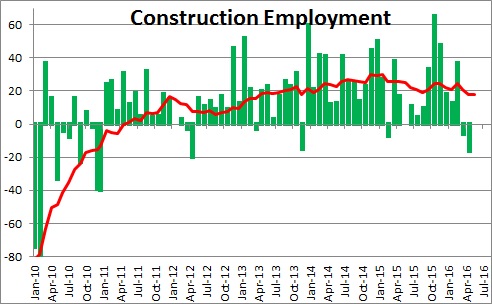
If the economy truly is at full employment jobs growth should slow to something roughly in line with growth in the labor force. In the past twelve months the labor force has risen on average 154 thousand per month. So if payroll employment in the past three months has risen 147 thousand, that is roughly in line with what we should expect to see in the months ahead.
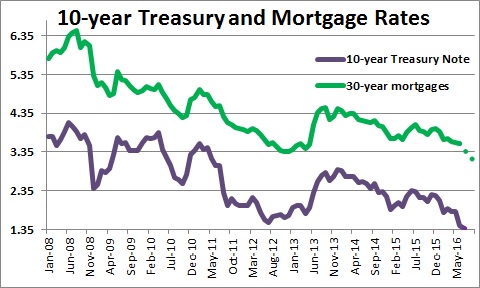
Speaking of housing, long-term interest rates have fallen to a record low level. The yield on the 10-year Treasury note is now 1.38%. The 30-year mortgage rate has been sticky at about 3.5%, but if the historic spread between the yield on the 10-year note and the 30-year mortgage rate matches its historical average of 1.75%, then mortgage rates are on their way to 3.15% which will give the housing sector yet another shot in the arm. Furthermore, the Fed is not about to raise rates any time soon. Not because of domestic reasons. But for it to raise rates when virtually every other central bank is going the other direction would weaken their currencies. The Fed is not about to make the Bank of England’s job more difficult.
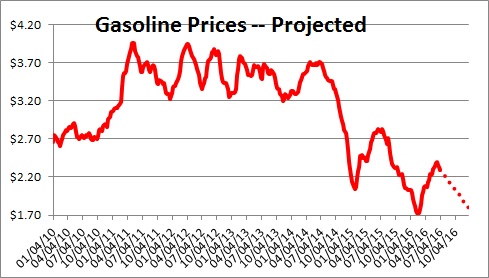
And if that’s not enough, gasoline prices have hit their intra-year high and should steadily decline between now and yearend. They always peak around the fourth of July as the summer driving season begins to wind down.
Against this background the stock market is right at its all-time record high level.
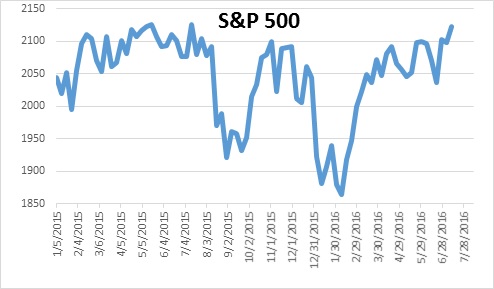
The economy has shrugged off its fear that the modest employment gain for May was a harbinger of things to come. Brexit is not going to have the negative impact on the U.S. economy that some may have originally feared. Long-term interest rates declined 35 basis points in the past couple of weeks. Gasoline prices are beginning another protracted decline. And the stock market at record high level. What’s not to like?
Stephen Slifer
NumberNomics
Charleston, SC
Follow Me