
October 23, 2014
For the past several years the economy remained on solid footing because monthly employment gains were consistently in excess of 200 thousand. But going forward they will gradually shrink to 150 thousand – or even lower. That is not a signal that the economy is slipping into recession. Rather, it is a sign that the economy has achieved full employment at which point everyone who wants a job has one and firms can no longer find an adequate supply of qualified workers. While it may not be a sign of impending doom, it does have important negative implications.
- GDP growth could slip below the 2.0% mark. That means that the economy has less ability to withstand an unanticipated shock without dipping into recession.
- Inflation could begin to rise as firms bid more aggressively for available workers and pass through the higher costs to their customers.
- As inflation rises the Fed could raise rates more quickly than is currently anticipated.
Payroll employment gains in August and September were well below the recent average of 200 thousand. We dismissed the smaller increases in these two months for two reasons. First, we had small employment gains in the third quarter of last year, but they came roaring back in the fourth quarter. Second, the data on layoffs in the economy are at the lowest level since 1973. That seems inconsistent with emerging weakness in the labor market. As a result, we expect an increase in payroll employment for October of 225 thousand. If we get that, all is right with the world. Or is it?
Here’s another thought. The economy could be at full employment. At its peak the unemployment rate was 10.0%. Today it is at 5.1%. The Fed believes full employment is 4.9%. Once the economy reaches that level, everyone who wants a job has one.
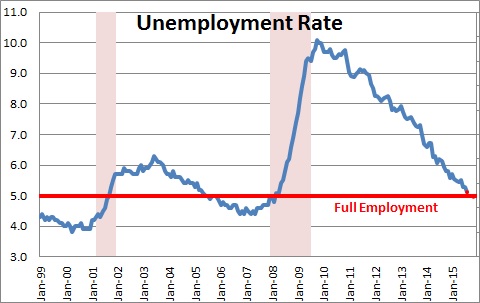
Then what happens? Because the economy is still expanding at a respectable pace the need for workers remains robust. But firms are unable to hire enough bodies. To attract the workers that they require, firms poach them from other firms by bidding up wages or offering more lucrative benefits. Because labor costs represent two-thirds of a firm’s total cost prices soon rise and inflation begins to climb.
Currently the year-over-year increase in the CPI is 0.0%; excluding energy the rate is 1.9%. The only reason the CPI is behaving so well currently is because the energy component has fallen 20% during the past year. A 20% drop in 10% of the index means that falling energy prices have subtracted 2.0 percentage points from the rate of expansion in the CPI this year. At some point oil prices are going to level off. Indeed, the Department of Energy expects crude prices to average $53.57 next year versus $46 currently. As energy prices begin to climb the inflation rate will quickly exceed the Fed’s 2.0% target.
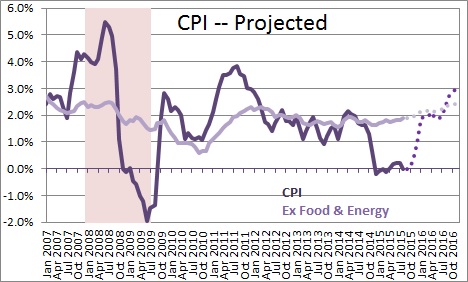
How does the Fed respond? GDP growth of slightly less than 2.0% seems sluggish which suggests the Fed will remain on the sidelines. But remember, potential GDP growth has slowed. It is no longer the 3.5% rate that existed in the 1990’s. The combination of slower growth in the labor force (as the baby boomers retire) and slower growth in productivity means that the potential rate is now somewhere between 1.5-2.0%. The Fed thinks it is about 2.0%. We think it is about 1.5%. Nobody really knows – and it can change over time. If the economy is growing at a pace roughly in line with potential, the economy is cranking out enough jobs so that new entrants to the labor force have a job awaiting them and the unemployment rate remains steady. Thus 1.5-2.0% growth is not, from the Fed’s viewpoint, an alarmingly slow pace. At the same time, inflation is climbing above the Fed’s 2.0% target as oil prices rebound. The Fed does not want that to happen. The Fed has promised us that once it begins to raise rates it will do so at a very slow deliberate pace. However, faster inflation may expedite the process in which case the Fed could raise rates more quickly than is currently expected. Ouch!
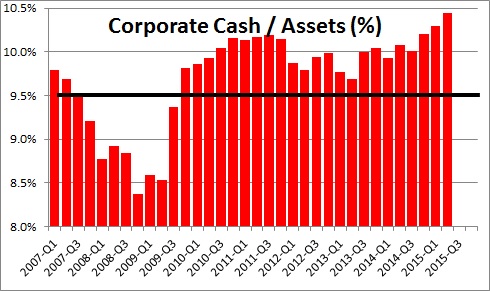
But there is a happier scenario – which happens to be our forecast. Once the economy reaches full employment and firms can no longer get enough workers, they could decide to deploy some of their ample cash holdings on technology. Currently, firms have a record 10.5% of their assets in the form of cash which is invested in Treasury bills and CD’s which essentially yield 0%. They could spend some of that cash on technology in an attempt to make existing workers more productive rather raise wages to lure bodies from other firms. As productivity accelerates, potential GDP growth begins to climb. We currently think potential growth consists of 0.5% growth in the labor force and 1.0% growth in productivity which implies potential GDP growth of 1.5%. But if employers begin to loosen up on the purse strings and spend more money on technology then, presumably, productivity growth rebounds to, say, 2.0% and potential growth becomes a more acceptable 2.5%. It is still not the 3.5% pace that existed in the 1990’s, but it is far better than the 1.5% that exists at the moment.
Our forecast for GDP growth of 2.5% next year assumes a rebound in productivity, in which case firms can produce enough goods to satisfy demand without raising prices. That allows the Fed to continue on its slow but steady path towards higher interest rates. But for this to happen we need to see employers spend more money on technology. Thus far there is no evidence that is happening. But once firms can no longer get an adequate supply of workers, they may change their behavior. We’ll see.
Stephen Slifer
NumberNomics
Charleston, SC
Follow Me