
September 9, 2011
Suddenly our policy makers – both at the Fed and in the White House and Congress — appear ready to “do something” to assist an economy that, in their view, is on the verge of dipping back into recession. But such action is costly, unlikely to help, and probably unnecessary.
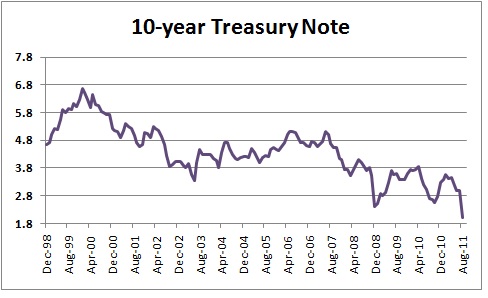
The Fed has proposed several options. Option #1 is known as “Operation Twist”. The Fed would sell shorter maturity Treasury securities and buy longer-dated ones. The idea would be to produce lower long-term interest rates. But with the yield on the 10-year Treasury note at a record low level of 1.97%, and 30-year mortgage rates at a record low level of 4.25%, it is hard to see how a further modest reduction in long rates is going to entice consumers and businesses to borrow.
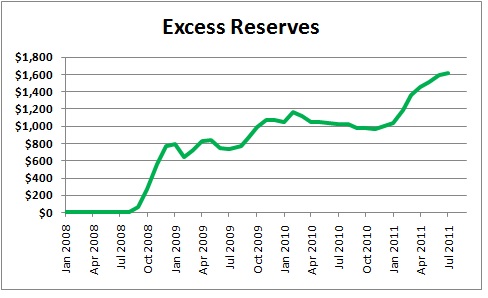
As Option #2, the Fed has talked about lowering the rate it pays on cash balances that banks hold at the Fed from 0.25% currently to 0.0%. If banks are no longer paid 0.25% on their holdings at the Fed they might, in theory, be more willing to lend those funds than let them sit idle and earn no interest. But the banking system already has $1.6 trillion of surplus reserves that they could choose to lend. Some banks may be reluctant to lend because want surplus liquidity in the event the European bank crisis deepens. The loss of 0.25% return on those funds is unlikely to change that decision. Furthermore, to make a loan the bank must find a consumer or business that is willing to borrow. Even if banks are prepared to lend, they cannot manufacture loan demand. It is hard to see how either of these actions by the Fed will help.
On the fiscal policy side President Obama recently proposed at $447 billion jobs package. The basic idea is for the government to spend more money now to get the economy moving, but then cut spending in the future once the economy has begun to accelerate. Of that amount $245 billion comes about from a cut in the payroll tax for the Social Security pension program for both workers and employers in 2012. This would provide considerable near-term stimulus, but at the expense of making the longer run financing of Social Security more challenging. An additional $140 billion would be used for “infrastructure investments” and the re-hiring of teachers and first responders. But we have learned that so-called “shovel ready” projects are rarely “shovel ready”. This part of the plan is unlikely to produce any near-term stimulus. The final part of the plan, extending unemployment benefits, is highly controversial. While there is a clear case to be made to assist those unemployed workers who have been jobless for a protracted period, providing benefits for 99 weeks runs the risk of making joblessness a career path.
Every element of the jobs package requires additional spending at a time when Americans are already worried about the extent of government debt in the years ahead. And they do not believe that such spending will be paid for by “closing loopholes”. The steep stock market decline since mid-July has been triggered by debt fears. At that time the European debt crisis resurfaced with a vengeance. The problems in Greece, Portugal, Ireland, and Spain spread to Italy, the third biggest economy in Europe and European policy makers have been unable to find a solution. At that same time the debt ceiling debate in the U.S. intensified and U.S. policy makers were equally frustrated. The subsequent downgrade of Treasury debt by Standard and Poor’s highlighted the fact that the U.S. already has too much debt.
In 2008 the global financial markets were on the verge of collapse. Without the $787 billion stimulus package passed at that time, the steepest recession in the past 70 years threatened to become a repeat of the Great Depression. But 2011 is not 2008. GDP growth is not falling at an 8.0% pace as it was in late 2008 and early 2009. Rather, first half GDP growth averaged 0.7%. Further, many of the problems that produced such slow growth early in the year have disappeared. Virtually every economist believes that third quarter GDP growth is poised to expand by 2.0-2.5% pace. Sluggish? Certainly. Threatening to slip back into recession? Hardly.
Passing a $447 billion jobs package at a time when Americans are already worried about debt, is downright dangerous, not to mention the fact that it may be unnecessary. Trying to solve a debt problem by creating still more debt does not seem like the right policy prescription.
Stephen Slifer
NumberNomics
Charleston, SC
Follow Me