
February 27, 2015
There is sufficient evidence from a variety of sources to conclude that in the past decade the share of income and wealth going to the richest Americans has increased while those at the bottom are less well off. But the reasons why this is happening are not well understood.
Income
It is important to recognize is that income inequality can widen in a variety of different ways. If income is rising for all Americans but rising more rapidly for the top 5% than for the vast majority, that is generally not regarded as a problem. Indeed, that was the largely the case from 1989 until the recession. For example, from 1989 through 2004 income for the top 5% rose 22%, income for the next 45% rose 17%, and for the bottom 50% it rose 19%.
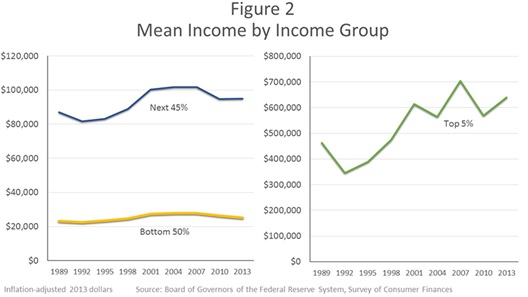
The recession changed all that. From 2004 through 2013 income for the top 5% rose 31%, but for the next 45% it declined 7% and for the bottom 50% it fell 9%. To have income for those at the top rising while income for the vast majority of Americans is falling is inconsistent with the notion of equal opportunity for all.
Wealth
The situation with respect to wealth was similar between 1989 through 2004. Wealth for the top 5% rose 76%, for the next 45% it climbed 53%, and for the bottom 50% it increased 39%. Rising home values benefited everyone and higher net worth families received additional value from the rising stock market.

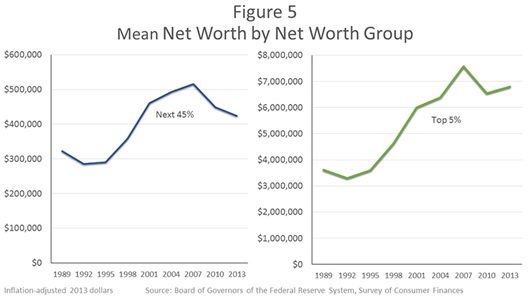
Since 2004 wealth for those in the top 5% has increased 6%, but for the next 45% it declined 14%, and for the bottom 50% it plunged 60%. To put that into perspective wealth for the lower half of the distribution declined from a peak of $31,000 dollars in 2007 to just $11,000 by 2013. A Fed survey indicates that one-fourth of these families reported zero or negative net worth, and a significant number owed more on their home than it was worth.
Another major source of wealth for many families is financial assets which include stocks, bonds, mutual funds and private pensions. Families in the top 5% own almost two-thirds of all these financial assets while families in the next 45% own the remainder. Those in the bottom half own just 2% of the pie. Thus, the dramatic stock market gains in the past five years have only benefited families in the top-half of the wealth distribution.
Causes
What are the causes of this significant widening of the income and wealth gap? Most economists agree that labor-saving technology has eliminated many manufacturing and service sector jobs. There is also general agreement that globalization has allowed U.S. firms to take advantage of low cost workers overseas at the expense of more expensive workers in this country. These developments eliminate jobs in the short term, but technology will also create many more jobs longer term once workers acquire the skills necessary for these new positions. Unfortunately, that re-education process can take some time.
Other possible causes are far more controversial. Low capital gains tax rates tend to benefit wealthier individuals. While that is true, the low rate on capital gains is also meant to encourage savings and investment which creates jobs and helps the economy grow.
Others suggest that lax anti-trust legislation has allowed monopolies and near-monopolies to emerge which benefit the rich.
Low inheritance taxes allow the rich to pass along their wealth from one generation to the next. But the income that was used to generate that wealth has already been taxed. Should it be taxed again when it is passed to the next generation?
Others are quick to blame the decline of union membership. There is no doubt that unions can attain higher wages for their workers. But that implies higher labor costs for heavily unionized firms and industries relative to their non-union counterparts. In a global marketplace with low wages available elsewhere, unionized firms tend to lose market share and may ultimately be forced out of business which results in a significant number of job losses. In the longer term did the workers really benefit? Probably not. It is also important to recognize that union membership has been falling for the past 50 years. This is not a recent development.
Even the Federal Reserve is being blamed. By holding short-term interest rates near 0% it has helped support the stock market which, as we have seen, benefits wealthier individuals. But if the Fed had raised rates sooner the economy might not have been able to withstand it and dipped back into recession. We suspect that those arguing that the Fed is responsible for the wider income gap would not have been happy if the Fed had chosen to raise interest rates a year ago.
Then there is the question of good, old-fashioned greed. While not confined to any one sector the financial industry instantly comes to mind. Young people today are not choosing to join investment banking firms because of some desire to enhance the greater good of society, but because of the lucrative financial rewards. Is that bad? Can you blame them? Corporate leaders receive multi-million dollar payouts even though their firm underperforms. Similarly, they receive huge payments when they are ousted by the board. Are those practices defensible?
There can be little doubt that income and wealth for the top 5% has increased in the past decade but living standards for the majority have been stagnant. Because of the numerous causes it is difficult to find a solution. But this is an important issue. The American economy is based on the idea of equal opportunity for all. That does not appear to be the case in today’s society.
Stephen Slifer
NumberNomics
Charleston, SC


Stephen,
This is a very insightful piece which clearly describes the reasons for the current economic situation. Re-education of the workforce to gain access to the new jobs that do and will exist is very important, if we wish to the the Middle Class to flourish in the future of the 21st century. I wonder if our Republican friends in state and federal legislatures comprehend that fact. As the Greeks pointed out, the only absolute in the universe is change. We are in the change mode and it is accelerating as we speak. As an educator I will do all I can to help young people find success in the future; I thank you for providing a well-thought out understanding of what is going on at the moment.
Darrel Staat