
January 2, 2015
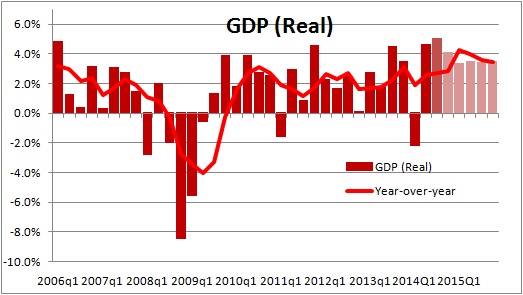
Late last month we learned that third quarter GDP growth was revised upwards to a steamy 5.0% pace. Fourth quarter growth should remain robust at about 4.0%. While the economy has been plodding along at roughly a 2.5% pace for some time the pace has quickened. Almost certainly the upswing in growth is attributable to the precipitous slide in gasoline prices which has freed up money that consumers can spend on other goods and services.
The Commerce Department’s final estimate of third quarter GDP growth was 5.0%. The initial reading at the end of October was 3.5%. A month later it was revised to 3.9%. Now it has been revised upwards further to 5.0%. A pattern of steady upward revisions has been evident for most quarters for the past couple of years.
On January 30 we will get our first look at fourth quarter GDP. We currently estimate that growth in that quarter remained robust at 4.0%. If that forecast is accurate it means GDP will have risen 2.8% in 2014.
Economists typically estimate GDP growth for any given quarter in two different ways. First, they look at the available data on production. They then make some estimate of the change in productivity for the quarter, add the two figures together, and come up with a GDP estimate based on production. Second, they add up the available sales data for the various components of GDP such as consumption spending, investment, trade, etc. and come up with an estimate of GDP based on spending. In theory the two estimates should be identical. They never are because every single economic indicator has measurement problems – but they should be close.
To estimate fourth quarter GDP based on production we know from the employment report the number of people working and how many hours they worked. Presumably that should give us some idea of how many goods they produced which is what GDP is all about. The employment and hours worked data are combined in the “aggregate hours index”. Data for October and November have already been released. If we assume the index is unchanged in December then the fourth quarter average will have risen 3.2% compared to the third quarter.
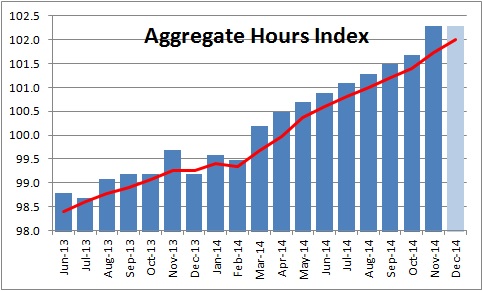
Next economists must make some assumption about productivity growth for the quarter. While productivity can be volatile on a quarterly basis it has averaged about 1.0%. So if hours worked increase 3.2% and workers are 1.0% more productive then, presumably, GDP growth for that quarter – based on production – should be 4.2%.

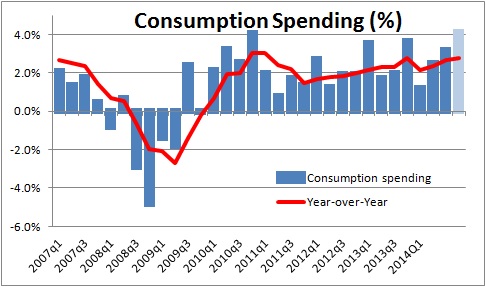
When economists look at the opposite side of the coin and try to estimate fourth quarter GDP growth based on spending they come up with a similar conclusion. Consumption spending represents about two-thirds of GDP. We know consumer spending for October and November and if we assume it is unchanged in December then consumer spending will have risen 4.1% in the fourth quarter. Compare that to the 3.2% increase in consumer spending registered in the third quarter when GDP growth climbed by 5.0%. Economists must also look at the available monthly data on investment spending, trade, and government spending, but once everything is said and done it is easy to envision fourth quarter GDP growth based on spending of 4.0% or higher.
Combining these two estimates of fourth quarter GDP growth, we estimate GDP growth in that quarter at 4.0%. The street consensus is for growth of about 3.0%. Do not be surprised if at the end of this month we learn that, once again, the pace of economic activity surprises on the upside.
What is the catalyst for this pickup in growth? Quite clearly it is oil-related. Thus far, gasoline prices nationally have fallen from $3.70 per gallon back in July to $2.30. That is a decline of almost 40%. Consumers still buy the same amount of gas (which is what goes into GDP), but because they are paying less for it they have more money to spend on other goods and services. Put another way, if the typical family used to spend $60 to fill up the tank with gas now they only need to spend $35. The $25 in savings can be spent on other goods and services. The drop in gasoline prices also has an impact on confidence as consumer spirits rise which encourages them to spend even more.
This positive impact on GDP growth only works if gasoline prices remain low. The Energy Department estimates that gasoline prices will average $2.60 this year. So while prices in 2015 may rise somewhat from their current level, the bulk of the recent decline will remain intact. In part for this reason we estimate GDP growth in 2015 of 3.4% compared to 2.8% in 2014.
As the growth pickup becomes more apparent we think the Fed could well accelerate the timing of its first rate hike from mid-2015 to perhaps April.
Stephen Slifer
NumberNomics
Charleston, SC
Follow Me