
March 4, 2011
The employment situation continues to improve, but the employment gains are slightly less than we had anticipated. We were looking for employment gains of 200-250 thousand by February. We are currently seeing private sector employment rise by about 150 thousand per month. Close, but no cigar. At the same time, the sales data got whacked in January by the extraordinarily bad weather. While sales will rebound smartly in February, the GDP statistics are an average of the three months of the quarter. With January coming in so far below expectations it is hard to produce the hoped for GDP gain this quarter. Accordingly, we are lowering our first quarter GDP estimate from 5.0% to 4.0%. For 2011 as a whole the GDP growth rate has been trimmed slightly from 4.3% to 4.1%. The general depiction of the economy has not changed, but things seem to be developing just a bit slower than we had expected.
In February private sector employment surged by 222 thousand after having risen just 68 thousand in January. These swings in employment reflect the extraordinarily bad weather conditions in January, followed by the return to more normal weather in February. Over the past three months private sector employment has climbed on average 152 workers each month. That is clearly an improvement from the 98 thousand monthly average gain in 2010. However, by this time we thought that we would be seeing monthly increases in employment of 200-250 thousand. The labor market is moving in that direction and steadily improving, but the strengthening has been somewhat slower to develop than we had hoped. We are going to get there, but it might take another couple of months.
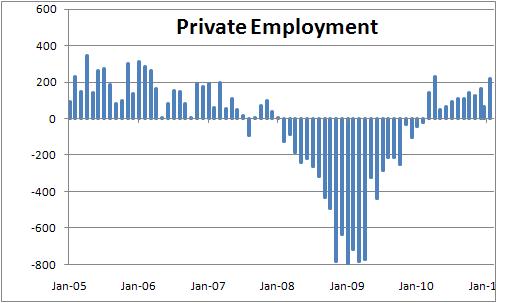
There are three reasons why we continue to anticipate additional labor market improvement . First, the economy is gathering momentum. GDP growth came in at 2.8% in the fourth quarter. Even with our downward revision to first quarter growth, we still expect GDP growth of 4.0% in the current quarter.
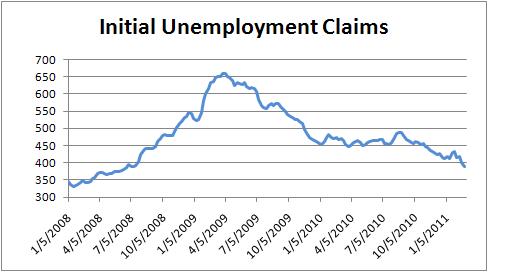
Second, initial unemployment claims are a measure of layoffs. As shown in the chart below, those layoffs continue to fall which means that the labor market is steadily gaining momentum. The most recent week showed claims at the 368 thousand mark. To put that in perspective, you have to keep in mind that this series rarely falls below 300 thousand. Thus, a 368 thousand level is impressive.
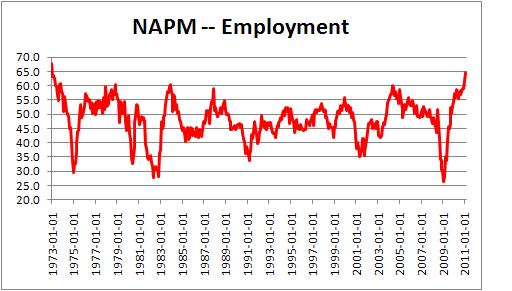
Third, the Institute for Supply Management publishes a monthly survey of conditions in the manufacturing sector. In February their employment index rose to 64.5. Take a look at the chart below. That index has not been at 64.5 since January 1973. That makes it the highest level in 38 years! Somebody is planning on hiring! This same group publishes a similar index for non-manufacturing. It, too, has risen but its level is merely the highest since January 2005. Any way you slice it, the employment outlook is improving rapidly.
The other factor of importance is that sales got hit so hard by the bad weather in January it is hard to recover in time for the first quarter average to come in where we thought it would. For example, if we expected sales of $100 per month in each month of a quarter, the quarterly average would be $100. But if bad weather reduces growth in the first month to $90, and the other two months come in at $100 each, then the quarterly average would be lowered to $97. The only way the math can work is if the sales rebound in the second month surges to $110. Everybody who did not buy in month 1, not only buys what they normally would have bought in month 2, but makes up for the January shortfall. That is possible, but is probably a tad optimistic.
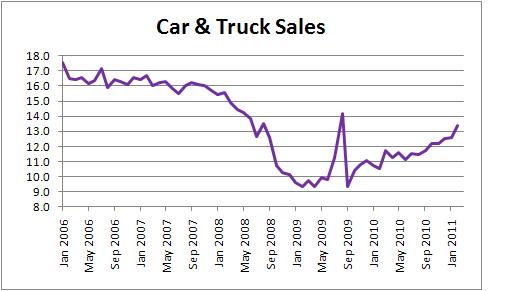
We do not yet know much about February sales, but we do know what happened to new car and truck sales in that month. Those sales surged to a 13.4 million pace in that month versus a selling rate of 12.6 million in January. That represents a sales jump of 6.4%. What goes into retail sales includes not just new cars, but used cars and car parts as well. We know nothing at this point about sales in those two categories. The new car sales gain is impressive, but whether it is sufficient to offset the loss of sales in January is unclear. We would like to think that it would, but that would probably put us in wishful thinking mode. For now we will opt for a slightly less aggressive first quarter GDP growth rate.
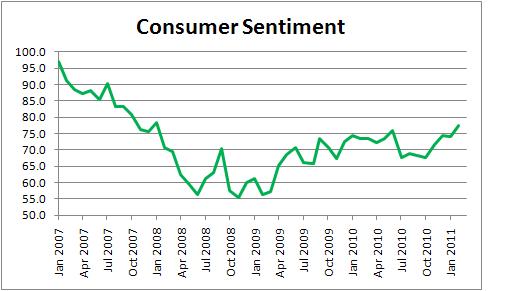
Last week we talked about oil prices and how the impact on the inflation rate and on GDP growth this year were probably going to be far smaller than what the markets feared. The one piece of evidence that suggests might be the case comes from the University of Michigan consumer sentiment survey. The index continued to climb in February from an already high level of 74.2 in January to 77.5. That places it at its highest level since the recession began in December 2007. Keep in mind that oil prices have been rising steadily since the end of September 2010 and are now 20% higher than where they began. The problems in Tunisia began in December, and the leader was ousted in January. The problems in Egypt began in January and Mubarek was overthrown in February. These events have all been dismissed by consumers who remain enthusiastic. Keep in mind that the University of Michigan publishes this sentiment measure twice a month. About mid-month they provide a preliminary estimate reading, and then they revise it at the end of the month. In this case the revised reading was higher than the preliminary reading, which suggests that confidence in the second half of the month was higher than the first. We may talk about these events a lot but, thus far at least, we are not worried them actually having any significant negative impact on the economic outlook for this year.
On balance, the economy is developing about the way that we thought that it would, but we want to temper our enthusiasm just a touch.
Stephen Slifer
NumberNomics
Charleston, SC
Follow Me