
April 5, 2012
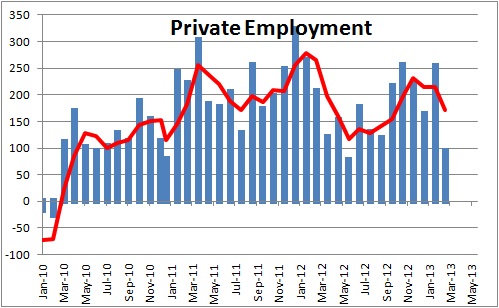
Private employment rose by 95 thousand in March which stands in sharp contrast to an average increase in the past three months of 214 thousand. Should we be concerned that after another strong start to the year that economic activity is once again beginning to fade — just as it did in 2011 and 2012? We do not think so.
Employment rose by 95 thousand in March which is the smallest increase since June of last year. A surprisingly small gain makes everybody nervous and raises questions about the pace of economic activity. But it is important to recognize that employment data frequently bounce around sharply from month-to-month. We need to see several months of soft data before we can conclude that employment growth is slowing.
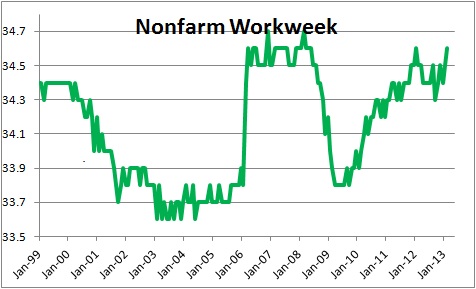
One reason we are not worried about a repeat of the 2011-2012 experience is because the workweek rose 0.1 hour in March from 34.5 to 34.6 hours. Every month firms can boost production by working existing employees longer hours or by hiring new workers. In March business executives primarily chose the former rather than the latter. Given that the workweek is as long as it ever gets, it makes no sense to conclude that the labor market is softening. The power of a 0.1 hour (or a 0.29%) increase in the workweek is profound. It has the same impact on production as the hiring of 325 thousand additional workers. To put that in other terms, if firms had chosen to boost output in March exclusively by additional hiring, we would have seen an increase in private sector employment for that month in excess of 400 thousand. There would not be a discussion about the economy slowing down if employment had increased by that magnitude.
It is important to understand why after a fast start the economy slowed so sharply in each of the past two years. In 2011 civil unrest in many North African countries boosted gasoline prices and curtailed spending, the tsunami in Japan interrupted the supply chain, and events in Greece made everybody nervous and confidence plunged. In 2012 the November election and concerns about the fiscal cliff at yearend as well as the looming sequester sharply curtailed business hiring and investment in the second half of the year. There were reasons why growth swooned in each of those years. None of those factors are present in 2013. And fears about the fiscal cliff and the sequester have proven to be unwarranted.
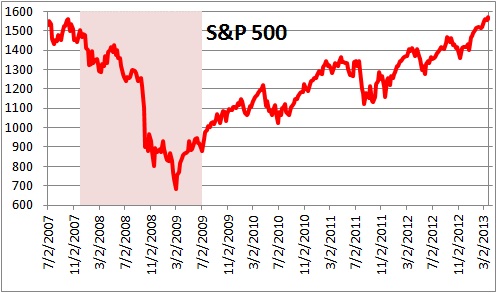
It is hard to imagine that the economy is in the midst of a slowdown when the stock market hits a new record high level every few days. The stock market should be performing well given a moderate pace of economic activity and near record low interest rates. It is no surprise that corporate America is experiencing record profits and has an unprecedented amount of cash to invest.
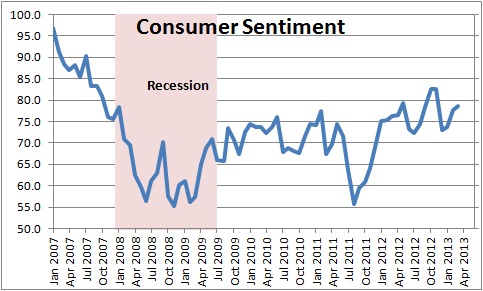
On the consumer side, the University of Michigan initially reported that consumer sentiment fell sharply from 77.6 in February to 71.8 in March. That could have been a problem. But upon receipt of additional data the University of Michigan subsequently indicated that consumer sentiment in March did not decline after all. Instead, it actually increased 1.0 point from 77.6 to 78.6. Presumably the initial decline reflected some initial concern that the sequester was going to substantially reduce the pace of economic activity, but that never materialized. With a respectable number of jobs being created each month and income on the rise, consumers continue to feel confident that economic activity will remain robust through the summer months.
By every metric the housing sector gathers momentum with each passing month. Sales are on the rise, home inventories are lean, shortages of available housing are boosting home prices which have risen 7.5% during the course of the past year are accelerating. Builders are stepping up production as quickly as they can to satisfy demand.
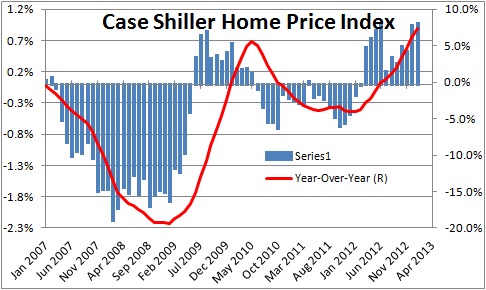
We understand that people are worried that because the economy slowed sharply in each of the past two years that it will happen again this year. But the slower growth for those years was triggered by events that are not present currently. Furthermore, the recent strength in the stock market, robust corporate earnings, and a rebounding housing sector, suggest that the soft employment report for March was an aberration and not the beginning of a new trend.
Stephen Slifer
NumberNomics
Charleston, SC
Follow Me