
March 17,2011
It has been a scary couple of months. First, oil prices skyrocket as turmoil spread throughout the Mideast. Then, the earthquake and tsunami in Japan has created the possibility of a serious radiation leak. These events will have only a minimal impact on U.S. GDP growth.
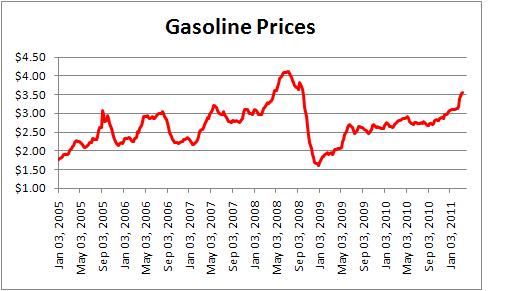
First of all, gasoline prices have risen 32% since the end of September and now stand at $3.56 a gallon. But oil output from Tunisia, Egypt, and Libya combined only account for 3% of global oil output. Clearly, there is a fear that Mideast unrest will spread to major oil producers in the region – Saudi Arabia, Iran, Iraq, and the United Arab Emirates. Is that going to happen? Probably not. After their giddy success in Tunisia and Egypt in ousting unpopular rulers, the students took on Kahdafi. Rightly or wrongly, the rest of the world did nothing to support the cause of the rebels and Kahdafi appears to have squashed the rebellion. In Bahrain the rulers apparently asked for military help from the Saudis to suppress a budding rebellion in that country. Unfortunately, in these cases, might makes right. As a result, students in other countries throughout the region are likely to re-think their willingness to protest. If so, the market’s fear of widespread rebellion in the region is overdone. At some point, that should translate into a sharp drop in gasoline prices.
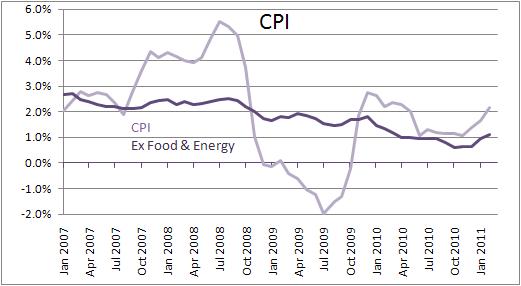
The CPI jumped 0.5% in February in response to surging food and energy prices, and has now risen 2.2% in the last twelve months. Economists typically dismiss such gains and focus on the more stable “core” rate of inflation. They do this because the overall index frequently rises and falls rapidly. As a result, it is difficult to determine the underlying rate of inflation. Most of the time rising food and energy prices prove temporary and quickly reverse direction, in which case our policy makers — the Federal Reserve — should not respond. If the gains become so long-lasting that they threaten to spill over into rising prices in the remainder of the economy, the Fed will be forced to act. But if the situation in the Mideast calms down and the recent run up in energy prices proves to be temporary, the Fed’s lack of response is appropriate.
The earthquake in Japan and subsequent tsunami, will prove to be a temporary setback to GDP growth in Japan. Because many factories have shut down and will face power shortages in coming months, GDP growth in the first half of 2011 will fall dramatically. However, much of northern Japan needs to be rebuilt which will sharply boost GDP growth in the second half of this year and in 2012. That is the way natural disasters impact the economy. There is an initial loss of life and significant property damage, but the subsequent rebuilding process breathes new life into the economy. Keep in mind, too, that many of the materials they will need in the re-building stage will come from the U.S. Europe, and elsewhere in Asia.
The damage to the nuclear power plants in Japan is frightening and still not under control. But, thus far, the radiation leaks have been small and concern is limited to an area within 12 miles of the reactor. The experts seem to agree that this situation is a regional problem, not a global problem. Japanese nuclear plants have survived a 9.0 earthquake – the most devastating ever in Japan and the fifth largest on record anywhere — and the subsequent tsunami, with minimal radiation leakage. Going forward, both the Japanese and the rest of the world can learn how to construct even safer plants.
From where we sit the U.S. economy remains relatively robust. The stock market has fallen only about 5%. It declined 14% a year ago in response to the debt problems in Greece and elsewhere and survived with just a single quarter of reduced growth. Since that time consumers have paid down considerable debt, the economy has begun to produce a significant number of new jobs, and corporate America is sitting on a pile of cash just waiting to get spent.
Rest easy. The world is safe.
Stephen Slifer
NumberNomics
Charleston, Sc
Follow Me