
June 29, 2012
Consumers and small business owners continue to complain that banks are not making credit readily available. But there are two parties involved in any loan – the borrower and the lender. Does the problem lie exclusively with the banks? Or could it be that consumers and small businesses remain reluctant to borrow?
Business loans. The Federal Reserve conducts a quarterly survey of bank lending practices. Over the course of the past year most lending officers have experienced a pickup in demand for commercial and industrial loans. And while they do not indicate any particular loosening of standards on their part (shown below), the reality is that consumer and industrial loans have been rising at an impressive 13% pace over the course of the past year with both large and small banks contributing to the upswing. While they are certainly not throwing money at any borrower that walks in the door, it is clear that banks have become far more willing to make business loans today than they were a year ago. In this case both parties to the transaction are willing participants. The borrower needs money, and the bank is relatively willing to comply.


Consumer loans. In the case of consumer lending, the bank lending officers’ survey indicates that banks are far more willing to make consumer loans. Indeed, the net percentage of banks more willing to make such loans is currently about 25%.
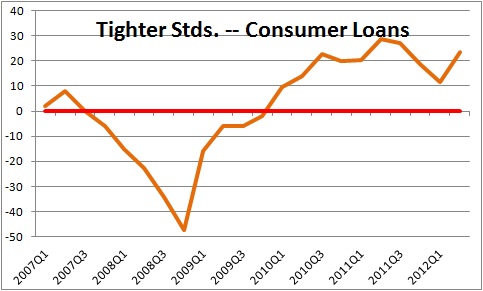
But yet consumer loans made by banks have increased only slightly — about 2.5% — over the course of the past year. In would appear that in the case of the consumer the bank is eager to extend credit but, for whatever reason, consumers remain reluctant to borrow.

Let’s take this analysis one step farther and look at consumer credit more generally, which includes consumer loans made by banks but also credit made available to the consumer by other types of institutions like finance companies, credit unions, non-financial businesses and the Federal government. Consumer credit has been growing at a relatively rapid 5% pace over the course of the past year. Included in this category would be credit card debt as well as car loans, boat loans, personal loans, and student loans.
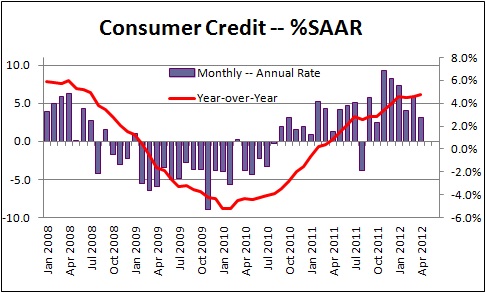
Given the recent 5% rate of expansion, it would appear that consumers may not so be so credit shy after all. Upon closer inspection it turns out that the entire increase in consumer credit has occurred in a single category – student loans. Since the end of 2008 student loans made by the Federal government (the blue bars in the chart below) have risen from $100 billion to $450 billion.
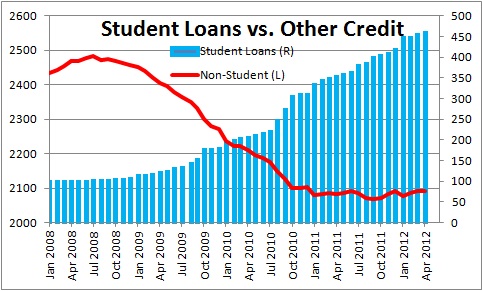
This growth in student loans is perfectly understandable and obviously reflects the weakness in the labor market. Graduating high school seniors can’t find a job so they go to college. Graduating college seniors also unable to find a job continue on for an advanced degree. Unemployed workers seek to upgrade their skills. But growth in this particularly loan category should be regarded as a sign of economic weakness rather than strength.
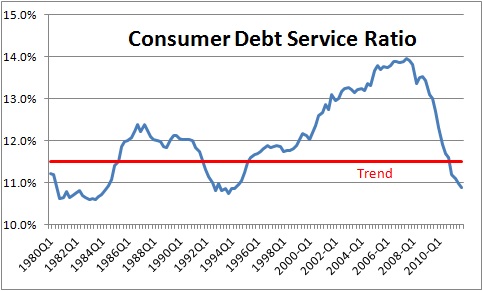
All other types of consumer credit have been essentially unchanged for more than a year. The consumer is perfectly capable of taking on additional debt as evidenced by the fact that his/her debt service ratio is below the average of the past 30 years, and banks are increasingly willing to extend credit. But the consumer is not yet ready to borrow. Perhaps their experience with excessive debt in the first half of the last decade left a bad taste in their mouths. Maybe they look at the still high level of the unemployment rate and are concerned that their job could be next. Perhaps they worry about the financial situation in Greece and elsewhere in Europe and are concerned that it could spill over into the U.S. Or maybe even they worry about the so-called “financial cliff” that is supposed to occur at the end of this year. Whatever the reason it is clear that consumers, unlike business people, are not yet ready to take on additional debt. Their time will come, but they are not there yet.
Stephen Slifer
NumberNomics
Charleston, SC
Follow Me