
September 19, 2014
The Federal Reserve began to gradually reduce its pace of bond purchases in January. At the beginning of the year it was purchasing $85 billion a month of U.S. Treasury securities and mortgages. It has reduced its purchases by $10 at every FOMC meeting throughout the year and will eliminate the bond purchase program entirely on October 29. As the Fed reduced its purchases of U.S. Treasury securities and mortgages, most economists expected long-term interest rates to rise. Instead, the yield on the 10-year note declined 0.5% from 2.9% at the end of last year to 2.4% currently. What happened? What’s next?
The Fed lowered short-term interest rates to zero percent in December 2008. That exhausted its ability to stimulate the economy using conventional monetary policy which utilizes short-term interest rates. Because the economy remained under pressure and threatened to slip into a full blown depression, the Fed began to pursue unconventional measures to help get the economy back on track. By purchasing long-dated U.S. Treasury securities and conventional mortgages for the first time ever, the Fed hoped to lower long-term interest rates and provide support for the beleaguered housing sector. And, indeed, long rates declined rapidly. The yield on the 10-year Treasury note fell from 3.5% at the time the Fed began its so-called “quantitative easing” to a low of 1.5%. However, in June of last year when the Fed announced its intention to slow its pace of bond purchases long rates quickly jumped to 2.9%.

But then something odd happened. As the Fed actually began to reduce its bond purchases in January of this year, the yield on the 10-year note declined from 2.9% to 2.4% which puzzled most economists. How could this happen?
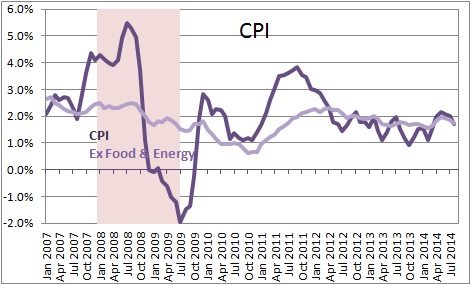
Typically, long rates move in lock step with inflation and/or inflation expectations. But the core CPI (excluding the volatile food and energy categories) has changed very little during the course of this year. It was rising at a 1.7% pace at the end of last year and remains at 1.7% currently so something else must be happening. In this particular situation, the net issuance of Treasury securities has been steadily shrinking.
Think of it this way. The budget deficit for 2009 was $1.4 trillion. To finance this budget deficit the U.S. Treasury had to issue an equivalent $1.4 trillion of Treasury securities. But the Fed was purchasing $45 billion of Treasury securities every month or $0.5 billion during the course of a year. That means that $0.9 billion of Treasury securities was available for purchase by bond funds and individual investors.
In the subsequent five years the budget deficit has been steadily shrinking as the wars in Iraq and Afghanistan have come to a close, but Fed purchases have remained the same. This means that in fiscal year 2014 the budget deficit narrowed to $0.5 billion while Fed purchases remained at $0.5 billion. Thus, the Fed purchased the entire amount of issuance that the federal government presented to the market. No wonder the yield on the 10-year note fell by 0.5% from 2.9% to 2.4% during the course of this year.
As we move into a new fiscal year on October 1 that situation will change. The budget deficit for fiscal 2015 is expected to be $0.4 billion; Fed purchases will drop to zero. Thus, net issuance of Treasuries will be $0.4 billion compared to $0.0 billion in the prior fiscal year. As a result the yield on the 10-year note should rise. Our expectation is that by yearend the yield on the 10-year note will have climbed slightly to 2.8% and will continue to increase slowly in the first half of next year to 3.1%.
By the middle of next year the Fed will begin raising short-term interest rates. By the end of 2015 the federal funds rate should have risen from 0% currently to 1.25%. This will also help to push long-term rates higher. By the end of next year the yield on the 10-year note should be about 3.5%.

While the decline in long-term interest rates in 2014 was a surprise, it is almost certain that the current 2.4% rate will prove to be its low point as the combination of faster GDP growth, less slack in the labor market, and increased Treasury issuance will ultimately induce the Fed to push rates higher.
Stephen Slifer
NumberNomics
Charleston, SC
Follow Me