
January 21, 2011
Ever heard of him? Probably not. He is one of those unsung, hard-working Fed officials who are trying hard to keep our economy on an even track — he happens to be President of the Federal Reserve Bank of Dallas. He gave a speech earlier this month which was one of the most refreshing and insightful talks I have heard – ever. Want a few highlights? Try these:
“The new Congress and the new staff in the White House have their work cut out for them. You cannot overstate the gravity of their duty on the economic front. Over the years, their predecessors – Republicans and Democrats together – have dug a fiscal sinkhole so deep and so wide that, left unrepaired, it will swallow up the economic future of our children, our grandchildren and their children.”
“After much debate – which included strong concern expressed by one member with a formal vote and others, like me, who did not have voting rights in 2010 – the FOMC collectively decided in November to temporarily undertake a program to purchase U.S. Treasuries that, when added to previous policy initiatives, roughly means we are purchasing the equivalent of all newly issued Treasury debt through June.”
“The entire FOMC knows the history and the ruinous fate that is meted out to countries whose central banks take to regularly monetizing government debt. European Central Bank President Jean-Claude Trichet said it best: ‘Monetary policy responsibility cannot substitute for government irresponsibility.’ “
“But here is the essential fact I want to emphasize today. The Fed could not monetize the debt if the debt were not being created by Congress in the first place. Those lawmakers who advocate “Ending the Fed” might better turn their considerable talents toward ending the fiscal debacle that has for too long run amuck within their own house. The Fed does not create government debt; fiscal authorities do.”
He then goes on to present the chart shown below which looks at employment growth by Fed district over the past 20 years.
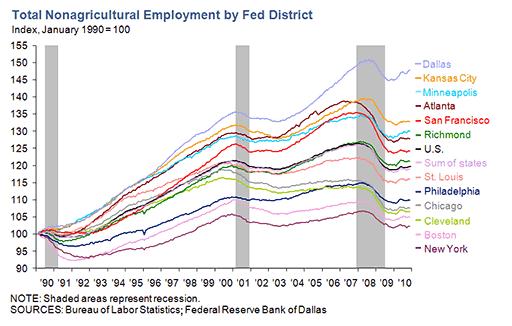
Which district is right at the top – Dallas? President Fisher then points out:
“Monetary policy is uniform across the 50 states; the base rate of interest paid on a business or consumer loan or a mortgage in Michigan, California, Ohio, or New York is the same as that paid in Texas. Yet there is a reason that Michigan and California each lost more than 600,000 jobs over the past decade while Texas added more than 700,000 over the same period.”
“That reason has nothing to do with monetary policy. It has everything to do with the taxation and fiscal and regulatory policies of the states. However, well-meaning tax and regulatory initiatives in the laggard states may have been when they were conceived and levied, they have had unintended consequences that have led to economic underperformance and job destruction.”
“None of my business contacts, large or small, publicly held or private, are complaining about the cost of borrowing, the lack of liquidity, or the availability of capital. All express concern about taxes, regulatory burdens and the lack of understanding in Washington of what incentivizes private sector job creation. All are stymied by a Congress and an executive branch that have appeared to them to be unaware of, if not outright opposed to, what fires the entrepreneurial spirit.” While Fisher does not specifically identify measures that might be curtailing employment growth, he is almost certainly expressing concern about the potential for increases in the corporate tax rate, cap and trade initiatives, and the cost to business of recently enacted legislation regarding health care and unemployment benefits.
While I have never quoted so extensively from a single source, I found President Fisher’s thoughts so compelling, inspiring, eloquent, and spot on, that I felt obliged to share them. Thank you Richard Fisher.
Over the course of the next several months our leaders in Washington, at both ends of Pennsylvania Avenue, will debate and decide the path of government spending and taxation for years to come. Their challenge is daunting. The path ahead will be painful and difficult choices must be made, but we cannot just keep kicking the can down the road. The time for procrastination is past. Fortunately, Americans seem to possess an indomitable spirit which, in the end, enables them to make those tough decisions. We have done it on many occasions in the past. We will do it again.
President Fisher’s full speech can be found on the Dallas Fed’s website at:
http://www.dallasfed.org/news/speeches/fisher/2011/fs110112.cfm
Stephen Slifer
NumberNomics
Charleston, S.C.
Follow Me