
December 17, 2010
As we approach Christmas we find clear cut evidence that the economy is finally gathering momentum. While there have been many pieces of good news lately, one that stands out is the retail sales report that was released this past Tuesday. Not only did sales rise a solid 0.8% in November, but there were upward revisions to September and October as well. Indeed, in the past three months retail sales have been growing at a torrid 13.9% pace. It doesn’t ever get much faster than that. In addition, the cut in the payroll tax, which will be a part of the budget package passed by Congress before Christmas, will add about 0.5% to GDP growth next year.
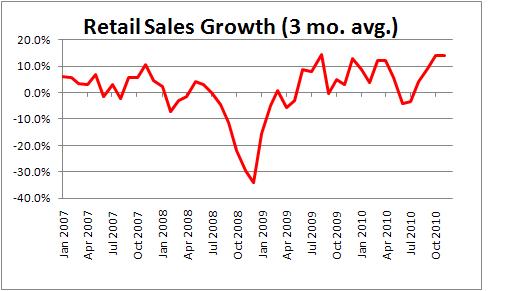
These new tidbits of information do a number of things.
1. First, third quarter GDP will revise upwards to something very close to 3.0%. Thus, we will learn that the economy was growing quite a bit faster than the initially report 2.0% figure was released at the end of October.
2. Second, the strong retail sales performance in October and November, coupled with a surprising shrinkage in the trade deficit for October (which adds to GDP growth), make it clear that fourth quarter GDP growth will be far stronger than most economists had anticipated. We have revised our estimate upwards from 3.7% to 4.2% as a result.
3. Third, it is not clear the extent to which this growth spurt at the end of 2010 will affect growth in 2011. We have GDP growth next year pegged at 4.0% which is the highest forecast we have seen, and we are inclined to leave it there. But, as noted earlier, our inclination would be to raise that forecast because of the cut in the payroll tax. If we played this absolutely straight, we might be inclined to raise our forecast by another 0.5% or so. But, as you all know, the economy always grows in fits and spurts, and we will undoubtedly hit a bump in the road some time during 2011, so we do not want to go too crazy revising upwards our growth estimates.
If the economy accelerates to this extent next year, lots of good things are going to happen:
1. Firms of all sizes and types will see sales accelerate and profits climb.
2. The increase in corporate profits will boost the stock market which will, in turn, bolster both consumer and business confidence.
3. Firms will respond by hiring more people. Job growth will quickly accelerate from 100 thousand per month currently to about 250 thousand per month. That will, in turn, cause the unemployment rate to decline and by yearend 2011 reach 8.7% versus 9.8% currently.
4. That additional job growth will boost income, which will further stimulate spending, which will encourage more hiring, etc.
5. As the economy grows more quickly firms will boost their capital spending – still more stimulus to GDP growth.
In short, the economy will have moved into that virtuous phase where good things spawn more good things.
If we get GDP growth at the speed we anticipate, don’t we have to worry about the Fed raining on the parade in the second half of next year by raising interest rates? Not likely. The Fed, as you know, has embarked on a plan – affectionately known as QE2 – to further stimulate the economy by buying long-dated U.S. Treasury securities. Indeed, they plan to purchase $600 billion of such securities between now and June 30. The idea was to purchase these securities and thereby push long-term interest rates lower. Thus far it hasn’t worked. Look at the yield on the Treasury’s 10-year note. Prior to the Fed’s announcement, the 10-year was trading at 2.5% in October. Today it has backed up all the way to 3.4%.

The same kind of thing has happened to mortgage rates. They had been about 4.25%. Now they are 4.6%. It is not a dramatic rise, but it is in absolutely the opposite direction of what the Fed intended.

So what gives? First of all, it highlights the fact that the Fed may have very tight control over the overnight Federal funds rate, but it has no control over longer-term interest rates. Second, the Fed may think the economy needs additional stimulus, but the market does not agree. Presumably, the backup in rates has occurred because bond holders think that the economy is doing just fine and that the Fed is inappropriately adding fuel to a fire. At some point they worry that the additional stimulus will spill over into inflation – hence, the backup in long-term interest rates.
So who is right? We have argued for some time that the economy is growing sufficiently rapidly that it does not need additional help. Hence, we disagree with the Fed’s action. But it really does not matter who is right. If the Fed continues to purchase Treasury securities it runs the risk of backing up longer-term interest rates to a point where the economy grows more slowly because of the higher interest rates. That is the exact opposite of what the Fed intended. Thus, we expect the Fed to stop buying Treasury securities by February or March of next year which may have the unintended (but desirable) result of actually pushing long rates lower.
Stephen Slifer
NumberNomics
Charleston, SC
Follow Me