
February 14, 2014
Following four consecutive years with budget deficits in excess of $1.0 trillion, the deficit for fiscal 2013 shrank to $680 billion. This year it should be $500 billion. It is tempting to conclude that the worst is over and budget problems will simply go away. Unfortunately, retiring baby boomers guarantee that will not be the case. Eventually the President and Congress still need to take action. But with budget deficits well in check for the next several years nothing of consequence is going to happen until after the 2016 Presidential election.
The projected deficit of $500 billion this year represents 3.0% of GDP which equals its average over the past 40 years. By 2016 the deficit once again begins to climb and reaches 4.0% of GDP by 2024 but that still does not appear to be ominous.
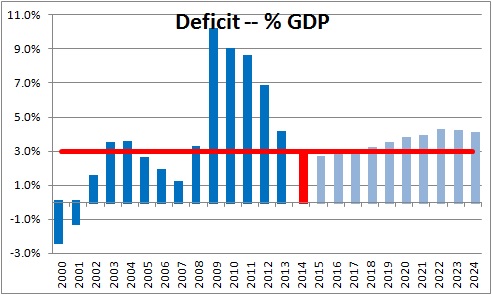
However, the Congressional Budget Office anticipates that GDP will grow continuously from now until 2024. That almost certainly is not going to happen. This expansion began in June 2009. The longest expansion on record lasted exactly 10 years. For the economy to continuously grow through 2024 implies that this particular expansion will last a record-breaking 15 years. That is not a very good bet. If the economy slips into recession revenues will decline, expenditures will rise, and the deficit and debt outstanding will grow accordingly.
The real problem for the budget deficit occurs beyond the 2024 forecast period. The long-range budget forecast done in September showed the budget deficit climbing to 6.5% of GDP by 2038 which is more than double its 40-year average.
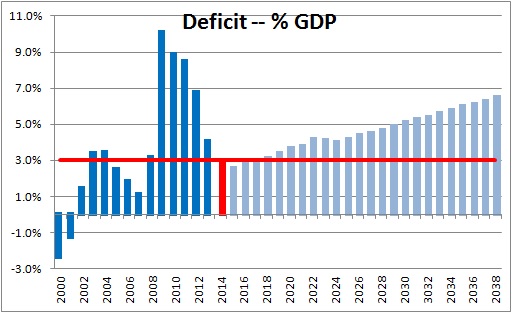
The deficit explodes largely because the baby boomers are retiring. As each year passes more and more of them begin to collect Social Security benefits and become eligible for Medicare. An aging population and the rising cost of health care will create budget problems for another 25 years. As a consequence government spending is projected to reach 26% of GDP by 2038 compared to an average of 20.5% over the past 40 years. It has not been that high since the end of World War II.

This sharp increase in spending is being driven by the major health care programs like Medicare and Medicaid, Social Security, as well as interest payments on the public debt. All of those expenditures fall into the “mandatory” spending category. Indeed, such programs will climb to 14% of GDP which is twice the 7% average of the past 40 years. In contrast, “discretionary” spending (which includes defense spending, highway construction, foreign aid, housing, education, and the like) will drop to just 7% of GDP which will be the smallest share of the economy since the 1930’s. To a large extent that drop-off in discretionary spending reflects the impact of the sequester.
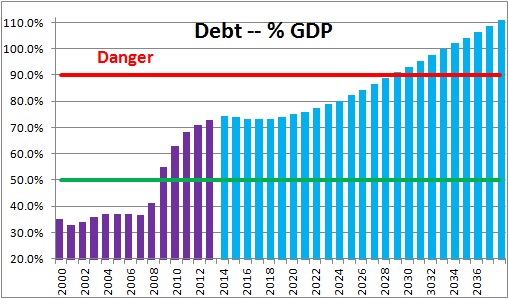
Every time the country runs a budget deficit the Treasury must issue an equivalent amount of debt to finance it. If we have a $1.0 trillion budget deficit, the outstanding debt climbs by $1.0 trillion. That brings up an even bigger problem. Debt is projected to climb to 110% of GDP by 2038. Economists generally believe a debt/GDP ratio of anything higher than 90% can be a problem for a variety of reasons. First, when the debt is that large the government has far less flexibility to use tax and spending policies in the event of some unexpected challenge. Second, interest payments will become a progressively larger chunk of total expenditures. Third, there is some risk of a financial crisis – like Greece, or Portugal, or Ireland — if investors worry about the ability of the U.S. government to repay its debts. They could demand very high interest rates to compensate for that risk.
Somewhere along the line our policy makers in Washington must make significant policy changes. The problem is clearly on the expenditures side. The various entitlement programs like Social Security and Medicare are spiraling out of control. Congress could reduce Social Security benefits for wealthier recipients, gradually increase the retirement age to 68, and/or increase the payroll tax maximum from $117,000 currently to perhaps $150,000. They could also raise the eligibility age for Medicare to 68, cut back the generous benefits offered by Obamacare, and take other compensation into consideration before awarding judgments in malpractice suits. There is much that can be done to resolve these issues. What is needed is the will to do so. Unfortunately, given shrinking budget deficits for the next several years and the inability of our government to act other than in a crisis, it is hard to envision any action to address these issues prior to the 2016 election.
Stephen Slifer
NumberNomics
Charleston, SC.
Follow Me