
September 11, 2015
Fiscal year 2015 ends on September 30. That means that the budget deficit, debt outstanding, and a possible government shutdown will be back in the news. Forecasts of a yawning budget gap towards the end of this decade and beyond have not changed. Congress and the president need to develop a long-lasting budget solution. Unfortunately, that will not happen this year. They will kick the can down the road and produce another band aid in the form of a “continuing resolution” to fund government spending for this coming year. Let the next president deal with the real issue.
The budget deficit for fiscal 2015 will be about $410 billion. In contrast to the series of $1.0 trillion deficits in the years shortly after the recession that seems tame. It amounts to 2.3% of GDP. Economists would like to see an annual budget deficit be less than 3.0% of GDP. So far so good. But problems are lurking.

First, the budget gap will gradually climb and exceed $1.0 trillion by 2025. Deficits of that magnitude will approach 4.0% of GDP by 2025 and climb further to 6.0% of GDP by 2040. Why? Because each year another batch of baby boomers will retire and become eligible to receive Social Security and Medicare benefits.
Second, the Congressional Budget Office assumes real GDP growth of 2.3% this year, 3.0% in 2016 and 2017, and 2.1% in the years beyond. But to achieve growth of that magnitude in the out years the CBO needs productivity to accelerate from 0.3% in the past three years to 1.6%. If GDP growth in 2016 or 2017 fall short of 3.0%, or growth in the out years is less than 2.1%, then the revenue side of the CBO’s forecast is too optimistic and the projected budget deficits will be larger than anticipated.
Third, CBO anticipates steady GDP growth for the next decade. But this expansion began in mid-2009. If the economy continues to grow until 2025 that implies that the expansion will have lasted 16 years. Given that the longest expansion on record is exactly 10 years that may be an unrealistic forecast. Once the economy slips into recession tax revenues decline, government spending (on unemployment benefits and welfare payments in particular) increases, and the budget deficit surges. We have not eliminated business cycles. At some point a recession is inevitable. When that happens the projected budget deficits will soar.
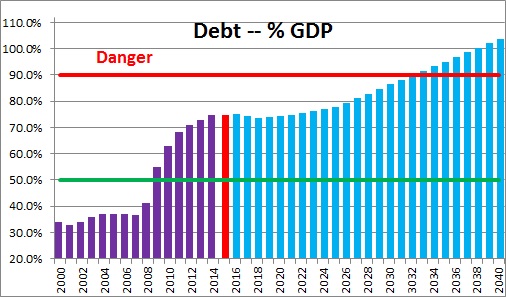
Finally, whenever the government runs a budget deficit, the Treasury must issue an equivalent amount of debt to finance that deficit. Between now and 2025 that ratio rises slightly from 74% to 79% of GDP. The real problem is beyond the 2015-2025 forecast period. By 2040 that ratio is projected to climb to 103% of GDP. Economists consider a ratio of 50% to be sustainable and a deficit in excess of 90% of GDP to be problematical. It seems clear that our policy makers need to do something to address the issue. They can raise taxes, cut spending, or some combination of the two.
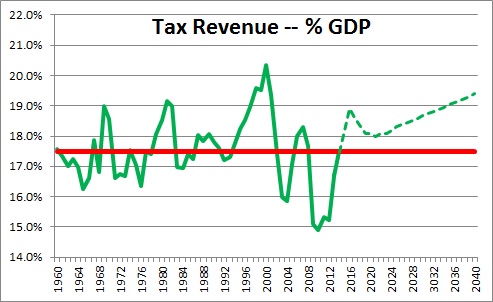
The difficulty is not on the revenue side. Tax revenues currently are 18.2% of GDP compared to an average of 17.5% in the past 40 years. They are projected to rise to 19.5% of GDP by 2040. It is hard to imagine that raising taxes represents a solution to the widening budget gap.
The problem is on the spending side. Expenditures as a percent of GDP currently are 20.6% of GDP which is in line with its long-term average of 20.7%. However, they will rise to 22% of GDP by 2025 and climb further to 25.3% of GDP by 2040 in large part because of the aging population and rising health care costs which boost Social Security and Medicare spending dramatically. Such spending is on an unsustainable upward trajectory.

While the current budget deficit is acceptable it is not going to stay that way. Both the budget deficit and debt outstanding as a percent of GDP will increase between 2015 and 2025, and escalate dramatically between 2025 and 2040.
There are many issues the next president will need to address. Amongst them is the growing budget deficit and outstanding government debt. We must require every presidential candidate to tell us how he or she plans to address this issue.
Stephen Slifer
NumberNomics
Charleston, SC
Follow Me