
April 26, 2013
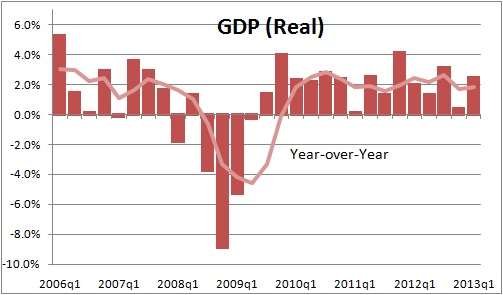
First quarter GDP growth quickened to 2.5% from an anemic 0.4% pace in the prior quarter. Three important points are worth noting.
- Hurricane Sandy was responsible for a significant portion of the dramatic swing in growth between the two quarters.
- Government spending – defense spending in particular – weighed heavily on growth in both quarters as the Iraq war comes to an end. The private sector grew at an impressive pace in each of the last two quarters.
- The economy has shrugged off numerous headwinds during the past three years but still continues to plod along. Its pace is not impressive, but given the obstacles it has encountered and overcome we remain impressed. In the absence of further problems growth should quicken in the quarters ahead.
GDP growth accelerated in the first quarter to 2.5% after nearly stalling in the fourth quarter as growth slipped to 0.4%. The impressive first quarter pickup creates an impression that the economy gathered considerable momentum, but that is not entirely accurate. In reality, Hurricane Sandy was responsible for a large portion of the dramatic swing in growth between the two quarters as inventory levels fell sharply in the fourth quarter and subtracted 1.5% from GDP growth, but then rebounded in the first quarter and boosted growth by 1.0%.
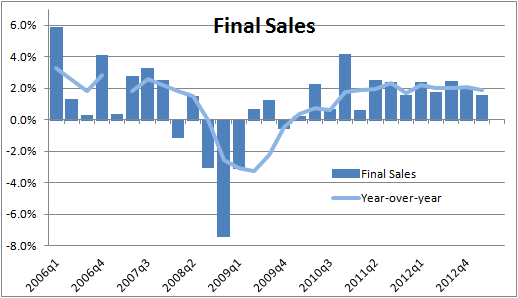
Final sales are GDP less the change in inventories. It turns out that final sales grew at a 1.9% pace in the fourth quarter followed by 1.5% in the first. Hence, growth between the two quarters was actually quite stable. But with growth in both quarters less than 2.0% one might conclude that the pace of expansion was anemic. That is also not quite accurate.
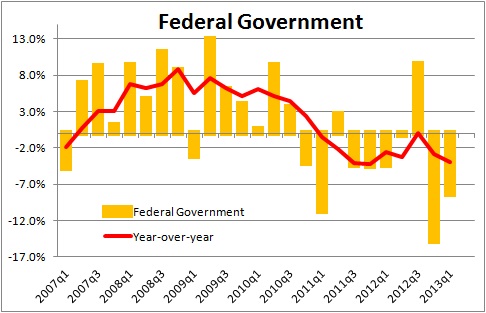
With the war in Iraq coming to a close late last year federal government spending – defense spending in particular – plunged. Government spending reduced GDP growth by 1.4% in the fourth quarter and an additional 0.8% in the first. Thus, private sector growth was 1.8% late last year and 3.3% in the first quarter with the swing in growth largely attributable to Hurricane Sandy. As we see it, the private sector has been slogging along at a 2.5% pace. Keep in mind that while a cutback in government spending reduces the pace of economic expansion, it simultaneously reduces our bloated budget deficit which is a good thing.
Looking back over the past several years think of the adversity our economy has faced — and shrugged off. In 2010 the financial crisis in Greece began. The problems spread in subsequent years to Portugal, Ireland, Spain and Italy. In 2011 there was the Arab spring when governments were overthrown in Egypt and Libya. Oil prices surged. The tsunami and nuclear disaster in Japan interrupted the supply chain and prevented U.S. manufacturers from getting the parts they needed. In late July the contentious debt ceiling debate and near default by the U.S. Treasury caused consumer confidence to plunge. In 2012 uncertainty about the election in November and the “fiscal cliff” caused U.S. firms to sharply curtail their hiring plans and investment spending in the second half of the year. Late last year and in the first quarter of this year defense spending plunged as the war in Iraq came to a close. And yet, despite all this, the economy continues to plod along.
Throughout that period of time the economy has chugged along at roughly a 2.0% pace. Economists do not incorporate into their forecasts political difficulties — like those currently being experienced in Europe, the problems in the Middle East, or fiscal policy blunders like we have had in the U.S. Nor do economists have the ability to foresee natural disasters like tsunamis or hurricanes. As a result, growth has typically fallen short of what the profession had expected and the American public has been disappointed. But in the face of the obstacles noted above we find a fairly steady 2.0% pace impressive.
Looking ahead, growth will continue to be supported by the rising stock market which boosts net worth, the sharp rebound in the housing sector which is pushing home prices higher, monthly employment gains of roughly 200 thousand which raises consumer income and reduces the unemployment rate, the rebuilding of farm inventories following last year’s drought, robust corporate earnings and record cash. In the absence of further political or natural disasters, the pace of economic expansion should continue to quicken as the year progresses.
Stephen Slifer
NumberNomics
Charleston, SC
Follow Me