
June 23, 2017
Here we go again. Every year we go through the same useless exercise of raising the debt limit. First, Congress votes to spend money. Then, the Treasury tries to pay its bills but eventually bumps up against a constraint on how much debt it can issue. It announces that the “debt limit” must be raised so that it can continue to pay its bills. Finally, Congress is horrified! It declares that expenditures must be slashed to curtail this runaway spending!
But wait a minute! Congress authorized that spending when it passed its budget for that year. In that process Congress authorizes each government agency to spend a certain amount of money. If Congress believes that government spending is excessive – and it is – it should use the budget process to rein it in. Congress should not vote to spend money, and then slap the Treasury’s hands when it is forced to borrow to finance the previously-authorized spending. That makes no sense. The debt limit is a superfluous piece of legislation that chews up endless days of negotiation and wasted time. In the end the debt limit is raised. Every year. And it will be raised again this year.
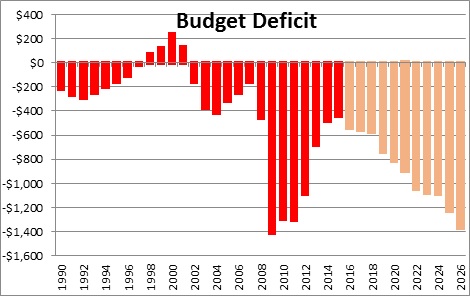
The most important thing to know about the budget process is that when Congress approves a budget that will result in a deficit of, say, $500 billion, the Treasury must issue an additional $500 billion of debt to finance that deficit. Thus, debt outstanding is cumulative. It increases every single year that the U.S. government incurs a budget deficit – which is to say that it increases annually. For the current fiscal year the Treasury faces an estimated budget deficit of $585 billion and will issue that amount of additional debt. The Treasury estimates that it will reach the statutory debt limit by early September.
Each month, in addition to its regular bills, the Treasury must pay off maturing securities and the interest on the remaining debt outstanding. If it cannot do so, it will default on its debt obligations. That has never happened. Why? Because a default by the Treasury would be unthinkable. If it becomes unable to pay its debts the Treasury would have to pay a higher interest rate on future debt because investors – both foreign and domestic — would demand higher interest rates given the possibility of default. Confidence in U.S. Treasury debt as a safe haven in times of uncertainty would be shaken. Foreign investors could reduce their willingness to buy U.S. debt.
Because the president and members of Congress are well aware of these potential adverse consequences the Treasury is not going to default. Congress will raise the debt limit in the nick of time.
Increasing the debt limit has become an almost annual ritual. It has been raised 72 times since 1960, of which 18 occurred between 2001 and 2017 and the Treasury has never defaulted on its debt. And it is not going to happen this year. Having said that, negotiations will continue right up to the last minute and make us all nervous. Nancy Pelosi and the House Democrats say they will not increase the debt ceiling to finance tax cuts for the rich. Senate Republicans want a vote on the debt ceiling in July, but that comes at the exact same time that it wants a vote on its proposed health care legislation. In September the administration would like to turn its attention to its proposed cuts in individual and corporate income taxes. These issues could become politically entangled. We do not know exactly how this will play out but, most likely, at the last possible moment there will be a temporary increase in the debt limit.
The bottom line is, be prepared for some scary headlines during the next two months about a possible default by the Treasury on its debt obligations and a potential government shutdown. The stock market could get hit. Consumer confidence might decline. But rest assured the Treasury is not going to default on its obligations and, once the debt limit is raised, the potentially nasty near term consequences will be quickly reversed.
We wholeheartedly support the notion of cutbacks in government spending in order to shrink future budget deficits which are projected to climb from $585 billion today to $1.4 trillion by 2026. But Congress should have the courage to make the required spending cuts during the budget process. Then eliminate the debt ceiling requirement entirely. It is not only distracting, it is unnecessary. It does nothing to actually constrain government spending.
Stephen Slifer
NumberNomics
Charleston, S.C.


another great article, Steve