
March 25, 2016
At the beginning of this year the widespread expectation was that the dollar would continue to strengthen. That made perfect sense. The Fed would continue to gradually raise interest rates while central banks elsewhere attempted to push rates lower. At the same time expected U.S. GDP growth of 2.4% was stronger than likely growth in Europe or Asia. Both factors would cause foreign investors to pour money into dollar denominated investments. But, alas, it has not worked out that way – at least thus far. The dollar declined in both February and March and is now roughly where it stood at yearend. What happened? To what extent does that alter the economic outlook for the months ahead?
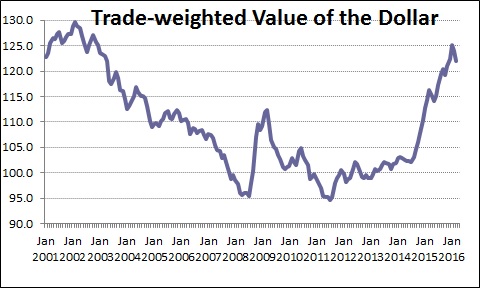
Given the timing of the dollar’s decline it appears to reflect the Fed’s less aggressive pace of tightening. Data made available following the March FOMC meeting indicated that the Fed has pulled two 2016 rate hikes off the table. Rather than a yearend funds rate of 1.4% it now expects that rate to be just 0.9%. With fewer rate hikes presumably on tap, the dollar declined 2.5% in February and March. This is not a huge decline, but it is clearly different from what had been expected. Whether that is important or not depends upon the actual pace of Fed tightening in the months ahead (not what the Fed thinks its pace of tightening is likely to be in mid-March).
The 20% increase in the value of the dollar between mid-2014 and the end of last year made U.S. goods more expensive for foreigners to purchase which caused exports to decline in 2015 and the trade component to subtract 0.6% from GDP growth for the year. At the same time the strength of the dollar caused commodity prices to decline 2.3% in 2015 and reduced the CPI inflation rate by 0.8%. Thus, the sharp increase in the value of the dollar reduced both GDP growth and inflation in 2015.
At the beginning of this year (for the reasons cited above) we expected the dollar to increase an additional 7% this year which would presumably reduce GDP growth by about 0.3%. Given that it has been essentially unchanged in the first three months of 2016, how much should we modify the forecast? Answer: Very little.
The reason for that is that we are concerned about the inflation outlook this year. The 0.8% increase in the CPI for 2015 incorporated sharp declines in commodity prices – oil prices in particular. With oil prices having risen in the early part of this year the significant downward bias to the inflation rate last year from falling commodity prices will disappear in 2016. At the same time price increases for services in general – rents and medical costs in particular– are gathering momentum. We expect the overall CPI to rise 2.2% this year and the core rate of inflation to increase 2.6%.
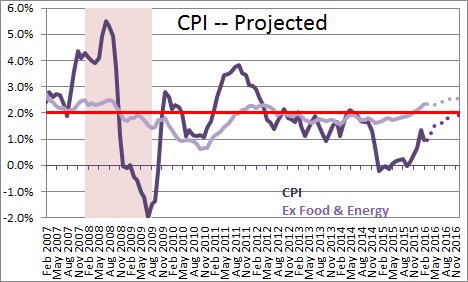
That 2.6% increase in the core rate of inflation is about 0.5% faster than the Fed expected earlier this month. If that is the case, the Fed may well raise the funds rate beyond the 0.9% mark that they currently expect by yearend, and the verbiage accompanying those rate hikes will increasingly focus on the higher-than-anticipated inflation rate. Thus, the early year weakness in the dollar may well reverse direction as the year progresses. Whether it will increase by the 7% we expected in our beginning of year forecast is uncertain. But if it does rise by a smaller amount – or not at all – it would boost both our GDP forecast for the year and our outlook for inflation. Both of those developments would encourage the Fed to raise rates more quickly than it indicated earlier this month. Sometimes short-term movements in the dollar – like short-term changes in the stock market – have very little economic significance. We think that may well be the case with respect to the recent decline in the value of the dollar.
Stephen Slifer
NumberNomics
Charleston, SC
Follow Me