
December 22, 2016
The bond and currency markets have been spooked by a fear of faster economic growth, a sharp pickup in the rate of inflation, and additional rate hikes by the Fed. We believe that the current reaction is overdone.
After Trump’s victory in early November market participants focused on the stimulative economic impact of corporate and individual tax cuts, repatriation of corporate earnings, and a dramatic reduction in the regulatory burden. This fiscal stimulus will eventually lift GDP growth from its currently anemic 1.8% pace to about 3.0%. Given that the economy is already close to full employment such stimulus could boost the inflation rate and induce the Fed to raise rates more rapidly than it has previously described. Great for stocks. Good for the dollar. Not good for the bond market.
A month later the markets learned that the Fed would raise rates three times in 2017 rather than two. More bad news for bonds.
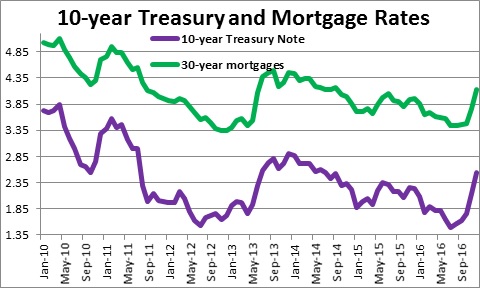
Between early November and mid-December the yield on the 10-year note jumped 0.75% from 1.75% to 2.5%. The yield on the 30-year mortgage rate moved in lockstep from 3.4% to 4.1%.
A 0.75% increase in long-term interest rates in a four-month period of time is eye-catching. However, it is important to remember that in both cases the rate gains started from near-record low levels. The lowest monthly average on record for the 10-year note was 1.50% in July of this year. The yield on the 30-year mortgage was 3.4% at that time. Both rates remain quite low by any historical standard and, therefore, are unlikely to do any significant damage to the economy.
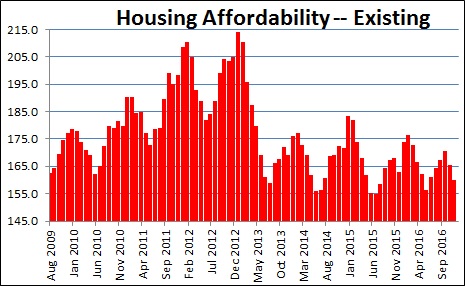
In the case of the 30-year mortgage rate housing remains affordable despite the increase in mortgage rates. The housing affordability index has slipped somewhat since rates first began to rise, but at 159 it implies that a median income home-buyer has 59% more income than is required to purchase a median-priced home. The index has not fallen more sharply because consumer income continues to climb almost as quickly as mortgage rates have risen. Rates will need to rise a lot farther before long-term interest rates begin to bite.
The markets are worried about a significant acceleration in both GDP growth and inflation. If that occurs then the Fed will be forced to speed up the pace of rate hikes. But we have a much more sanguine view.
The policy changes described earlier will stimulate an investment led pickup in GDP growth from 2.0% in 2016 to 2.3% in 2017. That is not a dramatic acceleration. Furthermore, the additional investment spending will cause productivity growth to accelerate which will mitigate the upward pressure on inflation caused by the tight labor market. If wages rise because workers are more productive, they will have earned their wage hike and their employer will have little reason to raise prices. As a result, we look for the core CPI inflation rate to rise from 2.3% in 2016 to 2.7% next year. The Fed’s target is the core personal consumption expenditures deflator which tends to average about 0.5% less than the core CPI or, in this case, 2.2%. The Fed will view that as being perfectly consistent with its desired 2.0% inflation pace and, thus, will have no incentive to raise rates faster than they outlined earlier this month.
Our sense is that as we move into the first few months of next year the markets will realize that its worst fears are unlikely to be realized and long-term interest rates may decline slightly before resuming their gradual rise later in the year.

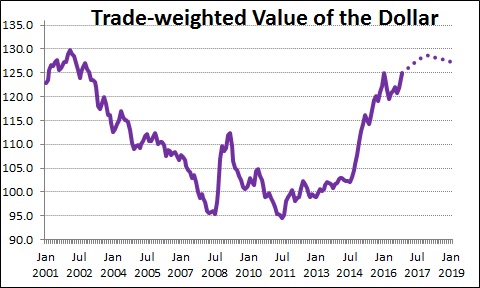
The expected pickup in the pace of economic activity, a higher rate of inflation, and a faster pace of rate hikes by the Fed have caused the dollar to rise sharply as foreign investors seek the higher returns available in the U.S. stock and bond markets. Indeed it has risen 5% in the past four months. But because the dollar declined between January and August, it is currently 2% higher than where it was back in January. To put this in context, the dollar appreciated 22% between mid-2014 and the end of 2015. That made U.S. goods significantly more expensive for foreigners to purchase and, as a result, the dollar increase subtracted 0.4-0.5% from GDP growth in 2014 and 2015. We believe that the dollar will increase about 4.0% in 2017 which would subtract only about 0.1% from GDP growth for the year.
In the end, we believe that the recent increases in long-term rates and the dollar are similar to the taper-tantrum that occurred in 2013 when Bernanke suggested that the Fed would slow its pace of bond purchases. The bond market grossly overreacted but eventually settled down.
Stephen Slifer
NumberNomics
Charleston, S.C.
Follow Me