
April 6, 2012
While the employment report for March was weaker than expected, there is no reason to alter our view that the economy grew at a 2.5% pace in the first quarter, will expand at a 3.0% pace for the year as a whole, monthly job gains will average 225-250 thousand in 2012, and the unemployment rate will end the year at the 7.6% mark.
The 121 thousand increase in private sector employment for March was disappointing. But it must be evaluated in conjunction with changes in other recent months, and with all other economic indicators. First of all, the March increase follows outsized gains of 234 thousand, 277 thousand, and 233 thousand in the prior three months. We expect employment gains to average 225-250 thousand this year. Had the March increase been of similar magnitude to other recent months we may have been tempted to boost that estimate. As it stands, private employment in the first three months of the year has risen on average 210 thousand. With the economy gathering momentum, that early year gain seems consistent with our outlook for the year as a whole.
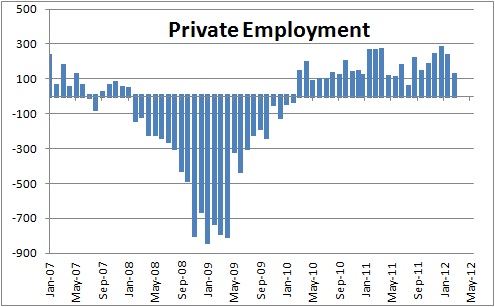
Second, during the winter months weather throughout the country was considerably warmer than usual. Almost certainly some of the increase in employment that might ordinarily have occurred in March actually took place in earlier months.
Third, no other labor market indicators reflect any incipient weakness. Initial unemployment claims, a measure of layoffs, continues to decline slowly and is now at a level consistent with sizable employment gains. The number of people receiving unemployment benefits is falling rapidly. Automatic Data Processing (or ADP), which processes over 500,000 payrolls, indicates that payroll employment rose 209 thousand in March and 207 thousand on average in the first three months of the year. And the employment indexes reported by the Institute for Supply Management (or ISM), continue to climb.
Finally, other non-labor market indicators suggest that the economy continues to expand at a moderate pace. The stock market is essentially at its highest level thus far for the cycle. Consumers have paid down enormous amounts of debt in the past several years. Sizeable increases in both employment and hourly earnings are boosting income. Consumers continue to feel good despite rising gasoline prices and are once again willing to borrow.
Given the pickup in consumer demand, employers need to boost production. But with the workweek now back to its pre-recession level and productivity rising slowly, the only way firms can do that is to boost headcount. Monthly economic statistics bounce around from one month to the next. In this case, the weak employment performance in May does not appear to be indicative of any incipient economic weakness.
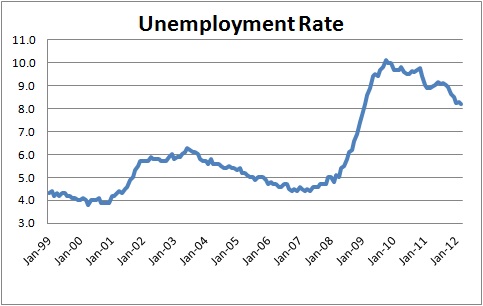
The unemployment rate declined 0.1% in March to 8.2%. Thus it has fallen 0.9% — from 9.1% to 8.2% — in the past seven months. Fed Chairman Bernanke points out that a decline of that magnitude is excessive given the moderate pace of economic activity. While he is factually correct, we would suggest that the decline is legitimate given a significant jump in self-employment. For example, in that seven-month period of time payroll employment rose 200 thousand per month. Employment from the household survey, which is used to calculate the unemployment rate, has averaged 326 thousand. The difference is largely attributable to the fact that the latter includes self-employed workers. Given the difficulty in finding employment, our sense is that many long-term unemployed workers have chosen to go into business for themselves. If so, the bigger gains reported by the household survey of employment, and the corresponding decline in the unemployment rate, are both legitimate and likely to continue.
The monthly employment statistics reported by the Bureau of Labor Statistics are arguably the most important economic indicators released during the course of any given month. If, as in this case, the monthly increase in employment is far smaller than anticipated, it is important for economists to evaluate its importance in the context of other economic indicators. Fortunately, there is no other evidence to suggest that the economy is losing momentum.
Stephen Slifer
NumberNomics
Charleston, SC
Follow Me