November 6, 2026
Two things happened this past week. The election on Tuesday, followed by wild swings in stock prices on the final three days of the week. So is this good or bad? On balance, we think it is good.
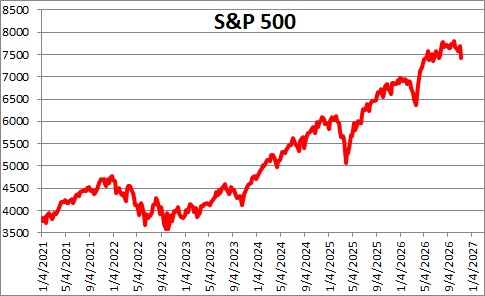
The stock market surged on Wednesday, got clobbered on Thursday, and then rebounded on Friday as investors tried to determine the extent to which Democrats may impose regulations on the high flying AI sector. While volatility has been wild the S&P 500 has only fallen 5.0% from its early October peak. It has not yet reached the 10% threshold which is widely regarded as a “correction”. In our opinion, a stock market correction is long overdue. But a correction is not necessarily a bad thing as capital can then be reallocated to other sectors of the economy.
In our opinion, investors are missing some other likely changes to the economic outlook caused by the election. We believe that the election outcome will result in a continuation of relatively rapid GDP growth, lower inflation, lower long-term interest rates, and only a single rate hike by the Fed in December of this year – nothing thereafter. In the months ahead consumers will conclude that there will probably not be any more Trump bombshells. No escalation of the war in Iran. No further tariff hikes. A cessation of overly aggressive ICE raids. Against that background consumer confidence should rebound. Oil prices will fall. Inflation will slow. Long term interest rates should decline. AI investment should also slow which is probably a good thing as developers figure out how to prevent the technology from spiraling out of control.
This is a time for reflection by both parties. Republicans will need to lick their wounds and learn how to compromise with Democrats. Democrats will hopefully conclude that the election results were not a mandate for their own progressive agenda, but rather a reflection of extreme voter dissatisfaction with everything Trumpian. Split government will be a welcome change from one-sided Republican rule of the past two years.
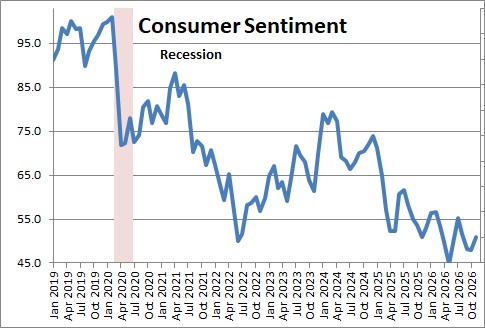
The process will likely begin with some increase in consumer confidence. Given the election results it should not remain at its current record low level. Prior to the election voters feared that Trump would escalate the war with Iran. But now the resumption of full-scale fighting in Iran is almost certainly off the table. Ditto for additional tariff hikes. In fact, it is not hard to envision some reduction in tariffs on goods coming in from Canada. We expect a jump in sentiment to perhaps 65.0-70.0 from the current level of 51.0 which is still not high. A high level would be 95.0-100.0.
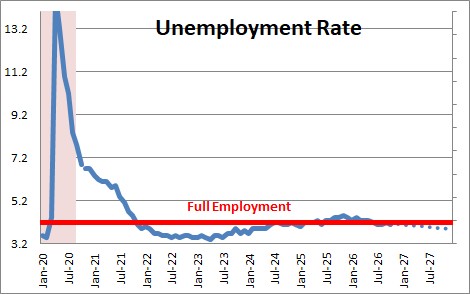
Business leaders are currently in a slow hire/slow fire environment. But the reduction of uncertainty surrounding the war and tariffs could encourage them to step up the pace of hiring and the unemployment rate could drop from 4.1% currently to 3.9% or so by the end of next year. The somewhat brighter economic outlook should encourage some job seekers to re-enter the labor force and begin to look for a job.
Democrats will push hard for a negotiated end to the war with Iran. If they are successful oil prices will decline. Retail gasoline prices are $4.15. Spot prices have fallen sharply in the past couple of weeks so retail prices are headed to about $3.80 even before any hint of a negotiated end to the war. If that were to happen we could easily see a further drop to $3.25-$3.50.
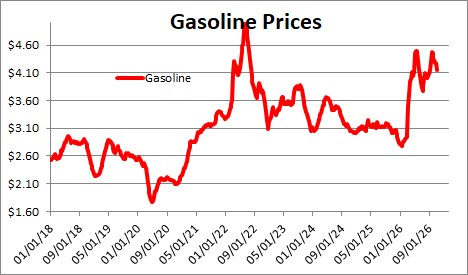
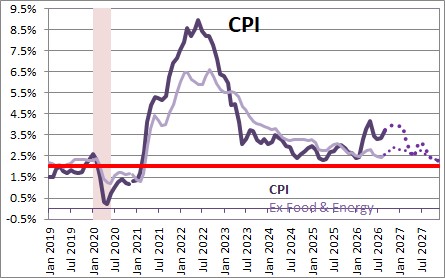
A 20.0% decline in energy prices would subtract about 1.5% from the CPI in 2027. The core CPI should also slow because the increase in oil prices has boosted prices for all sorts of goods from rubber, paint, plastics, cosmetics, pharmaceuticals, and cleaning products that incorporate oil in the production process. At the same time no further increase in tariffs overall, and perhaps a drop in tariffs on many products being imported from Canada, should help. All of a sudden the overall CPI and the core rate should slow by the end of next year and begin to approach the Fed’s 2.0% target for the first time in 6 years.
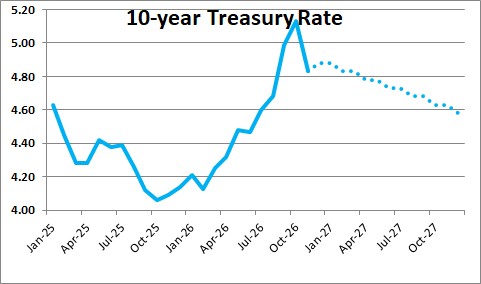
Long rates will be impacted by two factors – the reduced rate of inflation, and the heavy issuance of U.S. Treasury securities to finance another expected $2.0 trillion budget deficit combined with significant demand for capital to finance the AI buildout. As a result we expect the yield on the 10-year note to decline only slightly from 4.9% currently to 4.6% by the end of next year. That should allow the 30-year mortgage rate to fall from 7.1% today to 6.6%. The increased affordability will provide a moderate amount of stimulus to the beleaguered housing market.
If consumer confidence climbs somewhat and the war in Iran comes closer to an end, the economy should look particularly appealing in 2027. We expect GDP growth of 2.6% in that year which is not excessive because continuous gains in productivity have boosted the economy’s potential growth rate to 3.0%. The inflation rate should slow to 2.2% in 2027 and finally approach the Fed’s 2.0% target. That should lead to one widely expected final rate hike by the Fed in December of this year, and then a steady 4.1% funds rate throughout 2027.
Divided government may be just the tonic that will keep the economy on track for the next couple of years.
Stephen Slifer
NumberNomics
Charleston, S.C.
Follow Me