
July 5, 2013
Almost every single economic indicator released in the past month provides evidence that the economy has snapped out of its three year slump and is tracking at a more robust pace. A surprisingly rapid recovery in the housing sector, larger job gains, and a rising stock market are all combining to bolster consumer sentiment to its highest level yet in the cycle. Corporate profits continue to climb, corporate cash is at a record high level and looking for an attractive investment opportunity, and corporate borrowing rates are roughly in line with where they were in the 1960’s.
Most economists have whined about surprisingly slow GDP growth in the first three years of recovery. But it should be emphasized that the economy faced some significant headwinds in each of those years that kept a lid on growth. Specifically, in 2011 the Arab spring boosted oil prices and slowed the pace of economic activity, the tsunami interrupted the supply chain, then there was the near default by the U.S. Treasury in connection with the increase in the debt limit which caused consumer confidence to plummet. In 2012 we had the November election and concerns about the fiscal cliff at the end of that year which threatened to plunge the economy back into recession. Both investment spending and employment growth slowed noticeably beginning at mid-year. Then this year there was worry about both the fiscal cliff and the mandated cuts in government spending caused by the across-the-board sequester of funds. No wonder GDP growth has had a hard time getting untracked.
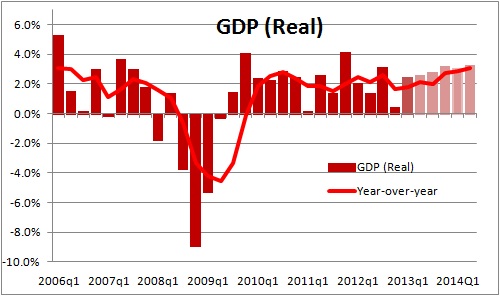
But that was then. This is now. And all of those headwinds have disappeared. More may arise, but for now there seems to be smooth sailing.
Our expectation is that GDP growth will quicken from roughly a 2.2% pace in the first half of this year to 2.9% in the second half and to 3.2% or so in 2014. Thus far, the data seem consistent with such an outcome.
The main driver thus far is the surprisingly rapid rebound in housing. While we have known that near-record low mortgage rates, and home prices that even now are 25% below their 2006 peak value are attractive to potential home buyers, and housing is affordable. As a consequence, home sales have been accelerating for the past two years.
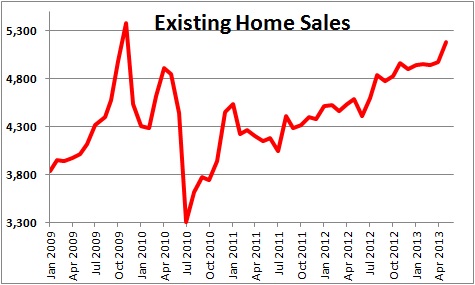
The surprisingly rapid pickup in sales has created shortages of available housing which, in turn, has boosted prices. The Case Shiller index indicates that such prices have risen 11.6% in the past year. Rising home prices coupled with the recent increase in mortgage rates from 3.5% to 4.5% has forced the fence sitters to take action.
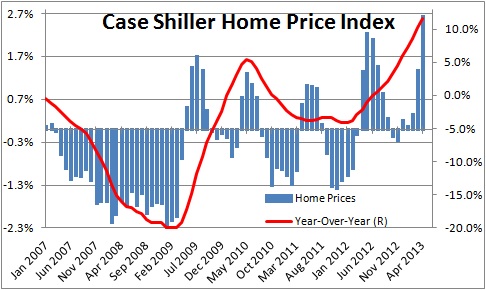
Builders, meanwhile, are enticed by both the faster pace of sales and rising prices. Indeed, their confidence level is as high as it has been any time in the past seven years.
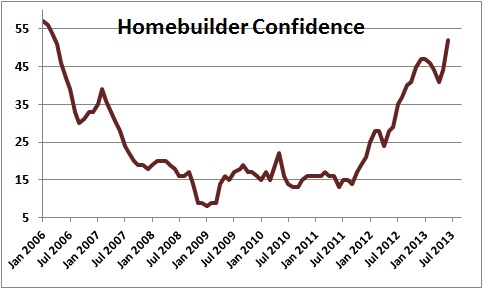
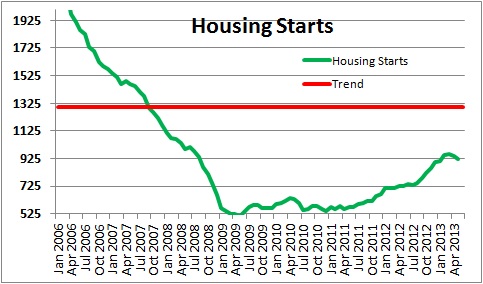
They are rapidly boosting the pace of construction of both single-family houses and apartments to satisfy demand. But they are sometimes constrained by the difficulty in finding financing so they are having a hard time catching up. Keep in mind, too, that 1.3 million new families are formed every year, so we need 1.3 million new houses or apartments to keep pace. Not only is the current 900 thousand pace of construction below that requirement, but builders have not produced 1.3 million new homes in any year since late 2007. Thus, there is a huge 6-year backlog of demand which should keep housing humming for years to come.
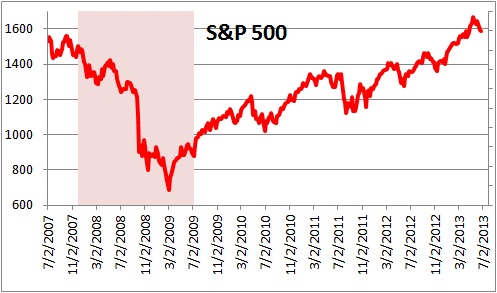
At the same time the stock market continues to do well. It experienced a minor hiccup in June as Bernanke got everybody nervous about some form of Fed tightening by the end of the year. But, eventually, the market figured out that he was not actually talking about tightening, but simply slowing the Fed’s pace of easing by cutting its monthly purchases from $85 billion per month currently to, say, $50 billion per month by year end. As a result, the stock market has rebounded and is, once again near its high for the cycle.
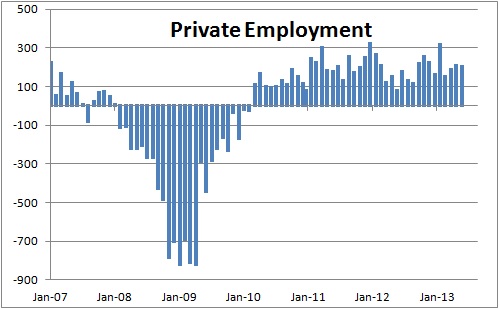
Firms are responding to the apparent signs of a growth pickup by boosting their pace of hiring. Private sector employment is currently rising at 200 thousand per month. As shown by the red line in the chart below, such employment rarely rises by much more than 235 thousand per month over any 3-month period of time. Thus, current job gains are impressive.
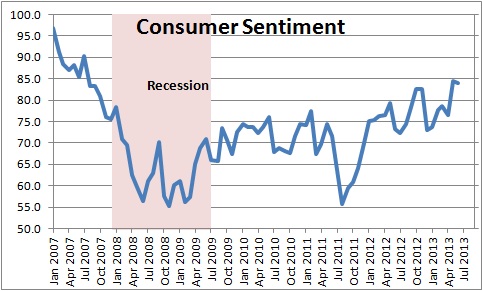
Between what is going on in housing and the stock market, a record high level of net worth, and fairly impressive job gains, consumers, not surprisingly, are as confident as they have been at any time since before the recession.
The more confident they are the more likely they are to spend. The most recent observation on their spending patterns came from the car and truck sales data for June which surged 4.3% from a 15.2 million annual rate to 15.9 million which suggests that June retail sales released next week will also be impressive. This is important because housing and vehicle sales are the two biggest items in any consumer’s budget. If they are willing to spend on high ticket items, a faster pace of spending on lower-priced merchandise seems certain to follow.
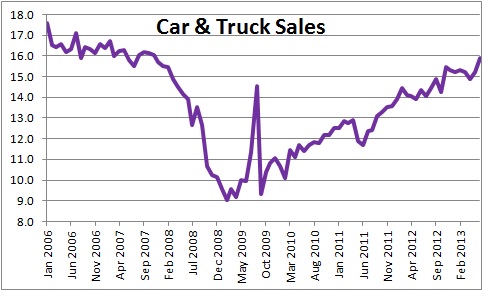
With economic headwinds a thing of the past (at least for now) the economy has the ability to accelerate to a more impressive pace of expansion. Virtually every piece of recent data fits that pattern. As this occurs the stock market will continue to climb, consumer and business confidence will rebound, sales will accelerate, job gains will increase. In short, it appears to be the beginning of a virtuous cycle for the economy.
Stephen Slifer
NumberNomics
Charleston, SC
Follow Me