
August 28, 2015
Stock market gyrations the past two weeks have been breathtaking to say the least. In the end it appears to have been nothing more than a good, old-fashioned correction. The catalyst was the precipitous slide in the Chinese stock market that began in mid-June. The drop had nothing to do with a perceived change in the pace of economic activity here in the United States, but some Fed officials are reportedly less inclined to raise rates in mid-September because the global economy is so “fragile”. We hope that the Fed is not looking for yet another excuse to postpone the inevitable. The one thing that the Fed should have learned from this recent China scare is that it needs to raise interest rates – now! It has virtually no ability to respond to a crisis if one should arise.
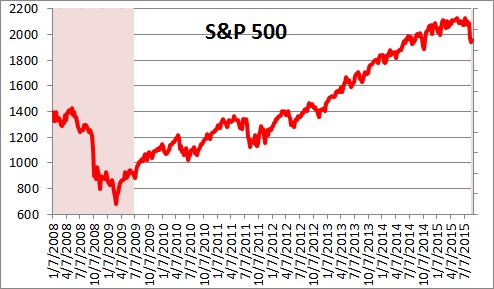
From peak to trough the drop in the S&P 500 was about 12.5%. The market has partially recovered and is now only about 8.0% below its peak. In hindsight the drop appears to be nothing more than a hiccup that will allow the S&P to resume its ascent to new record high levels.
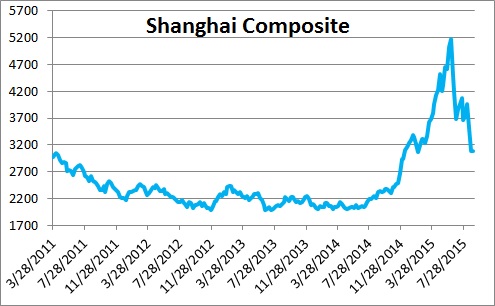
The correction was triggered by the precipitous drop in the Chinese stock market. The Shanghai Composite fell 40% from its peak in early June and pundits declared that Chinese stocks were now in a “bear market”. That generated a fear that the Chinese economy might be slowing far more than expected, and that Chinese officials were unable to arrest the decline. But those negative soothsayers fail to point out that between the end of August 2014 and early June of this year, the Shanghai Composite Index rose 135%. In our opinion, the price swings in the past year – in both directions –were attributable to the introduction of options trading in China and tell us little about the pace of economic activity in that country. At its current level the Index is still 40% higher than it was at this time last year. If somebody had told you a year ago that the Chinese stock market would climb 40% during the next 12 months, you probably would not be entertaining the notion that the economy was on the verge of collapse. For the Fed to postpone a necessary rate hike in the U.S. because of gyrations in the Chinese stock market is simply misguided.
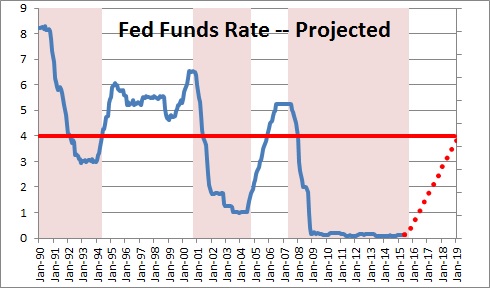
If something big were to happen– in China or elsewhere — that threatened to interrupt the expansion, the Fed has an obvious problem. Short-term interest rates are at 0% and have been for the past seven years. It cannot push them lower. Furthermore, the Fed believes that a so-called “neutral” funds rate is about 3.5% and it would like to gradually lift rates back to that level. Trying to push short rates even lower to a negative interest rate is counter to the desired direction.
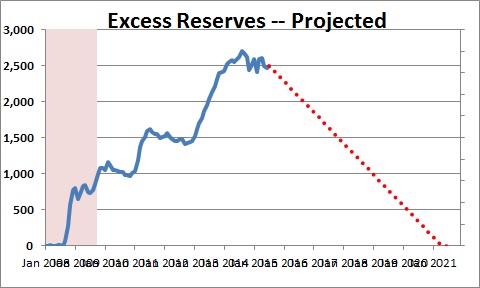
The Fed could re-implement its bond buying program. But the prior program flooded the banking system with surplus reserves. Excess reserves skyrocketed from $2 billion in late 2008 to $2.5 trillion. Those funds are available to banks to lend and have the potential to be highly inflationary. The Fed wants to gradually shrink those reserves back towards $2 billion – not increase them further.
Fiscal policy is similarly handcuffed. With budget deficits projected to once again climb to $1.0 trillion annually by the end of this decade as a growing number of baby boomers retire, tax cuts and/or increases in government spending to counter an unanticipated economic slowdown are not an appropriate policy prescription.
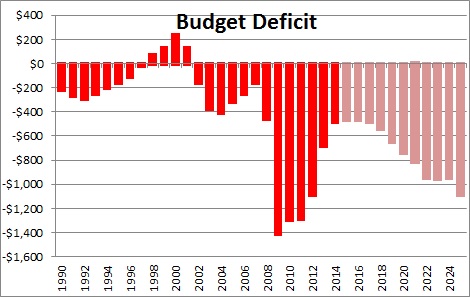
To be in a position where both monetary and fiscal policy are constrained in their ability to respond to a crisis is completely unacceptable. The Fed, for its part, needs to gradually boost rates back to a neutral level which is somewhere around 3.5%. With nominal GDP climbing at a 3.7% pace currently the economy is no longer in need of 0% interest rates.
Some have suggested that the U.S. economy is so soft that the recent problem in China could have been enough to short-circuit the expected moderate growth scenario. Prior to the recent GDP release that concern was perhaps understandable. Previously we thought that growth in the first half of the year was surprisingly slow at 1.5%. Post revision we learn that first half growth is now 2.2% — roughly in line with its current trend rate. While it is still early and available data are sketchy, third quarter GDP growth seems to be shaping up at about 2.5%. The economy continues to expand at a moderate – if unimpressive –pace.
Given that the Fed has not raised rates in nine years, admittedly that first move is hard and sends a clear message that the future direction of rates is upward. But higher rates are inevitable and there comes a time when they are appropriate. That time is now so that the Fed will eventually be in a better position to respond to the next crisis.
Stephen Slifer
NumberNomics
Charleston, SC
Follow Me