
October 4, 2013
The federal government has been partially shut down for four days. History suggests it probably will not last more than another week or so, and the damage inflicted on the economy is likely to be small. But every day the press interviews some furloughed government employee who has a heart-wrenching tale of hardship imposed by the layoff. What is likely to be the damage on the economy as a whole from the shutdown? And is the pain for federal government workers as dire as the press would lead us to believe?
The government has not furloughed all workers. Those in “essential services” remain on the job. The military will continue to get paid. Social Security payments will go out on time. Air traffic controllers, the border patrol, food inspectors, prison guards, and the weather service will all report to work and get paid as usual.
But such a shutdown is not costless. If someone needs to apply for a passport they will be out of luck for a while. Foreigners seeking a U.S. visa will also have to wait. Forget visiting a National Park until the shutdown ends. It is easy to conclude that the consequences of the government shutdown will be enormous, particularly when the negative factors are highlighted by the press . But is that really the case? Not really.
First of all, there are about 800,000 furloughed government workers which is about one-third of the government’s 2.7 million employees. That sounds like a lot, but there are 136 million people that hold jobs in this country. Thus, furloughs impact only about 0.6% of the work force.
Second, the longest federal government shutdown was December 1995 to January 2006 under President Clinton. It lasted 18 days. In the year leading up to the shutdown, the economy had been chugging along at a 2.7% pace. In the fourth quarter of 1995 when the shutdown began GDP growth came in at 2.8%. In the first quarter of 1996 when it ended GDP growth was 2.6%. Looking at those numbers it is hard to find any negative impact. At worst, the economic consequences were small. How can that be?
In most cases government spending was simply delayed, not eliminated. Invariably federal government workers eventually get compensated for those days they did not report to work. They might not be able to pay their bills for a week or two, but ultimately those bills get paid and their annual income is unaffected. The Passport and Visa Offices may temporarily fall behind on their processing of applications, but ultimately they catch up. As a result, government spending is simply shifted from one period of time to another, and economic activity for the entire period is largely unaffected.
Given that furloughed government employees ultimately get paid, it is hard to generate a lot of sympathy. They get to spend time off with their family or take a mini-vacation and still get paid. It is clearly inconvenient to not get paid on time, but it is not a calamity.
The lack of sympathy for temporarily furloughed, but ultimately paid, government employees is highlighted by the fact that they are more highly compensated than other Americans. The Congressional Budget Office did a study last year that showed total compensation for federal government workers on average was 16% higher than for those in the private sector.
There was little difference in the wage component of compensation. Government wages were only about 2% higher than for a private sector worker. But government benefits were far more substantial. For the average federal employee benefits were 48% higher than his or her private sector counterpart.
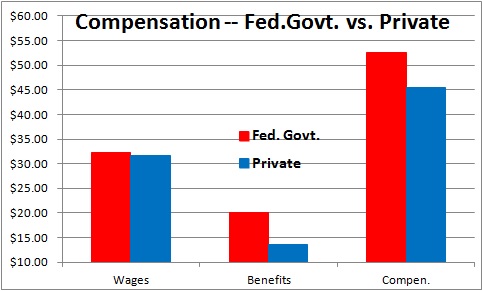
This difference in benefits largely reflects the fact that federal workers have a defined benefit retirement package, which means that at retirement they are guaranteed benefits which are typically about 80% of their three highest earning years. Because the cost of such packages is so high, most private sector firms have switched to defined contribution plans. In this case the employee contributes a certain amount each paycheck (which may be partially matched by the employer), puts it into a combination of mutual funds, and what he or she gets at retirement is whatever the fund is worth at that point in time. Once the employee retires the company is off the hook.
The federal government also provides subsidized health care for its retirees, a practice that has become uncommon in the private sector. Thus, deferred compensation accounts for a much larger share of total compensation in the federal government than in the private sector.
As we see, it the ultimate economic impact of the partial government closure will be minimal. And the consequences of the shutdown are grossly overblown for relatively well paid government employees who receive gold-plated benefits packages, and who will ultimately be compensated for those days off.
Stephen Slifer
NumberNomics
Charleston, SC
Follow Me