
July 10, 2015
While global stock and bond markets continue to react to the still unresolved difficulties in Greece, China, and Puerto Rico, the focus should soon return to world economic growth for two reason. First, the IMF recently revised downward its global growth forecast with most of the reduction attributable to a slower pace of expansion in the U.S. Second, at the end of this month we will get our first look at second quarter GDP growth in the U.S. as well as revisions to data for the past three years. By the beginning of August we should find that not only is growth in the first half of the year not as slow as we thought, but also growth for the second half of the year is shaping up nicely. Thus, the early year slowdown is over, and the focus will shift to a relatively robust pace of expansion after midyear and the timing of the Fed’s initial rate hike.
As it stands currently we know that GDP declined 0.2% in the first quarter and most economists expect second quarter growth to be about 3.0%. That implies first half growth of 1.4%. But in July of every year the Commerce Department does its annual benchmark revision which changes GDP data for the past three years. Post revision we should learn two things. First, that annoying pattern of extraordinarily weak first quarter growth followed by a significant rebound in the second quarter will be dampened considerably. Second, growth in the first half of the year, on balance, will be more robust than it appears at the moment.
Economists at the Federal Reserve Bank of San Francisco suggest that a portion of the extreme first quarter weakness is attributable to faulty seasonal adjustment. We all know that retail sales surge in the holiday period and then fall off sharply in the early part of the next year. Construction activity is depressed in the winter months and then surges in the spring. The Commerce Department tries to adjust for these recurring weather and holiday patterns, but over time normal patterns can shift. At the moment the adjustment process appears to be reducing first quarter GDP growth far more than it should and is overstating growth in the subsequent three quarters. To be specific they believe that first quarter GDP growth has been erroneously depressed by about 1.5%.
Thus, at the end of this month we are likely to learn that GDP growth in the first quarter is about 1.3% rather than the 0.2% contraction that was previously reported. But there is a second part to this revision. Seasonal adjustment does not alter GDP growth for the year as a whole. So whatever is added to first quarter growth must be subtracted from subsequent quarters. Let’s suppose that the 1.5% that is added to the first quarter gets subtracted out in equal increments of 0.5% in each of the subsequent three quarters. That means that second quarter growth, rather than 3.0%, might turn out to be 2.5%. But 1.3% growth in the first quarter followed by 2.5% growth in the second implies first half growth of 1.9%. That is less than the 2.4% growth registered last year, but given the hit on growth early this year caused by capping 50% of the oil rigs that were in operation at the end of September, it is not too bad.
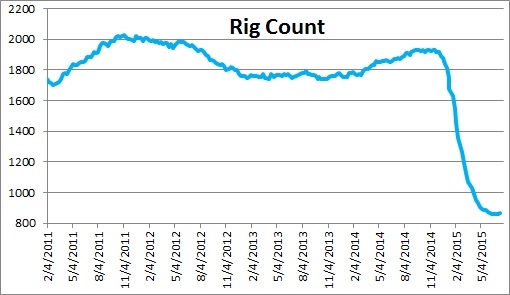
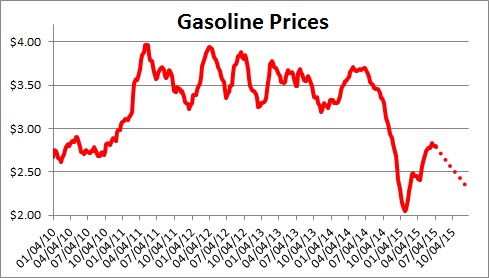
Looking ahead to the second half of the year the drag on growth caused by the contraction in oil drilling activity should disappear. The number of rigs in operation seems to have leveled off in recent weeks. The consumer will continue to benefit – and spend – some of the additional disposable income associated with lower oil prices. Oil prices appear to have peaked at about $2.80 per gallon at midyear and should now begin their second half descent to perhaps $2.30 by yearend. In addition, a continuation of sizeable increases in employment combined with likely increases in wages should boost consumer income and further stimulate spending. In short, second half growth should approach the 3.0% mark.
It is true that the IMF recently reduced global GDP by 0.2% from 3.5% to 3.3%. Most of that slower growth came about from a downward revision to U.S. growth of 0.6% from 3.1% to 2.5%. Thus, the cutback was attributable to an event that has already transpired (namely, the drop in oil prices and the commensurate capping of oil rigs) and does not reflect an expectation of slower growth in the quarters ahead. Thus, the drag on GDP growth early in the year should disappear in the second half, and the stimulative effect on consumer spending should become more apparent.
So while Greece, and China, and Puerto Rico will continue to grab headlines and create some sense of panic, do not be alarmed. The underlying fundamentals for GDP growth remain solid and should produce impressive growth in the second half of this year not just in the U.S. but for most developed economies.
Stephen Slifer
NumberNomics
Charleston, S.C.


Steve, there is nothing like your “big picture” perspective on the ruminations of the global economy. It helps to keep me sane. Today the newspaper reported that Greece and its European allies are coming up with a new settlement. It does not look pretty for Greece, but it could get them through.
I do wonder about China since it is so big, but I will definitely defer to your 20,000 ft overview.
Thank you. …Darrel Staat
Hi Darrel,
My, my. You must have been on vacation. Three comments in one day! Thanks as always for your attentive reading. Regarding China I presume (hope) you saw my piece on July 3. If not here is the link:
https://numbernomics.com/wp-admin/post.php?action=edit&post=14091
I talk about China and my general sense is that this is not a big deal for those of us outside China. It is a big deal for China. The stock market decline there seems to be attributable to a big run-up in margin borrowing. And while it has fallen rapidly lately, it increased about 150% between October and mid-June. If it gives back 35% I am not sure we are supposed to get all that excited. I do not think this carries with it any sense that the Chinese economy is doing worse than we thought. 6.7% GDP growth sounds about right for the year.