
July 18, 2014
The housing sector continues to expand, but the pace of expansion has been less impressive than anticipated. One reason for this sluggishness is that young adults, who represent the largest group of first time homebuyers, are unable — or perhaps unwilling — to make that commitment to buy. Will this decline in homeownership prove to be temporary? Or is this a permanent downshift in Americans’ desire to own their own home?
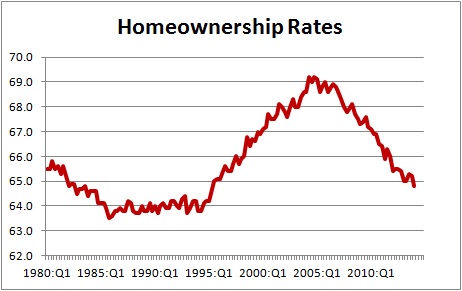
Owning your own home has always been an American dream. In 1992 Congress passed legislation which encouraged banks to lend to low and moderate income borrowers. Down payments fell from 20% to 2%. No income verification was necessary. Banks offered teaser rates to attract buyers. As a result homeownership climbed sharply from the mid-1990’s through 2004. Unfortunately, the housing bubble burst in 2008 and homeownership began a rapid descent.
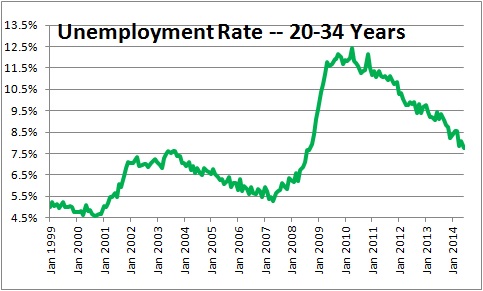
One reason for this drop in ownership is the high unemployment rate. For adults under the age of 35 – who are by far the biggest group of first time homebuyers — the unemployment rate peaked at 12.5%. It has since fallen to about 8.0% but remains well above the 5.5% threshold that existed prior to the recession. Amongst the 20-24 year old crowd the unemployment rate peaked at 17% and is still in double digits as recent college grads have had considerable difficulty finding employment.
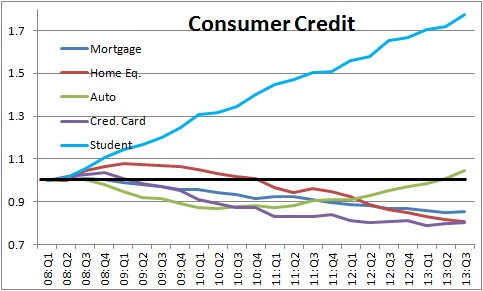
At the same time recent graduates are coming out of school with a sizable amount of student debt. Since the recession began student debt has doubled. The median amount of student debt outstanding has climbed from $10,000 to $15,000, and the share of student debt holders with more than $50,000 outstanding has tripled from 5% to 16%.
At the same time home prices have risen rapidly and mortgage rates have climbed from 3.5% to 4.25%. As a result, the mortgage payment required to purchase a median-priced home has risen from $650 to $800. While that is still affordable for most adults, it can be onerous for those just getting started in their careers. Compounding the financial pressures banks are requiring higher credit scores to qualify for a mortgage.
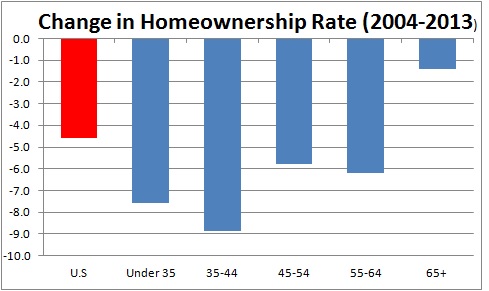
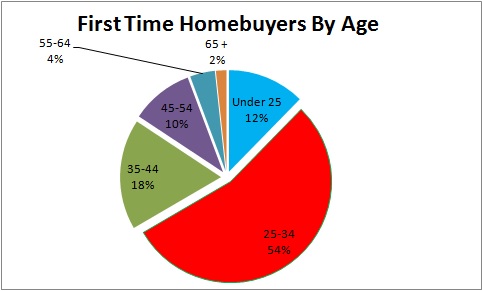
Given the combination of a high unemployment rate, rising student debt obligations, and an increase in home prices and mortgage rates, it is not surprising that the decline in homeownership has been most dramatic amongst younger adults. From its peak in 2004 the homeownership rate for the U.S. fell 4 points, but the rate for 25-34 year olds slid 8 percentage points and for 35-44 year olds it fell 9 points. Indeed, two-thirds of first time homebuyers are under the age of 35.
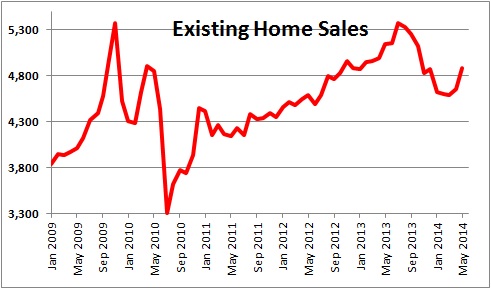
Against this background home sales have had difficulty sustaining their earlier momentum. As home prices and mortgage rates climbed sales began to waver in the middle of last year. That retrenchment was accentuated by the weather problems during the winter. Sales have begun to recover in recent months as price gains and mortgage rates have plateaued.
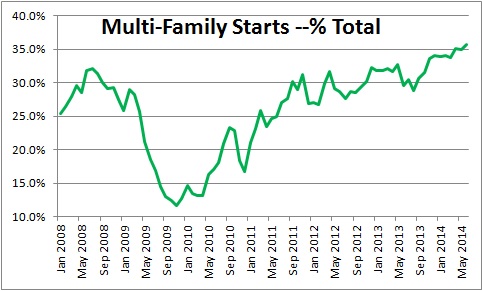
Given that homeownership is proving elusive many younger adults have chosen to rent. In the course of the past year single-family housing starts have increased 13% while multi-family starts have jumped by 36%. As a result, multi-family starts as a portion of the total have risen from 10% in the early stages of the recovery to about 35% today.
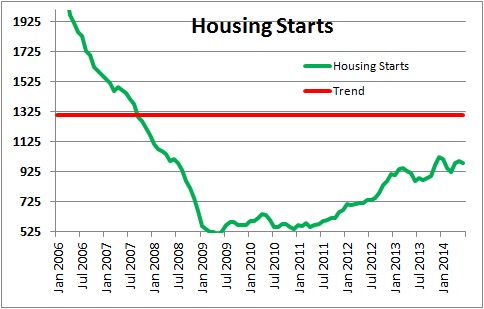
There is no doubt that the housing sector will continue to expand for years to come. Approximately 1.3 million new households are formed every year. Those people need a place to live. It could be a single-family home or it could be an apartment. At the moment the distinct preference is towards renting and builders are responding accordingly. Thus, housing starts will continue to climb, but the mix of single-family homes versus multi-family dwellings may continue to shift.
All of these factors that have been retarding home sales will be alleviated in the months ahead as the economy gathers steam. Jobs are now being created at a relatively impressive pace. The unemployment rate will continue to decline both overall and for younger adults. The increase in employment will generate income which will make housing more affordable. These factors suggest that homeownership rates should soon bottom out and eventually turn upwards.
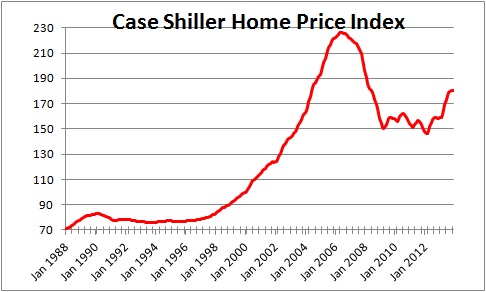
However, one important ingredient is still missing. Most adults living today have never experienced a decline in home prices — until recently. Home prices occasionally leveled off but they never declined. That changed during the recession as home prices plunged 35%. To what extent has the recent drop in prices scared potential buyers? Previously, home prices always went up, the only question was how quickly they would rise. There was little downside. But the recent recession showed that home prices can indeed fall and fall a lot. Has this recent experience permanently dampened the appetite for home ownership? While younger adults are finding homeownership challenging, the factors that have been holding them back should diminish in importance as the economy gathers momentum. But if their willingness to purchase a home has also declined the drop in home ownership will be far more long-lasting. Time will tell.
Stephen Slifer
NumberNomics
Charleston, SC
Follow Me