
November 13, 2026
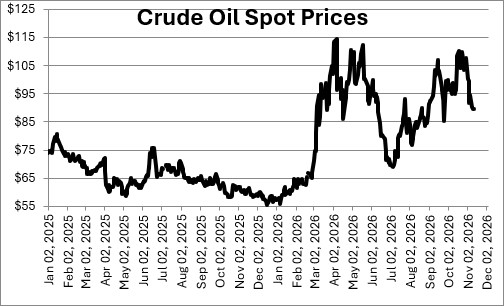
The CPI for October surprised on the upside and the 12-mointh increases for both the overall index and the core rate continued to climb. That is about to change because of the recent, dramatic drop in energy prices. Crude oil prices have fallen from a peak of $110 per barrel in mid-October to $89 in mid-November, a drop of about 20%. Spot prices for gasoline have declined from $3.68 per gallon to $2.41, a drop of 35%. It appears that the sweeping Democratic takeover of the House of Representatives and the U.S. Senate have tilted the odds towards some sort of negotiated settlement between the U.S. and Iran or, at the very least, they have taken off the table the possibility of any renewed escalation of the fighting. If the war is going to shift onto the back burner of potential worries, then lower energy prices are here to stay. The 20.4% increase in energy prices in the past year has added 1.5% to the overall CPI index during that period of time. And to the extent that higher oil prices have worked their way into the prices of such items as rubber, paint, plastics, pharmaceuticals, and cleaning products that use oil in the production process, the core CPI has probably been boosted by 0.5%. If all of that is true, then both the overall and core CPI inflation measures should slow to about 2.3% by the end of next year. Having said that, what concerns Americans today is the level of prices. After the dramatic increases in 2021 and 2022 the Fed told us that the higher prices would be “temporary” which led us to believe that prices would soon drop. They did not. The elevated prices simply grew more slowly. Looking ahead to 2027 energy prices should decline but everything else will continue to climb at a slow pace. Nevertheless, shelling out less to fill the car with gas each week will certainly boost consumer spirits and give us more money to spend elsewhere.
The Democratic takeover of the House and the Senate has significantly altered the outlook for oil prices which have risen so dramatically this year. Prior to the election Trump would oscillate between minimizing the intensity of the war and threatening to launch new strikes after the election. That was concerning. But now he makes statements that the war is “effectively over” and that Iran has been “decapitated”. Furthermore, both he and Vice President Vance acknowledge that the war and surging gas prices were the major reasons that Republicans lost so many seats in both houses of Congress. Traders and investors have translated that to mean that he no longer intends to intensify military action against Iran any time soon. Democrats clearly want the war to end and, no doubt, after the election a number of Republicans are in that same camp. A negotiated settlement of some sort now seems to be a foregone conclusion. The terms of the deal will determine whether that is a desirable outcome in the long term but, for now, it is a virtual certainly.
Against that background, oil prices have fallen precipitously. In mid-October, when there was still a possibility that Trump could resume bombing Iran, oil prices peaked at $110 per barrel. But now, a month later, they have fallen 20% to $89 per barrel. Prior to the start of the war at the end of February crude oil prices were $65 per barrel. So, if progress is made towards a negotiated settlement, oil prices have room to fall by another 25%,
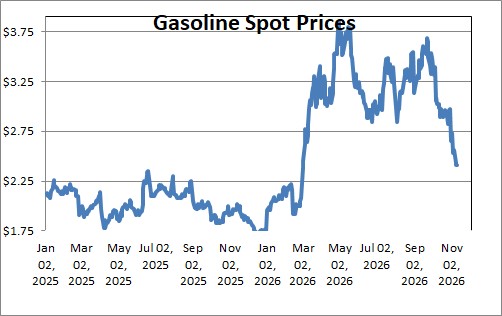
Spot gasoline prices have declined from a peak of $3.68 per gallon to $2.41. That is a decline of 35%.
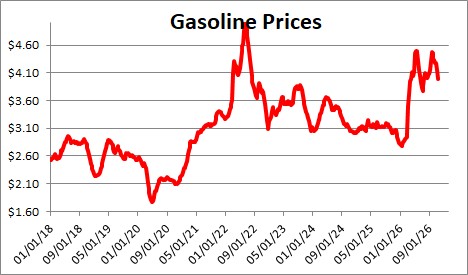
Pump prices so far have fallen 10% from a peak of $4.48 per gallon in mid-September to $4.00. Given what has happened to spot prices, pump prices are likely to fall farther to $3.60 within the next week or two.
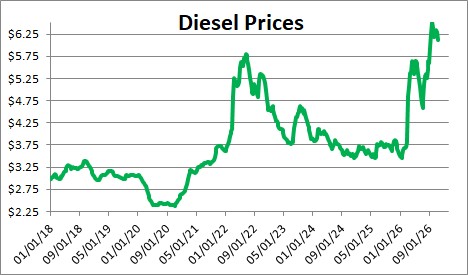
Thus far diesel prices have not declined as rapidly. They peaked at $6.52 per gallon in mid-September to $6.12 in the most recent week, a drop of 6%. One problem with diesel prices is that Ukrainian drone strikes have damaged key Russian refinery facilities which has curtailed the supply of diesel exports to much of the world. At the same time the naval blockade and the bottleneck of tankers through the Strait of Hormuz have constrained the global supply of crude oil. This suggests that diesel prices may not fall as rapidly or by as much as crude and gasoline prices in the months ahead. But they should continue to drop. That is hugely important to the U.S. trucking industry and the transportation cost of virtually every consumer product.
The drop in energy prices is hugely important to the outlook for consumer prices in 2027. The overall CPI should rise by 3.6% in 2026. Energy prices have risen 20.5%. Given its weight in the overall index that outsized gain has boosted the CPI by 1.5% in 2026. And to the extent that higher energy prices have filtered through to the prices of the wide variety of products that use oil in the production process, it has probably boosted the core CPI by another 0.5%. In other words, without the war the CPI this year would likely have been at or very close to the Fed’s desired 2.0% pace.
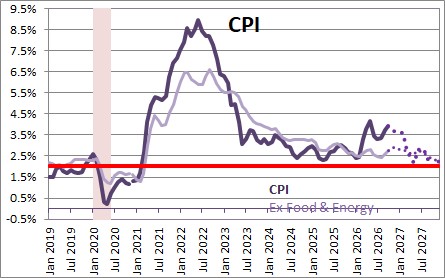
The bottom line is that we expect the overall CPI and the core CPI inflation rate to slow to 2.3% in 2027. Such a dramatic slowdown in the inflation rate combined with an actual sharp decline in gasoline prices should bolster consumer confidence in the months ahead. If gasoline prices fall and consumers spend less to fill the car with gas, there will be money left over to buy other (more fun) goods and services. Gas prices were the major factor contributing to the acceleration in the inflation rate in 2026. A reversal in gas prices should finally bring the inflation rate back down close to the Fed’s target in 2027.
And if inflation slows to the extent we expect, the Fed may well hike rates 0.25% in December, but no further action will be required in 2027.
Hallelujah!
Stephen Slifer
NumberNomics
Charleston, S.C.
Follow Me