
October 21, 2011
The 9.1% unemployment rate is bad enough, but other employment indicators suggest that the labor market weakness is far more problematical than the official unemployment rate suggests. Going forward it is hard to see how the economy can grow rapidly enough to bring the unemployment rate down quickly. Against this background policy makers feel compelled to “do something”. But will it help? Can we afford to do something? Can we afford not to do something?
The current unemployment rate of 9.1% includes 14 million workers that are unofficially counted as unemployed. But there are an additional 3 million workers who would like a job but have given up looking, and another 9 million workers who have been forced to take part time employment because they cannot find a full time job. Thus, 26 million workers in this country are working less than they would like.
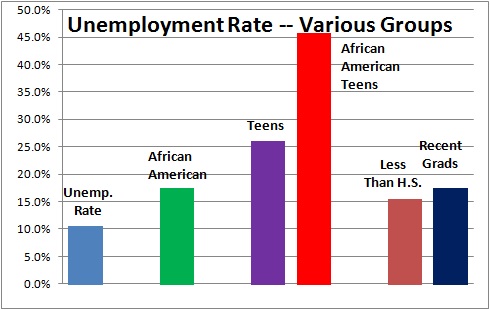
Looking at various categories of race, age, and education, some groups are being affected more than others. For example, the unemployment rate for African Americans is 16% versus 8% for whites. For teenagers it is 25%. For African American teens it is nearly 50%. Of those with less than a high school degree 15% cannot find a job. Even recent college grads are having a difficult time finding a job — 16% are unemployed.
Of those 14 million officially jobless workers, nearly half have been without a job for more than six months.
How did this happen? First, the economy experienced the deepest recession since the 1930’s. More than 8.6 million jobs were lost which is triple the drop in an average recession. Under the best of circumstances it would take 3-4 years to recover.
Second, job growth has slowed during the last decade. In the 1980’s and 1990’s employment growth averaged 1.8% per year. But in the first eight years of the 2000’s employment growth slowed to 0.6% annually. Much of this slowdown reflects changing demographics. Previous employment growth was fueled by the baby boomers. Women began entering the labor force in large numbers in the 1980’s and 1990’s. Population growth has slowed. Because these factors are unlikely to change any time soon, employment growth going forward will probably continue at subdued pace.
Third, the housing sector remains in the doldrums. Typically, it is one of the first sectors to recover and is an early engine of job creation. That has not been the case thus far in this expansion.
Fourth, state and local governments are struggling under the weight of spending cuts required to balance their budget.
Given these factors, most economists expect moderate GDP growth going forward. Unfortunately, GDP growth of 2.5% will produce only slightly more jobs than are necessary to absorb growth of the labor force. As shown below, it may take seven years for the unemployment rate to decline to the so-called “full employment” threshold of 5.0%.

As periods of unemployment stretch from months into years, workers will become permanently unemployable. Their skill levels will erode and no longer be of value to potential employers. As computer-related technology continues to advance, the economy will need highly skilled workers which the permanently unemployed will be unable to provide.
Given this bleak assessment of the labor market for the foreseeable future, policy makers feel compelled to act. President Obama has been pushing his jobs bill, the most promising part of which is a cut in the payroll tax for both employees and employers. With more money in their pocket consumers and might choose to boost spending which, in turn, might entice employers to hire a few additional bodies. But it comes with a cost – reduced revenue for Social Security.
The Fed has already decided to purchase additional mortgage-backed securities as a substitute for Treasury securities. The idea is to lower mortgage rates to stimulate the economy. But mortgage rates are already at near record low levels. Will even lower mortgage rates help much? Probably not.
In our opinion, the policy options being discussed will cost a lot, and produce too few jobs. We can’t afford them. But, given the consequences, others suggest we can’t afford not to spend the money. What do you think?
Stephen Slifer
NumberNomics
Charleston, SC
Follow Me