
July 22, 2011
The lack of jobs is depressing everyone. The unemployment rate is high and needs to be lower. The pace of job creation slowed in May and June. And even though the economy is soon going to quicken the pace of job creation, it will probably take until September 2013 for the economy to re-create all the jobs that were lost in the recession, and until mid-2015 for the unemployment rate to return to the so-called “full employment” level of about 5.0%. We can all wish for faster improvement in the labor market, but it will be almost impossible to achieve.
It has frequently been noted that the economy has been expanding for two years but has not yet recovered all the jobs lost during the recession. That is true, but it was also an unrealistic expectation. When the recession ended two years ago, we began to emerge from the steepest economic slump since the Great Depression. During the “repression”, which lasted from December 2007 through June 2009, the private sector lost 8.6 million jobs or 7.4% of the work force. That is almost double the job loss of the 1974-75 recession (which was the worst recession in recent memory), and almost triple the usual job loss in a recession.
| Job Losses During Recessions | ||
| Job Loss | % | |
| 1974 | 2,695 | 4.2% |
| 1980 | 1,012 | 1.7% |
| 1981 | 2,673 | 3.5% |
| 1990 | 1,636 | 1.8% |
| 2001 | 3,324 | 3.0% |
| Average | 2,268 | 2.8% |
| 2008 | 8,566 | 7.4% |
At the end of the recent downturn the economy was still losing more than 500 thousand jobs per month. Just because the recession officially ended in June 2009, did not mean that the economy would automatically start cranking out jobs. Instead, the declines got progressively smaller. Then, finally, in March 2010 they began to turn upwards and gradually gathered momentum until the setback in May and June when the pace of job creation slowed to a crawl. Since jobs began to climb in March of last year, the average gain in private sector employment has been 136 thousand. Just as it took a while to turn falling employment into job gains, it took another period of time for the monthly employment gains to shift from being modest to substantial. Against that background, the 136 thousand per month average increase in private sector employment in the past 16 months seems a bit anemic, but not overly so.
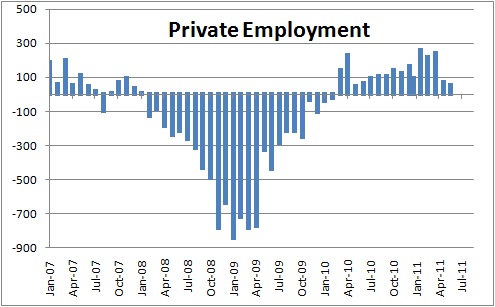
What should we realistically expect as a long-term average monthly increase in employment? To answer that question let’s go back to the decade of the 1990’s. That expansion lasted 10 years, or 120 months, and is the longest expansion on record for the U.S. economy. During that extended period of time the monthly average increase in employment was 195 thousand. Keep in mind that was during the go-go years for the U.S. economy – the economy was growing rapidly, the stock market was steadily rising, home prices were surging, and the dot-com phenomenon was just getting started. Because today’s world does not look nearly as rosy, it is unrealistic to expect that employment gains, over an extended period, will be larger than 200 thousand per month. At that pace it will take 42 months – 3.5 years — to recover the jobs lost during the recession. If we start the clock at March 2010, which was the first month when employment began to rise, it will take until September 2013 to get back to where we started.
If employment increases average 200 thousand per month going forward and the labor force grows by 100 thousand per month, it will take until mid-2015 to get the unemployment rate back down to the 5.0% level which is generally regarded as the full employment level for the U.S. At that level everybody who wants a job has one.

It is certainly discouraging to recognize that it will take us another two years just to recover the jobs lost during the recent recession, and until mid-2015 to get back to a 5.0% unemployment rate. But the reason it is taking so long is less a reflection of weakness in the jobs market currently, and more related to the deepness of the hole in the economy and the labor market that was created during the downturn. We cannot heal those wounds overnight.
Some may worry that the May/June slowdown in private sector employment to just 65 thousand per month may suggest that even the scenario described above may be too optimistic. While we understand the concern, we are not too worried about it for several reasons.
First, if there is a longer term slowdown in store, nobody has told the stock market. The S&P 500 index at 1,345 is within a couple of percentage points of recovering all the ground it lost during the recession. It got dinged earlier in the year in response to higher gasoline prices and the impact of the Japanese tsunami on the U.S. economy, but it has since recovered all of those losses. The stock market is a leading indicator of the economy which has never fallen into recession without the stock market first signaling its demise. Its recent behavior seems to suggest that whatever factors served to undermine growth in the first half of the year have probably run their course.

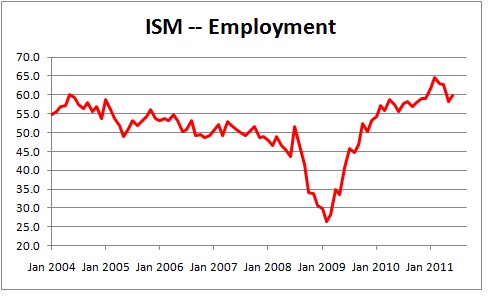
Second, the Institute for Supply Management does a monthly survey of current and future economic conditions, orders, inventories, prices, and employment amongst other items. The employment index for the manufacturing sector is about as high as it ever gets. Thus, it would appear that there are many firms in our economy that are very much in need of additional workers. The ISM does a similar survey for non-manufacturing services and the picture looks similar. So, like the stock market, the notion that employment is going to slow for a protracted period of time is probably not very likely. We remain confident that jobs growth will soon accelerate which will lead to a pickup in GDP growth in the second half of the year to 3.5-4.0%.
Stephen Slifer
NumberNomics
Charleston, SC
Follow Me