
January 9, 2015
The Bureau of Labor Statistics published yet another jaw-dropping employment report for December. The unemployment rate declined 0.2% to 5.6% and monthly job gains have now climbed to 280 thousand. With the nonfarm workweek and overtime hours at near record levels we will undoubtedly see more of the same in the first quarter. Given this impressive upward momentum in the labor market the Fed is on track to raise the funds rate by midyear. That means that for the first time since the recession ended in June 2009 the Fed believes the economy has sufficient strength to withstand a higher level of interest rates. That strikes us as a positive event, not a negative one.
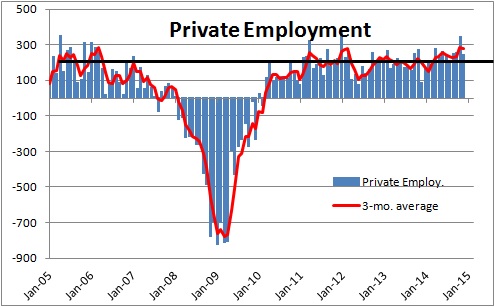
Private sector employment climbed by 240 thousand in December after having risen 345 thousand in November. In the past three months employment has risen by 280 thousand per month. That is as good as it gets. While some of those jobs are in the relatively low-paying retail and food service industries, there are also many high paying jobs in manufacturing, construction, technology, and financial services.
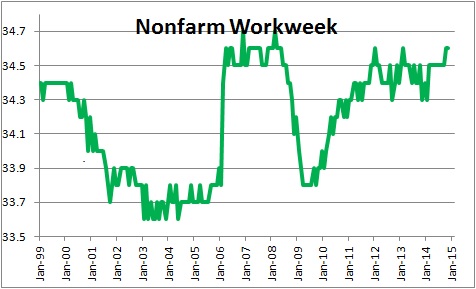
At the same time the workweek has risen to and remains at a near record high level of 34.6 hours. Overtime workers have also climbed to a record high level. As a result employers can no longer boost output simply by asking their employees to work longer hours. They need more bodies. Thus, we will continue to see robust gains in employment in the months ahead.
If we know how many people are working and how many hours they are on the job we should have a reasonable guesstimate of how many goods they produced. The aggregate hour’s index which combines these two indicators rose 3.4% in the fourth quarter. If those workers were even slightly more productive then GDP growth late last year probably rose 4.0% (which happens to be our estimate). That would be the third consecutive quarter with growth in excess of 4.0%. Clearly the economy has gathered some momentum.
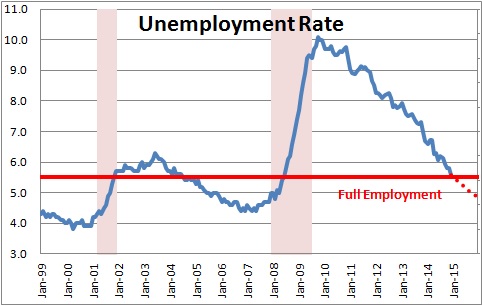
In December the unemployment rate declined 0.2% from 5.8% to 5.6%. In fact, it was very close to 5.5%. On an unrounded basis it was 5.56%. The Fed believes that the economy has reached full employment when the unemployment rate is in a range from 5.2-5.5%. It is almost there now and certainly will fall to that level during the first quarter. By the end of this year we believe the unemployment rate will have dipped below the 5.0% mark.
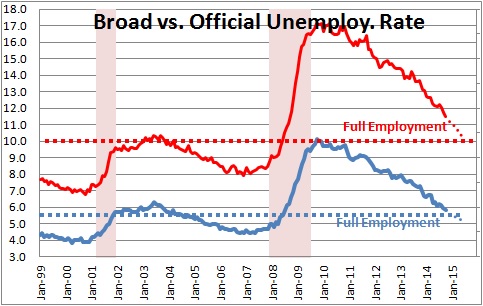
Ms. Yellen believes that this official rate is biased downwards by slow growth in the labor force caused by “discouraged workers” giving up their job search. She prefers to focus on a broader measure of unemployment which includes these so-called discouraged workers. This broad rate declined 0.2% in December to 11.2%. Because it is a broader measure of unemployment which includes unemployed workers (which are measured in the official rate) as well as underemployed workers, this measure is always about 80% higher than the published rate in the good times. If full employment for the official rate is 5.5%, full employment for the broad rate should be about 10.0%. By midyear this broad measure should reach the 10.3% mark. Any way one slices it, the labor market will be essentially at full employment by June.
With the economy on a roll and the labor market quickly approaching the full employment threshold, it is inevitable that the Fed will begin to raise the funds rate by midyear. While some argue that the dramatic decline in gasoline prices will lower the inflation rate sufficiently that the Fed has the ability to postpone that first rate hike until the end of next year. We do not think that will be the case. Oil prices are always volatile and they are almost certain to rise during the next six months. For example, the Department of Energy thinks gasoline prices will average $2.60 next year versus $2.20 currently. GasBuddy looks for gasoline prices to average $2.64 next year and reach $3.00 by May. If these experts are correct, the Fed will not have the luxury of using a falling inflation rate to delay action. We continue to look for the first rate hike to occur by midyear.
Stephen Slifer
NumberNomics
Charleston, SC
Follow Me