
July 12, 2013
The Federal Reserve continues to generate wide swings in stock prices and bond yields as statements by various Fed officials are deemed negative or positive for the initial date of reduced Fed bond purchases. Because this is the first time in seven years that the Fed will be doing anything that could be construed as “tightening”, it takes on enormous importance. There can be little doubt that the Fed’s easy money policy has bolstered the stock market, buoyed consumer and business confidence, ignited the rebound in the housing market, and enhanced employers’ willingness to hire. In short, the Fed is largely responsible for re-igniting economic activity. In doing so it pushed the federal funds rate to 0% in 2008, and bought $1.8 trillion of Treasury bonds and mortgages which produced record low long-term interest rates. Not surprisingly, any presumption that the Fed could do something to alter that happy outcome introduces fear into the markets as investors worry that higher rates might slow or stall economic activity. Those fears are normal and should be expected, but the fear is unwarranted.
Chairman Bernanke surprised the markets when he suggested that the Fed might taper off it pace of bond purchases by year end. That was widely interpreted as the initial Fed “tightening” move. That is simply not the case. Currently, the Fed purchases $85 billion of long-dated securities every single month. That means that the Fed continues to ease by $85 billion every single month. Its intention is to push long-term interest rates lower and provide further stimulus to economic activity. When Bernanke talks about slowing the pace of bond purchases he is suggesting reducing it from $85 billion per month to $50 billion, to $25 billion, and then – perhaps – ending bond purchases by this time next year. Thus, the Fed would continue to steadily ease monetary policy, but at a slightly slower pace than it is currently. Excess reserves are a good gauge of the “tightness” of Fed policy and their projected path could look like this:

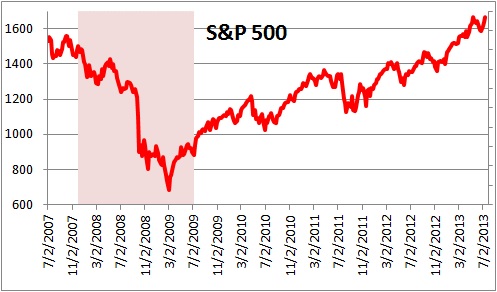
The stock market quickly sold off by about 5% when Chairman Bernanke made his remarks in mid-May. But subsequent economic data have been consistently been stronger-than-expected, other Fed officials have tried to clarify the Fed’s intent, and the stock market shrugged off its fear and climbed to a record high level in mid-July. The Federal Reserve made its point that its easy money policy was coming to an end without adversely impacting stock prices.
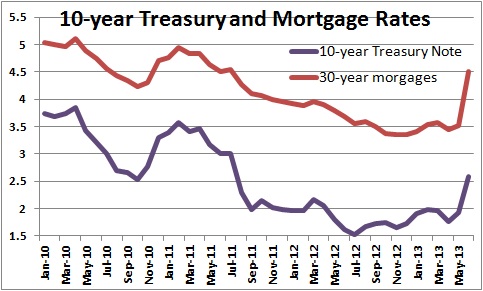
The bond and mortgage market reaction was even more pronounced. The yield on the Treasury’s 10-year note climbed almost a percentage point from 1.7% to 2.6%. Mortgage rates surged from 3.5% to 4.5%. The fear is that the Fed cannot control long-term interest rates, so any hint of tighter Fed policy could cause long rates to spiral upwards, abort the housing recovery, and short circuit economic activity. Those fears are greatly overblown.
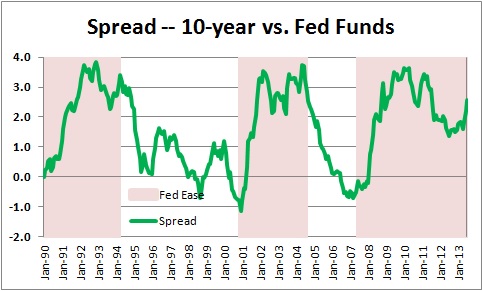
First, the relationship between short-term and long-term interest rates is known as the yield curve which is simply the difference between the two rates. The shape of the yield curve – its steepness – is dependent upon Fed policy – is it in tightening or easing mode? Right now the Fed is in easing mode as evidenced by the 0% funds rate and its continuation of bond purchases. Those easing periods are designated in pink below. When the Fed is aggressively easing by pushing the funds rate lower, the yield curve steepens to about 3.5% but that is not the case today. The funds rate has been at 0% since the end of 2008. Today with the 10-year note at 2.6% and the funds rate at 0.1%, the yield curve is 2.5% which strikes us as about right. It could steepen a bit more to be sure, but it could just as easily go the other direction. The point is that this relationship between short rates and long rates ensures that long rates are not going to spiral upwards and short-circuit the expansion.
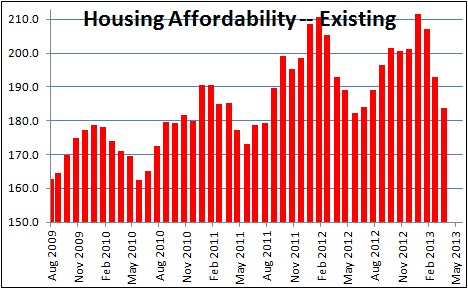
Second, could the rate increase we have already seen and the recent increase in house prices significantly weaken the housing market? No. The National Association of Realtors publishes a monthly index of housing affordability. It estimates the ability of a median wage earner to purchase a median priced home, assuming a 20% down payment, at the current level of mortgage rates. Housing affordability has come down from its peak late last year when mortgage rates were at a record low level and home prices had only begun to rise. At 183 currently, a median wage earner has 83% more income than is necessary to purchase that home. Thus, housing remains affordable and will remain so for several years.
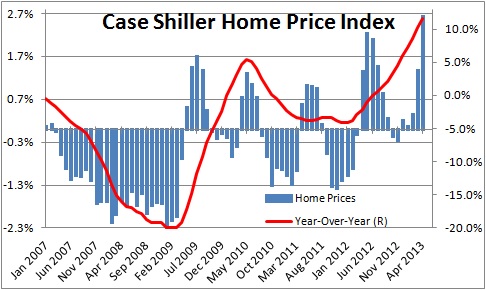
The risk is that home prices continue to rise far too quickly. Over the course of the past year they have risen 11.5% which is fast enough to quickly produce a housing bubble. If a homeowner purchases a home and makes a 20% down payment and during the next year the home rises 10% in value, the return on investment is 50% because he or she is leveraged 5:1. No wonder potential home buyers are jumping into the market! The solution to this rapid home price appreciation is for builders to step up the pace of production. They are trying but continue to fall short in part because they are having difficulty getting adequate financing.
In conclusion the Federal Reserve has made its point that the extended period of aggressive Fed easing will soon begin to be reversed and long-term interest rates have risen sharply in response. However, the stock market has shrugged off higher rates and climbed to another record high level. And even with the recent rise in mortgage rates, housing remains affordable. The bottom line – rates have risen sharply and the economic expansion is showing no sign of losing momentum. So far, so good.
Stephen Slifer
NumberNomics
Charleston, SC
Follow Me