
February 21, 2013
President Obama’s proposal to increase the minimum wage to $10.10 has triggered a passionate, highly political, debate. The President asserts that a higher minimum wage will boost income for millions of low wage workers and lift many out of poverty. Republicans highlight that an increase in the minimum wage will cost thousands of jobs. This past week the Congressional Budget Office (CBO) weighed in on the issue and both sides use the CBO findings to support their case.
In our opinion, both Republicans and Democrats are being disingenuous with the American people. They select those portions of the report that support their view, but conveniently ignore the rest of it. In the end it will not significantly boost income nor will it result in a significant loss of jobs. An increase in the minimum wage will basically redistribute income from business owners to some low wage earners which will reduce the number of people in poverty by about 2%. Lawmakers must decide if this is a desirable outcome.
As we see it there are three main questions:
- What will be the effect on employment?
- What will be the impact on income? Who wins? Who loses?
- How many people might be lifted out of poverty?
Impact on Employment
An increase in the minimum wage raises the cost of low wage workers. Firms could choose to offset the higher labor cost by raising prices. In today’s highly competitive environment that is often not possible. Many employers will counter the higher hourly wage by reducing the hours worked of low wage workers. Others will eliminate some low wage positions. And still other firms will trim the higher cost of labor by reducing the number of both low and high wage workers. Over the longer term a higher minimum wage creates an incentive for firms to use machines or take advantage of technology to boost output which also reduces jobs.
The CBO report concluded that implementing the $10.10 option would reduce employment by roughly 500,000 workers in the second half of 2016. That sounds like a lot particularly when it is characterized as “half a million” jobs. But as of January there are 145 million employed workers in this country. A difference of 500 thousand is 0.3%. Consider the following:
With moderate GDP growth our forecast for the unemployment rate at the end of 2016 is 5.0%. The Fed believes that when the unemployment rate dips to 5.5-6.0% everyone in this country who wants a job has one. If the unemployment rate really has dropped to 5.0% by that time there is going to be upward pressure on wages because firms cannot find an adequate number of workers. Once wages rise, inflation begins to climb. If the minimum wage is raised to $10.10 and the CBO is right about the number of jobs lost, the unemployment rate at the end of 2016 (once the new, higher, minimum wage has been fully implemented) would be 5.3% instead of 5.0%. But even at this higher unemployment rate everybody who wants a job has one. So while the economy has produced 500,000 fewer jobs by the end of 2016 it may not matter much.
For Republicans to argue that the loss of 500,000 jobs by the end of 2016 will negatively impact the economy is, in our opinion, misleading.
Impact on Income
If you are a current $7.25 minimum wage earner today and you keep your job and earn $10.10 in the second half of 2016, you are a winner. According to the CBO there would 16.5 million workers in this category. That sounds good, but there are also losers. As described above, some other low wage earners will lose their jobs or work fewer hours. In addition, business owners who must pay the higher labor cost will see their income reduced. The CBO has summarized their findings in the table below. Once all the increases and decreases in income for all workers are taken into account, overall real income would rise by $2 billion. But this happens in an economy that is $16 trillion. The additional income is insignificant.
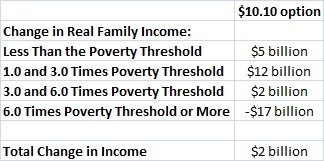
For the President to argue that an increase in the minimum wage will boost income for low income workers and thereby provide economic stimulus is disingenuous. While it will boost the income of many low wage workers, it will also reduce income for those people who lose their jobs or work fewer hours and for business owners in the form of reduced profits. It is almost a wash.
Impact on Poverty
The CBO estimates that under current law there will be roughly 45 million people in families whose income is below the poverty threshold in 2016 which they project will be $18,700 for a family of three and $24,100 for a family of four. Raising the minimum wage to $10.10 would reduce that number by 900,000 or 2%.
Conclusion
A minimum wage has been in existence since the Fair Labor Standards Act was passed in 1938. Furthermore, it has been raised many times in the past 76 years and the economy has still managed to survive. Given its history the American public seems to have decided that having a minimum wage and raising it periodically is the right thing to do and it is likely to be increased again this year. The only issue is whether the increase will be to $10.10 over four years or to $9.00 over three years. In either case the minimum wage would automatically increase thereafter in line with the inflation rate.
The debate about raising the minimum wage has become highly political and very passionate. The problem is that both sides are not being entirely honest and are not presenting the entire story. Thus, the Congressional Budget Office has contributed to a more intellectually honest debate about the issue.
Stephen Slifer
NumberNomics
Charleston, SC
Follow Me