
June 10, 2016
The economy has been chugging along at a 2.0% pace since the recession ended in mid-2009. Initially, growth was relatively well balanced. But since 2015 it has become very uneven. Any type of consumer-related spending is doing fine. But investment spending has dried up. Why? Does it matter? What is it likely to do in the quarters ahead?
For the first three years of the expansion investment spending was galloping along at double-digit pace. By mid-2013 growth began to slow, and in late 2014 the bottom fell out. The cause of the initial slowdown is not entirely obvious, but the second leg of the drop-off was clearly attributable to a precipitous slide in oil prices combined with a 20% increase in the value of the dollar.
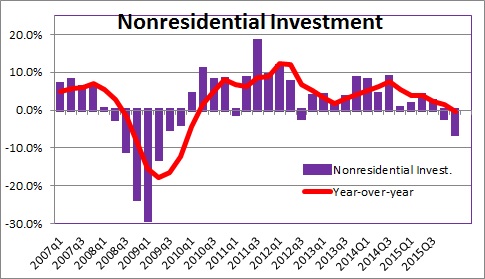
One of the hallmarks of this expansion has been fear. As the European financial crisis spread there was concern that the global economy would slip back into recession. That has been replaced by a fear that GDP growth in China would fall far more sharply than expected. Then, falling oil prices hit the oil companies hard along with related companies like agriculture, chemicals, and plastics. Investment in those sectors collapsed. Currently there is fear of the November election and what it might bring in terms of changes to tax rates and/or the regulatory environment. There is worry about the repercussions of a possible British exit from the European Union. Every discussion of the economy is permeated by fear. The financial press fans the flames of fear. No wonder business people are afraid to take a long-run view and invest in the machinery, computers, and new buildings that might propel their business forward.
Rarely does anybody mention the fact that the economy has just completed its seventh year of expansion, the stock market is at a record high level, consumers feel good and have little debt, the economy is creating nearly 200 thousand new jobs each month, and the Fed has pledged to raise rates at a glacial pace. To us the economy seems poised to chug along at a moderate 2.0% pace for the foreseeable future which means it will eventually become the longest expansion on record. These positive factors are at least worth considering. But business people continue to climb a wall of worry.
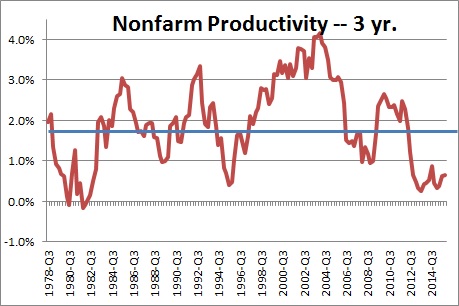
All of this matters because weak investment restrains economic output. Once investment spending ratcheted downwards onto a slower growth path, productivity did the same. Prior to the recession productivity had been zipping along at about a 2.0% pace. In the past three years that growth rate has plunged to just 0.6%. In part because of the slowdown in productivity the economy’s speed limit has downshifted to about 2.0% rather than the more familiar 3.5%. Our standard of living is simply not growing as fast as it used to.
Initially, business people were able to slash investment spending and still boost output by capitalizing on relatively cheap labor. The unemployment rate was still relatively high so there was a large number of workers without jobs. There was also a small army of part-time workers who were seeking full-time employment. Thus, firms were able to tap an abundant supply of cheap labor and produce the goods required to satisfy demand.
Even though companies were experiencing impressive earnings, record cash levels, and 50-year low interest rates, thousands of firms decided to bolster their share prices by buying back their own stock and increasing dividends to shareholders rather than plowing the funds back into the facilities and equipment that would boost worker productivity and, ultimately, increase wages. More recently, a string of mega-mergers have been in the news. The focus is on financial tinkering. Firms apparently see little prospect of achieving good returns through capital investment.
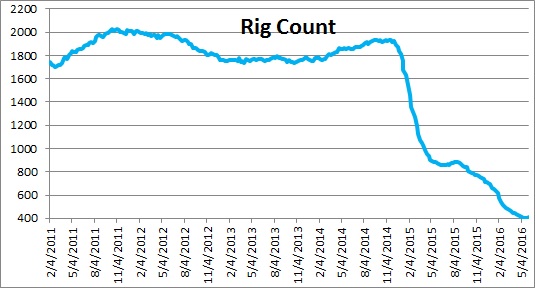
However, that bleak assessment may be changing. Much of the drop-off in investment was oil-related. In response to the drop in crude oil prices which fell from a peak of $107 per barrel to $26 spending on drilling oil and gas wells fell 75% from its peak in late 2014. Expenditures on mining and oil and gas field machinery dropped 33%. However, in recent months oil prices have rebounded from $26 to $50 per barrel. Thus, the relentless shutdown of oil rigs in production – and their drag on investment spending and GDP growth — should soon end. Indeed, in the week ending June 3 the number of oil rigs in operation rose for the first time since August of last year.
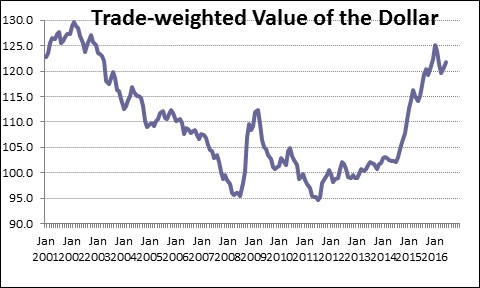
The remaining softness in investment spending has largely been in in export-related manufacturing firms. The drop in overseas demand has cut production in those industries and created surplus capacity. All of this was triggered by the 20% increase in the value of the dollar from mid-2014 to the end of last year. As the dollar rose U.S. goods become more expensive for foreigners to purchase and exports contracted. As the dollar rose and commodity prices declined profits shrank and firms prepared for the worst by slashing investment. But since the beginning of the year the dollar has declined about 4%. If the dollar remains at its current level through the end of the year, then the drag on investment spending and the trade sector of GDP from this source should also disappear.
Furthermore, labor is no longer in abundance. Firms are reporting difficulty finding skilled workers in a variety of industries. Job openings far exceed the pace of hiring. Labor costs are beginning to rise. The trade-off between cheap labor and investment spending may soon favor the investment side of the equation.
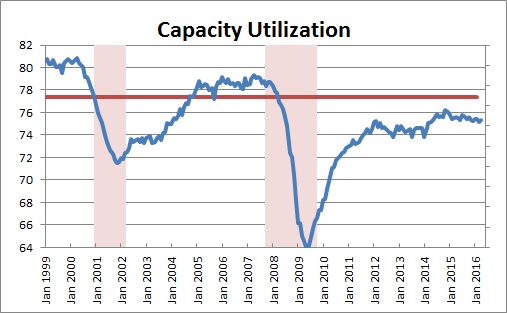
If the manufacturing sector turns upward, capacity utilization is close enough to its long-term average that many firms will soon have to spend money to refurbish their existing production facilities or build new ones in order to boost output. And because there has been so little investment for a protracted period of time, a large portion of their existing equipment has almost certainly become obsolete.
None of this is meant to suggest that we should expect vibrant investment spending any time soon. However, the sharp curtailment registered in the past six quarters should disappear. A somewhat faster pace of investment spending should boost productivity growth from its current 0.6% pace to, perhaps, 1.5%. But it will not return to its longer-term average of 2.0% until such time as business leaders are more confident about the future economic environment.
Stephen Slifer
NumberNomics
Charleston, SC


Mort logical brilliance!