
December 13, 2013
Two months ago Republican and Democrat leaders in Washington could not reach any sort of agreement and were willing to shut down the federal government for 16 days in early October. Two months later those same members of Congress are able to craft a formal budget agreement for the first time in four years. What gives?
This seemingly inexplicable behavior of Congress following a government shutdown is not unprecedented. In fact under very similar circumstances in 1995-1996 Congress came together and passed some surprising legislation within a year of the shutdown. The situation was similar to what it is today with divided government. At that time Bill Clinton, a Democrat, was president and Republicans controlled both the House of Representatives and the Senate. The government closure began in December 1995 lasted 27 days and ended in January 1996. At the time President Clinton was widely hailed as the winner in the showdown with Congress. The Republican-led House of Representatives with Newt Gingrich at the helm was viewed as the definitive loser.
But in August 1996, seven months after the shutdown, Congress passed welfare reform which not only cut welfare benefits but also introduced workfare which required poor individuals to work to receive assistance. One year later in August 1997 Congress passed the Balanced Budget Act of 1997 which slashed government spending with the idea of producing a budget surplus by 2002. But cutting entitlements, reducing government spending, and producing budget surpluses are very Republican-oriented ideas. So who really won? Democrats? Republicans? Perhaps one could argue the economy was the primary beneficiary. The budget deficits that existed prior to the shutdown quickly disappeared and turned into four consecutive years of modest surpluses.

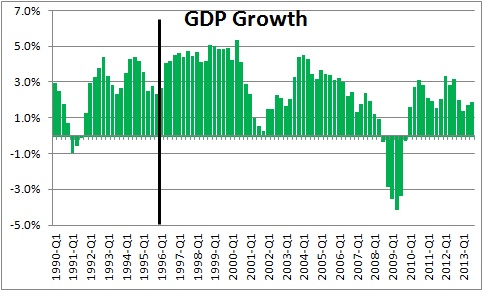
At the same time GDP growth prior to the shutdown had been climbing at a 2.5-3.0% pace. Following the shutdown growth quickly accelerated to 4.0-5.0%.
While government shutdowns are generally regarded as negative events, it could be that they serve an even more important purpose. They focus attention on the fact that government spending — entitlement spending in particular — is out of control and needs to be cut. In the current situation it may also reflect the low regard that the American people have of both Congress and the president. With elections coming up at the end of next year Democrats and Republicans need to work together to pass some important legislation to shed the image of political gridlock.
Some will argue that the budget agreement does not do much to lower the budget deficit. That is true. The Congressional Budget Office estimates that the deal will reduce budget deficits in both fiscal 2014 and 2015 by about $3 billion, and lower deficits by about $20 billion in fiscal 2022 and 2023. But its significance lies in the fact that for the first time in four years Congress has passed a formal budget document thereby ending for two years the recurring spending squabbles that have rattled investors, led to a downgrade in the country’s credit rating, and resulted in a government shutdown. House Republican leader John Boehner has re-emerged as a leader. The extremists have been isolated.
By reducing political uncertainty the budget agreement will bolster both consumer and business confidence and, like in the 1996-2000 period, stimulate the pace of economic activity. There can be little doubt that the crescendo of anti-government sentiment reduced firms’ willingness to both hire and invest in the spring and summer of 2013 and created a fiscal headwind that curtailed GDP growth.
But if business leaders, consumers, and investors believe more strongly that the two parties can work together to solve problems, spending decisions will almost certainly be enhanced. Those are amongst the many reasons that we expect GDP growth to quicken from 2.0% in 2013 to 3.0% next year. A faster pace of economic activity boosts hiring which causes the unemployment rate to fall more quickly and boosts income growth which stimulates additional spending.
A sidebar to faster GDP growth is a reduction in the budget deficit. The higher income level associated with faster growth lifts tax revenues. It simultaneously reduces government spending on entitlements such as unemployment and welfare benefits. Indeed, in the 2013 fiscal year that ended on September 30 tax revenues climbed by 13.3% while expenditures declined by 2.4%. As a result, the budget deficit shrank from $1.1 trillion in the prior fiscal year to $679 billion or about 4.0% of GDP. In the first two months of the fiscal year that began in October tax revenues continue to be about 10% above last year’s pace and spending is running 5% below last year. This suggests that the current year’s deficit will decline farther to perhaps $300 billion which would make it an even smaller – and very acceptable — 2.0% of GDP.
This past week our policy makers in Washington may have taken a baby step forward in their effort to reduce budget deficits, but they took a giant leap towards eliminating fiscal gridlock. Hurdles remain, like another increase in the debt ceiling which will come into play about the beginning of February, but the fact that our leaders can occasionally find a way to coexist and compromise is encouraging.
Stephen Slifer
NumberNomics
Charleston, SC


Steve, What about the excessive printing of money that is going on, what short term effect is it having? If it continues (yikes!) what long term effect willit have?
thanx