
October 12, 2009
The employment report for September brought a dose of reality to the investor community. The Dow Jones Industrial Average climbed a sizzling 50% between its low point of 6,547 on March 10 and September 23. Clearly, investors expected dazzling profit gains in 2010 to justify such a move. The economic data released during the summer were generally stronger than expected, and bolstered their enthusiasm. There was a chance that the economy might rebound vigorously.
But data released in early October make it clear that the summer strength was primarily caused by temporary, government-supported programs, and that the incipient recovery is anemic.
First, vehicle sales plunged to a 9.2 million annual rate in September after having registered a 14.5 million pace the month before. The July and August selling rates were boosted by the cash-for-clunkers program which ran from July 27 through August 24. Some of those summer sales clearly came at the expense of sales later in the year.
Second, home sales continue to show resilience, but the government program offering an $8,000 tax credit for first time home buyers expires at the end of November. When it expires the pace of home sales will slow. There is currently discussion in Washington about extending the program through February, so the temporary stimulus to the housing sector could last a while longer. But it will eventually end.
Third, the real killer for the economic outlook was the employment report for September. Many economists thought the monthly decline in employment might be as small as 175 thousand workers. Instead, employment fell by 262 thousand and it became clear that the economy was not recovering as quickly as anticipated.
Given these weak economic statistics, is the recession really over as many suggest? Maybe. It depends on how you look at it.
Third quarter GDP growth will be about 3.5% — the first increase in a year. This figure will be released at the end of this month. Many economists look at this expected third quarter gain and conclude that the recession ended in June and, in some sense, that is possible.
However, the National Bureau of Economic Research, which is the group that determines when business cycles begin and end, typically looks at more than GDP growth to make their determination. They also like to see gains in GDP supported by other indicators – most importantly – employment to confirm their judgment. But employment has not cooperated. Thus, we may get a statistical recovery, but until such time as employment begins to rise we will not have a real one.
Unfortunately, gains in employment are unlikely to occur until sometime next year. Once sales improve, firms do several things before they start to hire additional workers. First, they lay off fewer workers. They might have been thinking about firing Charlie a couple of months ago, but if sales climb steadily they might need him in a couple of months so he does not get laid off. That has happened. Initial unemployment claims (a measure of layoffs) has slowed from 650 thousand back in the spring to about 550 thousand today. Second, firms begin to work existing employees longer hours. Or they pay more overtime. Or perhaps they hire more temporary workers. None of that has happened. For instance, the chart below indicates that the nonfarm workweek for September slumped to a record low level of 33.0 hours. If businesses were experiencing any meaningful pickup in sales, the workweek should be getting longer and that is not happening. In some sense, changes in the workweek, along with overtime hours, and the hiring of temp workers can all be regarded as leading indicators of employment — none of them have begun to turn upwards.
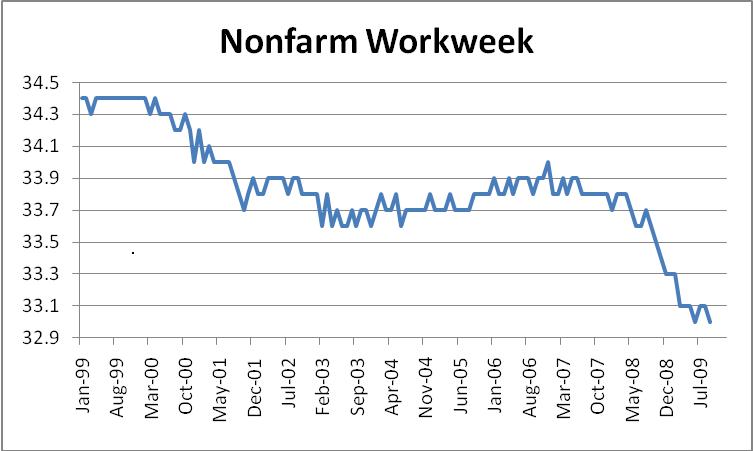
The bottom line of all this, is that the stock market continues to ebb and flow as investors get excited and then retrench. Meanwhile, the economy continues to inch towards recovery but the process is agonizingly slow. And even though the economy may register positive growth in the third quarter and some will say the recession has ended, a true recovery is probably still 3-6 months away. We need jobs.
Follow Me