
June 30, 2017
At midyear it is useful to reflect on how the economy and inflation are tracking relative to what had been expected at the end of last year. The biggest surprise, for us, is that the inflation rate did not accelerate in the first half of this year. What’s going on? Should the Fed postpone further rate hikes until the inflation rate begins to climb? We believe that the failure of the inflation to climb is attributable to two separate one-off events the positive impact of which will prove to be transitory. As a result, the Fed is justified in continuing on its path of gradual increases in the funds rate.
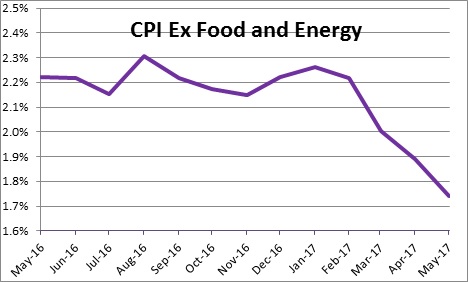
In our year ahead forecast in December we projected that the “core” inflation rate (i.e., excluding volatile food and energy prices), would rise from 2.3% last year to 2.7% in 2017. The labor market was tight which seemed likely to push wages higher and lift inflation in the process. The shortage of available homes and apartments was steadily lifting rents at a 3.5% pace. And the cost of medical care was surging. Instead, the core rate has backtracked and actually slowed to 1.7% in the first five months of this year. Two factors are largely responsible for this surprising behavior.
First, a price war has broken out amongst the nation’s wireless providers and in the past year cell phone prices have plunged 12.5%. A drop of that magnitude has shaved 0.2% off the core inflation rate during that period of time. Mobile phone prices have fallen for eleven months in a row capped by a whopping 7.0% decline in March alone. This means that the core rate today would be 1.9% rather than 1.7% in the absence of the cell phone price war.
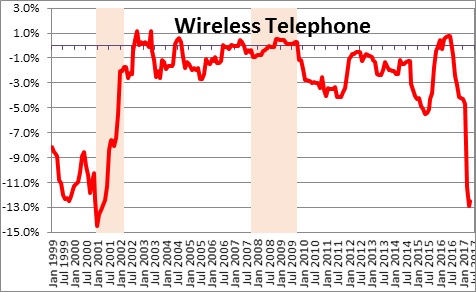
Competition in this industry is ferocious and will get even more intense now that the federal government has auctioned off rights to more wireless spectrum to new entrants such as television providers Comcast and the Dish Network. Spectrum, or airwaves, is what these companies use to deliver wireless calls. The price wars began in April of last year when major carriers such as AT&T, Sprint and T-Mobile slashed rates on their unlimited calling plans. The nation’s largest provider, Verizon, joined the fray earlier this year. The last time this happened was in 1999-2000. Eventually the price wars ended and prices stabilized for more than a decade. Thus, the current drop in cell phone prices will prove to be transitory.
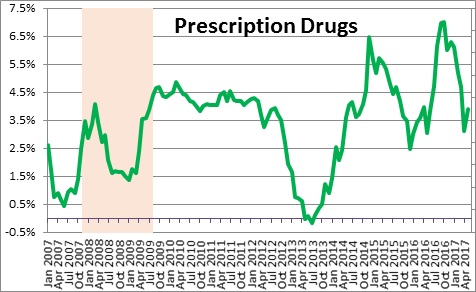
At the same time prescription drug prices have declined since the election. In October of last year, prior to the election, prices were rising at a 7.0% pace. Since the election prescription drug prices have fallen at a 1.0% rate. The chart below tracks the year-over-year change in this series so the most recent price declines are not fully reflected. During the election campaign Trump promised to drive down drug prices. He talked about allowing consumers to import prescription drug medicines from abroad, and having Medicare negotiate prices directly with pharmaceutical companies. His success thus far seems to stem less from legislation than fear of being called out by the president for price gouging. Last year EpiPen maker Mylan and Valeant Pharmaceuticals experienced public outrage over dramatic price increases. A Trump tweet could in a nanosecond put a company in his crosshairs with potentially damaging consequences to both its reputation and stock price. One may not approve of the method, but intimidation seems to be accomplishing his objective.
So what does the Fed do now? We believe it will view these recent price declines as temporary and continue on its slow but steady trajectory toward higher interest rates. Remember, Fed policy is determined not only by inflation but also by the pace of economic activity as well.
As we see it the economy seems to be gathering a bit of momentum. After stumbling to a 1.4% pace in the first quarter GDP growth seems poised to rebound to a 2.5% pace in the second quarter with similar growth rates likely in the second half of the year. GDP growth in Europe and Asia seems to be quickening as well. The unemployment rate has dipped from 4.7% at the end of last year to 4.3% which is below almost anybody’s estimate of the full employment threshold. Wage pressures are sure to intensify and, in the process, put upward pressure on the inflation rate. There continues to be a shortage of available housing which is boosting rents. That is not going away any time soon. On balance the economy seems likely to generate upward pressure on the inflation rate later this year and in 2018.
The recent prices declines in wireless services and drug prices will not continue, but they are not going to rebound either. In the case of wireless, following the extreme price drop in 1999-2000 prices leveled off for more than a decade. Competitive pressure in the industry prevented prices from rebounding.
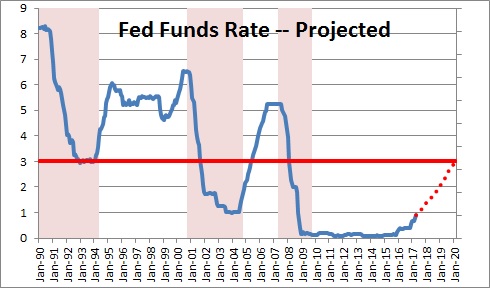
With respect to drug prices Trump has intimidated the entire pharmaceutical industry and it is being forced to behave. Going forward prices will climb slowly but they are starting from a lower base. In December we had expected the core CPI to rise 2.7% in both 2017 and 2018. Today we expect that core rate to increase 2.0% this year and 2.5% in 2018. The direction is the same, but prices will not rise as quickly as had been anticipated earlier. Either way, the core rate is likely to exceed the Fed’s 2.0% inflation target by the end of next year which should keep the Fed on its path of gradual increases in the funds rate. It still has a long ways to go before the funds rate reaches a “neutral” rate of about 3.0%, a level which it does not expect to reach until 2020. Inflation may be better behaved than the Fed thought, but there is no reason to alter its current path to neutrality. Higher rates will not begin to bite for several more years.
Stephen Slifer
NumberNomics
Charleston, S.C.
Follow Me