
June 26, 2015
Since the end of the recession economists have lamented the fact that the economy has emerged much more slowly from this recession than in the past. Two reasons seem apparent. First, the baby boomers have begun to retire. With fewer bodies working, not surprisingly, fewer goods and services are produced. Second, productivity growth (or output per hour) has slowed markedly.
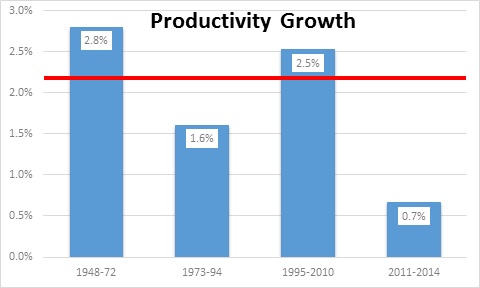
During the past 150 year productivity growth in the U.S. has averaged 2.2% but it grows in spurts. For example, productivity grew 2.8% annually in the 25-years following the end of World War II. That is the fastest growth rate we have experienced for any protracted period of time. Many economists characterize this as the “golden age” for productivity.
In the subsequent 20 years productivity growth slumped to 1.6% which at the time was the slowest growth period we had ever encountered. Nobody is quite sure why.
Then productivity re-accelerated from the mid-1990’s to the end of 2010. This growth spurt was almost certainly attributable to the widespread adoption of computers, communications equipment, software, and the Internet. During that time growth quickened to 2.5%.
But then look at what happened. In the subsequent four years from the end of 2010 through the end of last year growth plunged to 0.7%. It grew at about one-half the pace of the previous slow growth period. Why is that?
Some would suggest that no major innovations occurred during that period of time. That is probably true. Sure, we had the rapid adoption of Facebook and Twitter, but they provide nothing more than entertainment value. They certainly do not enhance the efficiency of the American worker.
All of this matters because it affects economists’ projections of how quickly the economy can grow in the years ahead. That growth rate can be determined by adding the expected growth rate of the labor force to the projected rate of growth for productivity.
Taking into consideration the brake on labor force growth created by retiring baby boomers, most economists believe that the labor force will grow at about a 0.5% pace between now and the end of the decade.
That brings us to the likely rate of growth for productivity. Should it continue at its current, miserable 0.7% pace GDP growth will average only 1.2% during the next five years. But projecting that productivity will extend its growth slump and continue to expand at the slowest pace in history seems unduly pessimistic.
Should it rebound to its long-term average of 2.2%, then we would expect GDP growth of 2.7% — which is roughly what we expect. For that to happen, however, to need to see productivity growth re-accelerate in a hurry.
The Fed believes that GDP growth in that period of time will be 2.0-2.3%. Implicitly it is assuming a rebound in productivity growth to 1.5-1.8% which is faster than its current growth but well below its long-term average. That is a perfectly plausible expectation.
Unfortunately, nobody knows who is right. As a result, GDP growth during the next five years could be anywhere between 1.2% and 2.7%. That is an extraordinarily wide range. Because growth in the labor force will be the same 0.5% in either case, the difference between productivity growth of 0.7% and 2.2% implies very divergent paths for growth in our standard of living – anything from surprisingly anemic to vibrant.
We are in the optimistic camp because we are believers in technology. We can’t say what the next “big thing” will be, but it is out there somewhere. Given recent developments in the cloud, apps, biotechnology, nanotechnology, robotics, 3-D printing, and the like we are convinced that the current productivity slump will not continue for long.
Our policy makers in Washington could, in our opinion, facilitate a productivity growth spurt by shrinking the size of the federal government. Taxes sent to Washington are funds which could be used more efficiently by the private sector. Tax reform would be high on our list. Cutting spending on entitlements such as Medicare, Medicaid, and welfare benefits would help. Caps on medical malpractice suits and the adoption of the concept of loser pays would curtail frivolous lawsuits. While there could be a shift in direction of fiscal policy after the 2016 election that is probably a long-shot.
Stephen Slifer
NumberNomics
Charleston, SC
Follow Me