
September 2, 2011
Early in the year the economy was chugging along at an acceptable pace, but it then got hit by the combination of sharply higher gasoline prices and the impact of the earthquake and tsunami in Japan. Consumers were left with less money to spend on other items, manufacturing firms could not get many of the parts they needed for production, and the pace of economic activity slowed sharply. By mid-summer it appeared that the negative impact from those two factors was coming to an end. But suddenly in late July and early August investors were unnerved by the contentious debt ceiling debate and near-default by the U.S. Treasury, as well as by renewed worries about the European debt crisis. These factors precipitated an ugly decline in stock prices. The summer of 2011 was beginning to look a lot like the final few months of 2008 following the collapse of Lehman Brothers, and many economists became alarmed about the possibility of the economy slipping back into recession.
We think such fears are unwarranted for a variety of reasons. Consumers have paid down an enormous amount of debt in the past couple of years. As a result, they now have a debt burden that appears to be quite comfortable by any historical standard.
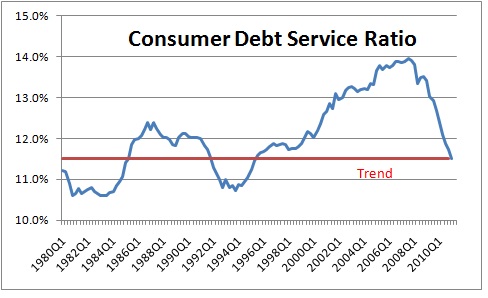
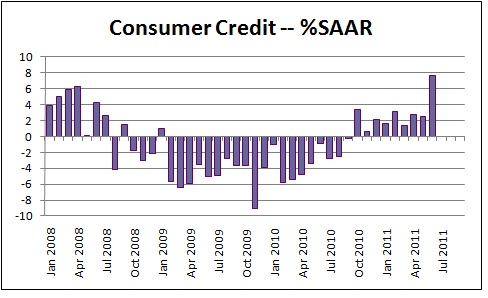
They no longer feel compelled to pay off debt each month. Instead, they have once again begun to borrow. This hardly seems consistent with the notion that the consumer is so worried that he or she has crawled back into a hole and is not spending.
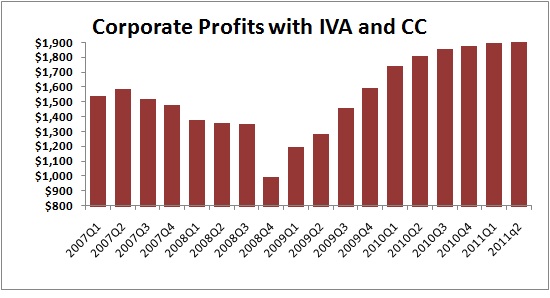
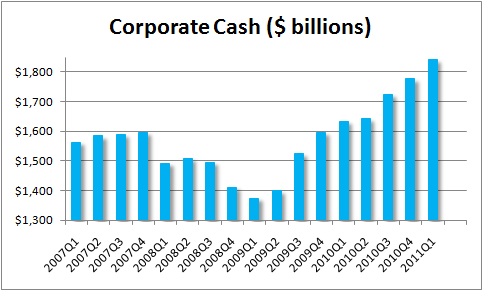
Meanwhile, corporations continue to earn record profits, and every quarter they add to already record high cash balances. Corporate America seems well positioned to withstand a fairly protracted period of subdued economic activity. Thus, the private sector is in surprisingly good shape.
If there is a problem, it is in the public sector as the Federal government continues to run sizeable budget deficits. For the current fiscal year the deficit will be $1.3 billion. It is expected to shrink to $1.0 trillion next year and to $400 billion annually in the years beyond. Each year to finance these deficits, the government must issue an equivalent amount of debt. Thus, the impact on Treasury debt outstanding is cumulative and the amount outstanding is imposing.
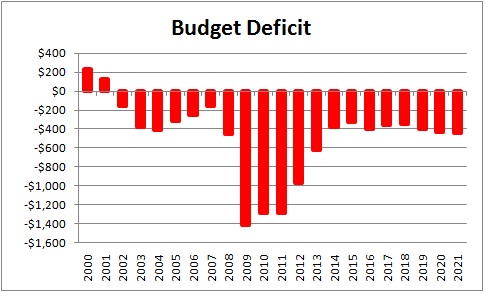
However, it is important to recognize that less than a month ago Congress passed legislation (as part of the agreement to increase the debt ceiling) that will reduce government spending by $3.5 trillion over the next decade — $2.3 billion in cuts that have already been identified, and an additional $1.2 billion of cuts that are as yet unspecified. As a result, by 2021 debt outstanding in relation to GDP has been reduced from 77% in the Congressional Budget Office’s February forecast, to 61% in the August revision.
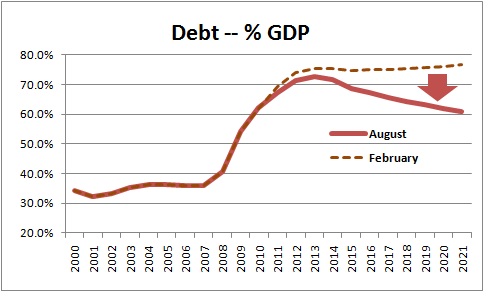
Economists would like to see a debt/GDP ratio of about 50%. While more work remains to be done, we are a lot closer to the goal than we were. This August action by Congress has been largely dismissed by investors, but it is significant.
Having said all this, the economy was far weaker than expected in August. Payroll employment in that month was unchanged. Worse yet the workweek declined 0.1 hour which is the equivalent of laying off 318 thousand workers. Given the August employment report it is clear that third quarter GDP will not grow at the 3.5% growth rate we had expected. We would like to review the data more fully, but something around 2.0% seems more likely. We like to think that for the reasons cited above, the economy will gather some momentum as we move into the fourth quarter. Unfortunately, at the moment there is little evidence that is occurring, which means that our 2.8% projected growth rate for that quarter may get reduced somewhat as well.
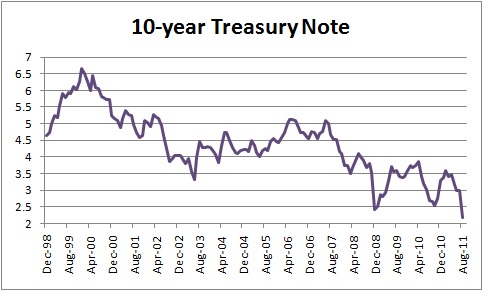
This weaker outlook brings the Fed into play and creates the possibility of additional easing. But interest rates are hardly an impediment to economic growth. Short-term interest rates are essentially at 0%. The 10-year Treasury note yields a record low 2.0%. Thus, lower rates probably will not help. But a central bank cannot simply throw up its hands and do nothing in the face of emerging economic weakness. Another round of Fed easing could provide an important psychological boost beyond whatever impact it might have on interest rates. While our own view is that such action is unnecessary, given the weakness in the August employment report it is at least possible.
Stephen Slifer
NumberNomics
Charleston, SC
Follow Me