
March 7, 2014
Every month people focus on changes in payroll employment and the unemployment rate. These two series are clearly important, but buried in the details and often overlooked is the change in hours worked which is extraordinarily powerful. In this particular instance it appears that employers have been adjusting to the bad weather partly by slowing their pace of hiring. But even more important is the cutback in the hours worked of existing workers. As a result, first quarter GDP growth is likely to slip to 1.3% after having climbed by 2.4% in the fourth quarter. As in the past several years the economy will get off to a slow start in 2014 and the naysayers will be out in force. However, not much can be done about the weather and eventually it returns to normal. As a result, we expect second quarter GDP to rebound to 3.6% and continue at about that same pace for the balance of the year.
Private sector employment rose 163 thousand in February which follows equally subdued gains in December and January. As a result, the 3-month moving average of employment has slipped to 131 thousand. That is substantially less than the 224 thousand average increase prior to the onset of bad weather. Clearly employers have been responding to the extremely bitter winter weather by slowing their pace of hiring. But economists are not too disturbed by the shortfall in payroll employment in part because the slowdown should be temporary and partly because other employment indicators have been less adversely affected.

For example, the unemployment rate edged upwards by 0.1% in February to 6.7%, but it fell 0.6% in the previous three months. The speed of its decline is largely the result of impressive gains in civilian employment. Indeed, such employment has increased by 274 thousand per month in the most recent 3-month period. That is more than double the average increase in payroll employment of 131 thousand in the comparable period of time.
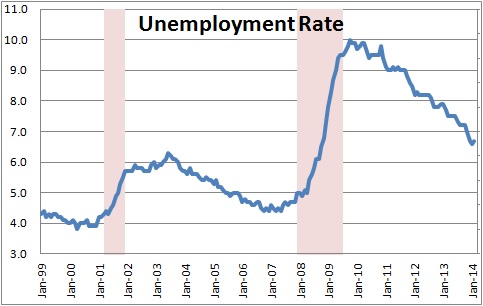
These two measures of employment come from two entirely different surveys. The payroll statistics are reported by companies. Civilian employment is determined by a door-to-door survey of households. Over time the two surveys provide results that are roughly comparable. The fact that civilian employment has been robust while payroll employment has been subdued suggests that in the months ahead payroll gains will be impressive as they catch up to civilian hiring.
But where the bad weather has really played a role is in hours worked. Firms can produce a given amount of output from some combination of the number of employees and the hours those people work. As described above, they have done less hiring than normal during these winter months. But that is only part of the story. Firms have dramatically cut the number of hours worked. For example, the nonfarm workweek has slipped from 34.5 hours in November – prior to the onset of winter – to 34.2 hours in February. That may not sound like much but a 0.1 hour change in the workweek has the same impact as a change in employment of about 400 thousand.
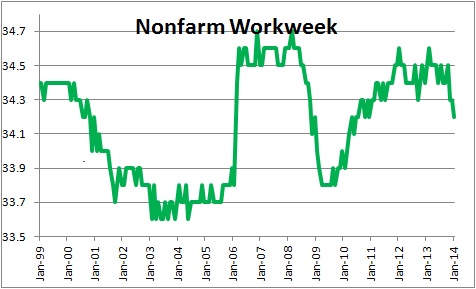
All of this is important because the combination of employment and hours worked can give us an early estimate of GDP growth in any given quarter. Presumably if we know how many people are working and how many hours they are on the job, we can make a reasonable estimate of how many goods they produce – which is what GDP is all about. If we go through the math, it turns out that aggregate hours worked in the first quarter may decline slightly. Even if these people are somewhat more efficient, it is difficult to envision a first quarter GDP growth rate higher than 1.3%.
A growth rate of that magnitude will encourage the naysayers who contend that the pace of economic activity has slowed. They are right, of course. But we continue to maintain that it is largely weather related and most of the lost output in the first quarter will be recovered in the spring. Indeed, we expect second quarter GDP growth to be 3.6% with 3.4% growth in each of the final two quarters of the year. That implies that growth for the year will be about 3.0% even with the bad weather versus a 2.5% pace in 2013. So while the economy is soft for now, it will not remain that way for long.
Stephen Slifer
NumberNomics
Charleston, SC
Follow Me